Free physics question bank
Electrostatic Self-Energy & Equipotential Surfaces questions with solutions
Practice Electrostatic for JEE Main, JEE Advanced, NEET, and Classes 11–12. Attempt each question, then open it for the full solution.
Showing 1–10 of 21 questions
- ParagraphmediumElectrostatic
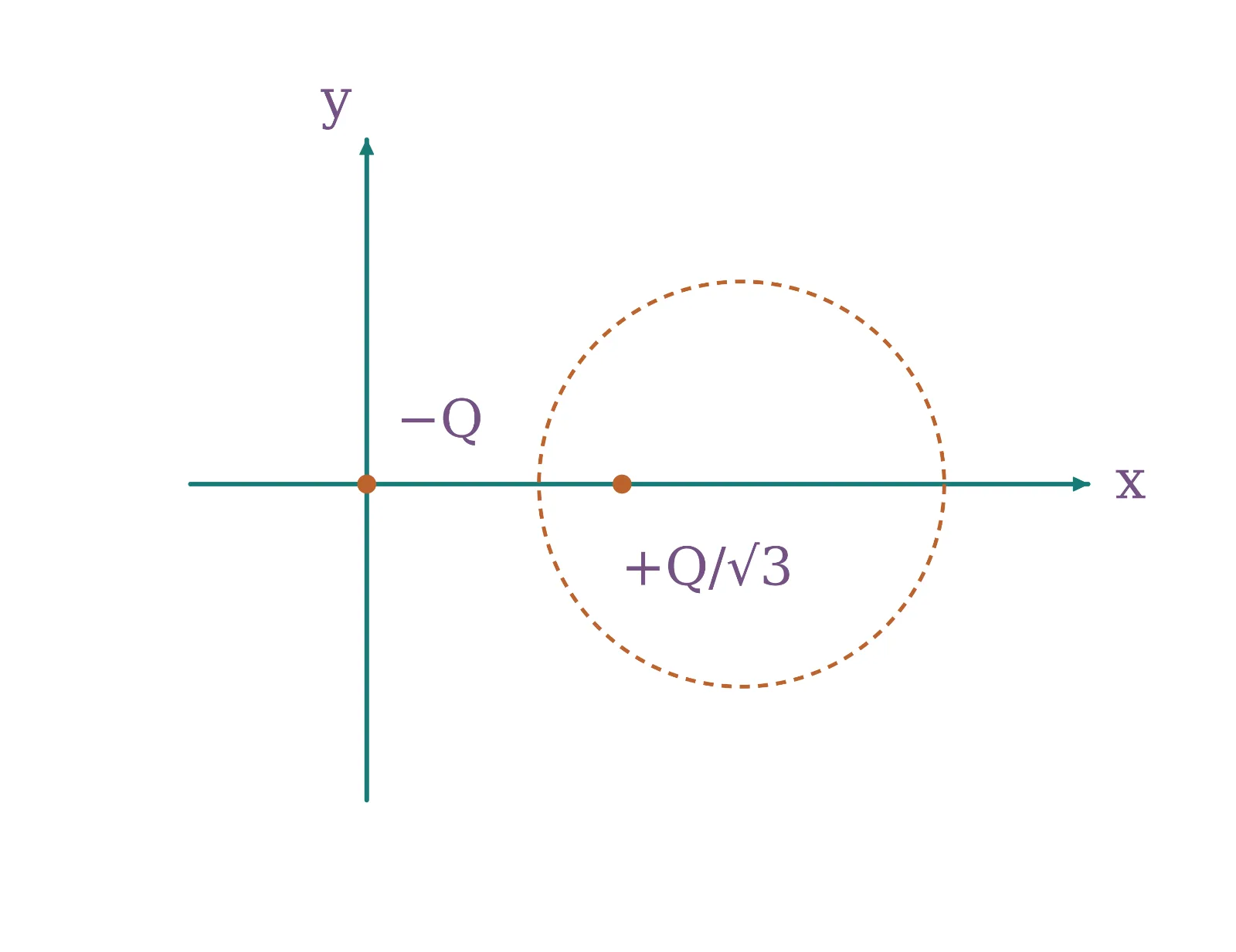
Two points charges -Q and +Q√3 are placed in the xy-plane at the origin (0, 0) and a point (2,0), respectively, as shown in the figure. This results in an equipotential circle of radius R and potential V = 0 in the xy-plane with its center at (b, 0). All lengths are measured in meters.
Sub-question 1
The value of R is meter.
Sub-question 2
The value of b is meter.
JEE Advanced 2021
Open question & full solution → - MCQmediumElectrostatic
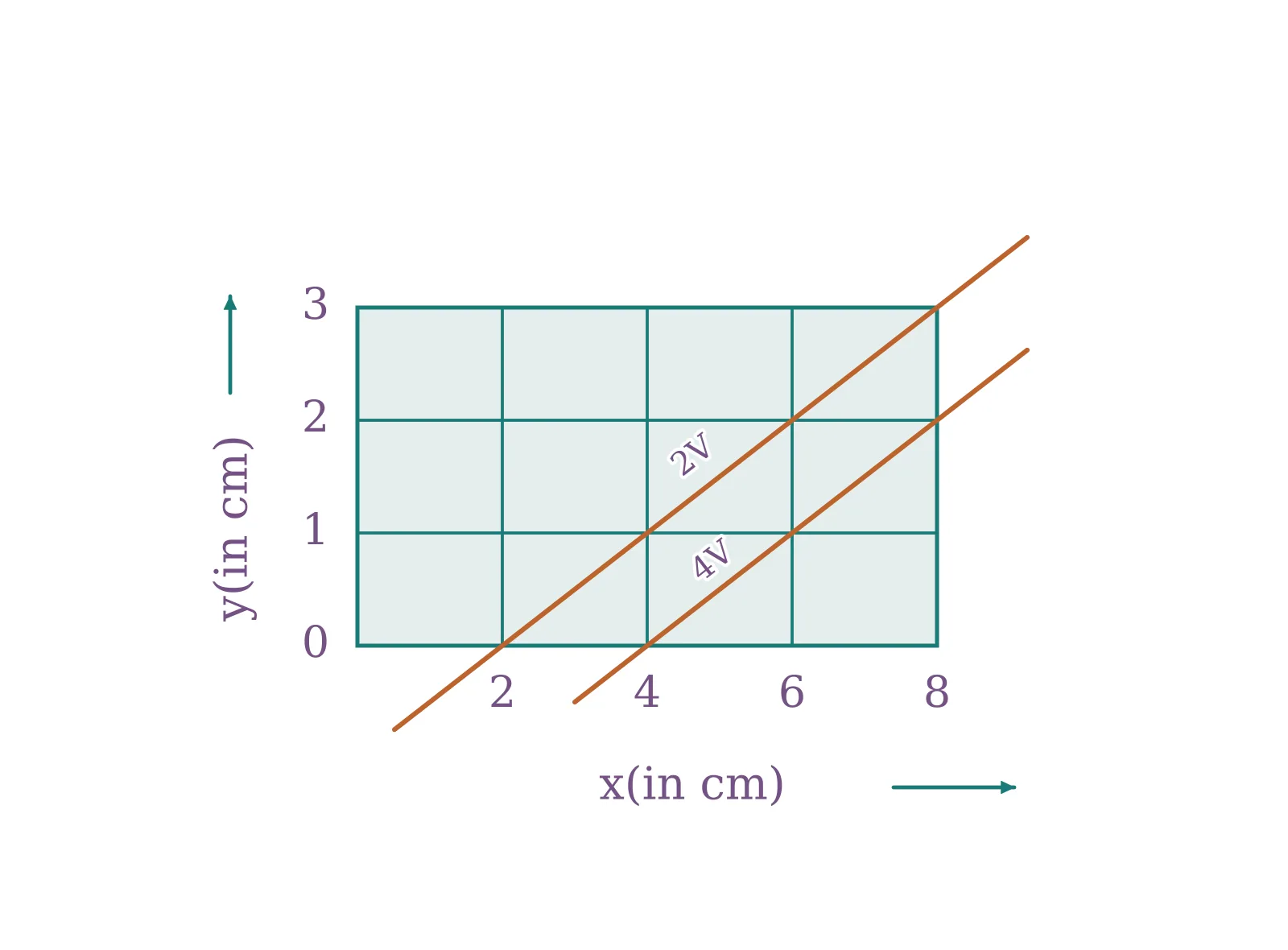
The figure shows two equipotential lines in the xy-plane. The x-component Eₓ and y-component Eᵧ of the electric field in the region between these equipotential lines are, respectively:
Options
JEE MainsAdvanced
Open question & full solution → - MCQmediumElectrostatic
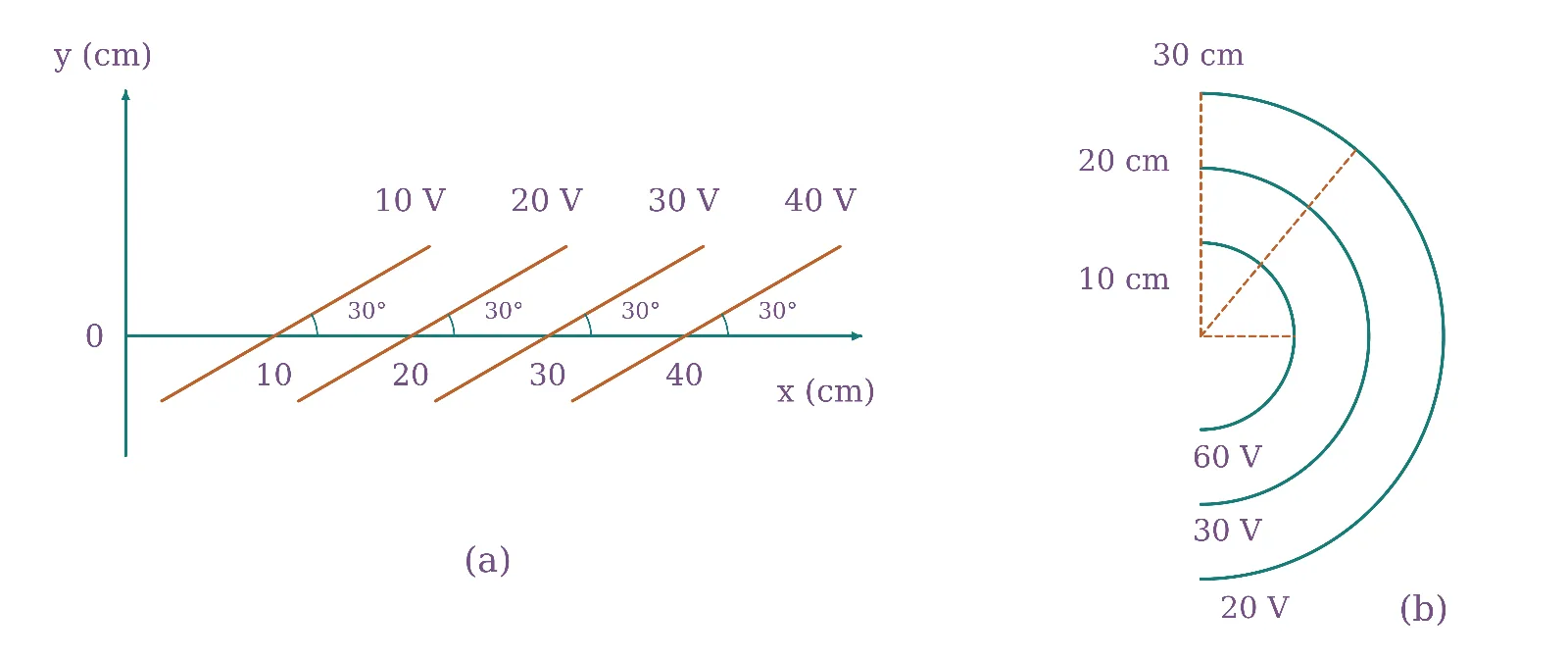
Some equipotential surfaces are shown in figure. What can you say about the magnitude and the direction of the electric field?
Options
JEE MainsAdvanced
Open question & full solution → - MCQmediumElectrostatic
Which of the following represents the equipotential lines of a dipole (two equal and opposite charges placed at small separation)?
Options
JEE MainsAdvanced
Open question & full solution → - MCQmediumElectrostatic
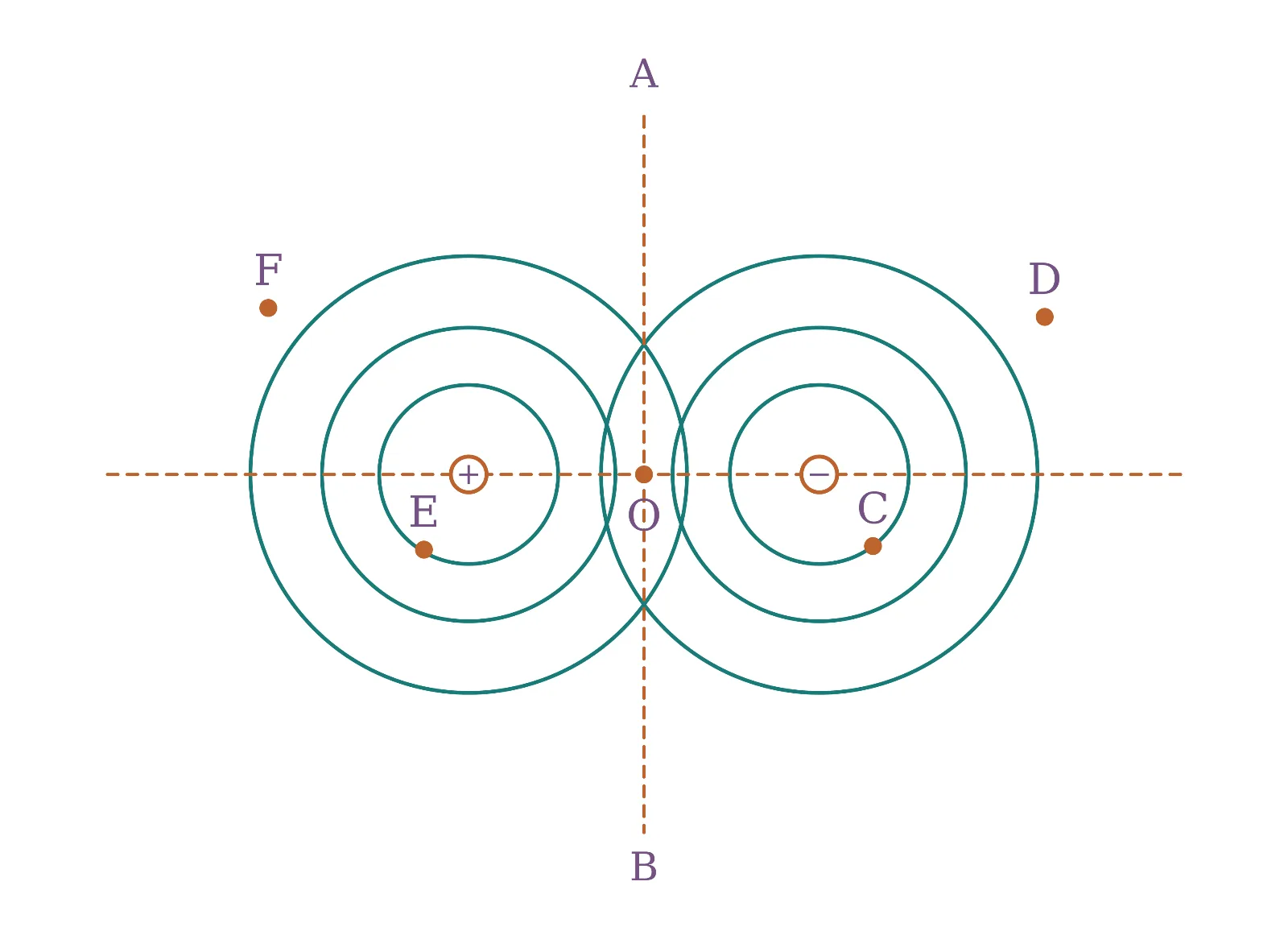
Figure shows a charge configuration with its equipotential surfaces and electric field lines placed in x-y plane. Mark INCORRECT statement :-
Options
JEE MainsAdvanced
Open question & full solution → - MCQmediumElectrostatic
The electric field is = √3 - V m⁻¹ at every point in space. Which diagram correctly represents the equipotential lines in the xy-plane?
Options
JEE MainsAdvanced
Open question & full solution → - MCQmediumElectrostaticOpen question & full solution →
Eight identical isolated conducting drops, each of radius r and charge q, are initially very far apart. They coalesce into one spherical conducting drop. The ratio of final to initial electrostatic self-energy is:
Options
- MCQmediumElectrostatic
Equipotential at a great distance from a collection of charges whose total sum is not zero are approximately
Options
JEE MainsAdvanced
Open question & full solution → - MCQeasyElectrostatic
Some charge is being given to a conductor. Then, its potential:
Options
AIPMT 2002NEET Previous Year
Open question & full solution → - MCQmediumElectrostatic
Three concentric spherical shells have radii a, b and c (a < b < c) and have surface charge densities σ, -σ and σ, respectively. If Vₐ, Vᵦ and V𝒸 denote potentials of respective shells, the correct relation is: [Diagram: Image]
Options
AIPMT Screening 2009NEET Previous Year
Open question & full solution →