Free physics question bank
Relative motion in 2-D and shortest distance problem questions with solutions
Practice Kinematics part-3 Relative motion for JEE Main, JEE Advanced, NEET, and Classes 11–12. Attempt each question, then open it for the full solution.
Showing 1–10 of 73 questions
- MCQmediumKinematics part-3 Relative motion
A bird flies south at 40 km h⁻¹ and a train moves east at 40 km h⁻¹. The velocity of the bird relative to an observer in the train is:
Options
JEE MainsNEET
Open question & full solution → - MCQmediumKinematics part-3 Relative motionOpen question & full solution →
A boat has speed u relative to water in a river of speed v, with u > v. First it is aimed perpendicular to the bank; its crossing time is t₁. Next it is aimed upstream so that it reaches the point directly opposite; its crossing time is t₂. Then t₂/t₁ equals:
Options
- Multi-correctmediumKinematics part-3 Relative motion
A is projected from ground with velocity (20î+30ĵ) m/s. Simultaneously B is projected from a point 40 m vertically above A with velocity (30î+20ĵ) m/s. While both are in free flight, which statements are correct?
Select all that apply
JEE MainsNEETJEE Advanced
Open question & full solution → - A/ReasyKinematics part-3 Relative motion
Evaluate the following statements.
Assertion
Assertion (A): At closest approach, the relative velocity of two particles need not be zero.
Reason
Reason (R): At closest approach only the component of relative velocity along the instantaneous line joining the particles must vanish.
Options
JEE MainsNEETJEE Advanced
Open question & full solution → - MCQmediumKinematics part-3 Relative motion
A straight road passes through A. Point B is perpendicular distance d from the road, and its foot P is distance L along the road from A. A person moves on road at speed v and through field at speed v/n (n>1). He leaves road at C before P; let CP=x. The minimum-time condition is:
Options
JEE MainsNEETJEE Advanced
Open question & full solution → - MCQmediumKinematics part-3 Relative motion
Two particles A and B move with constant velocities and . At the initial moment their position vectors are and respectively. The condition for particles A and B to collide is:
Options
AIPMT July 2015NEET
Open question & full solution → - MCQmediumKinematics part-3 Relative motion
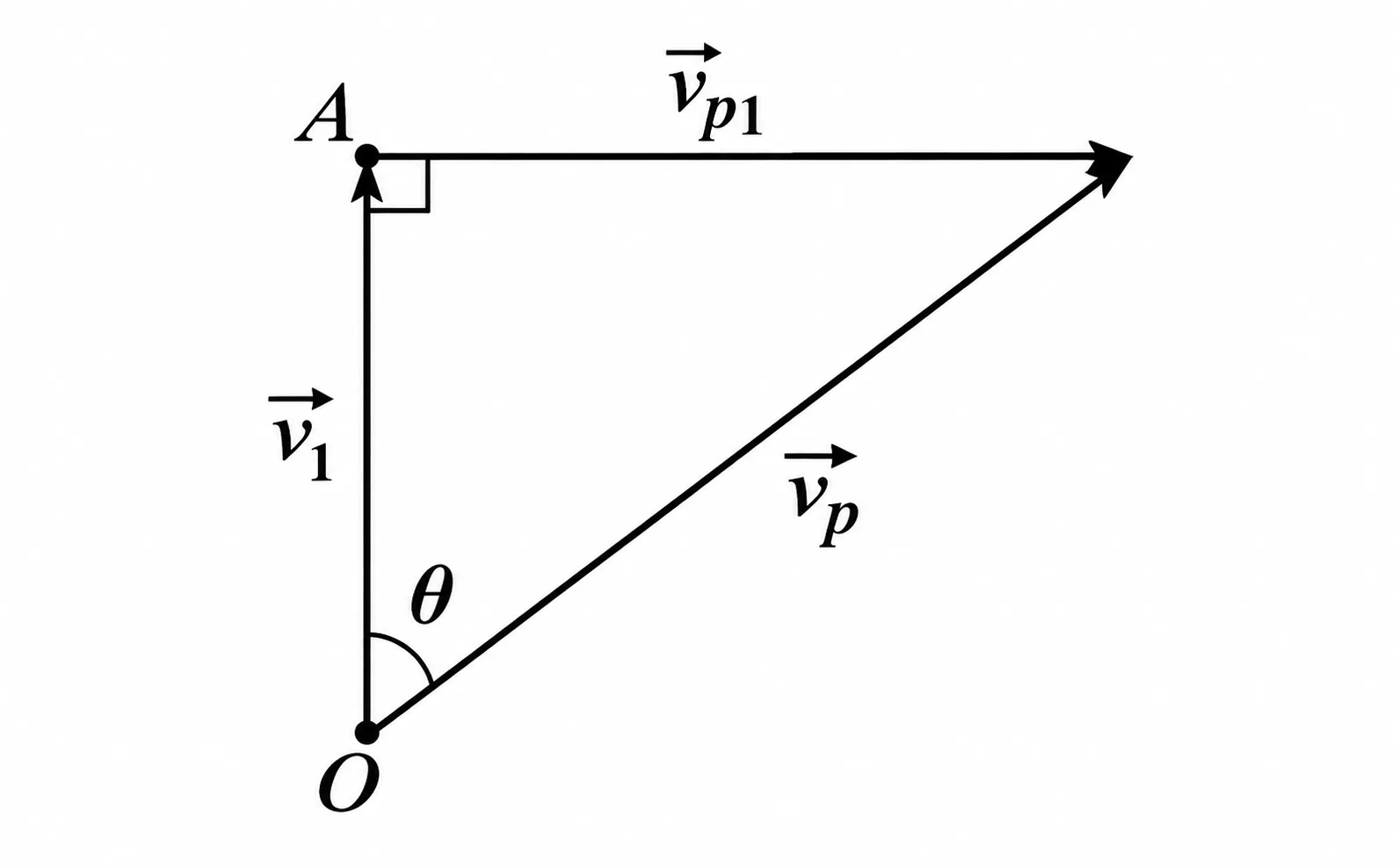
An aeroplane is observed by two persons travelling at 60 km h⁻¹ in opposite directions along a straight road. To one observer the plane appears to cross the road at right angles; to the other it appears at 45°. At what angle θ does the plane actually cross the road?
Options
JEE MainsNEET
Open question & full solution → - ParagraphdifficultKinematics part-3 Relative motion
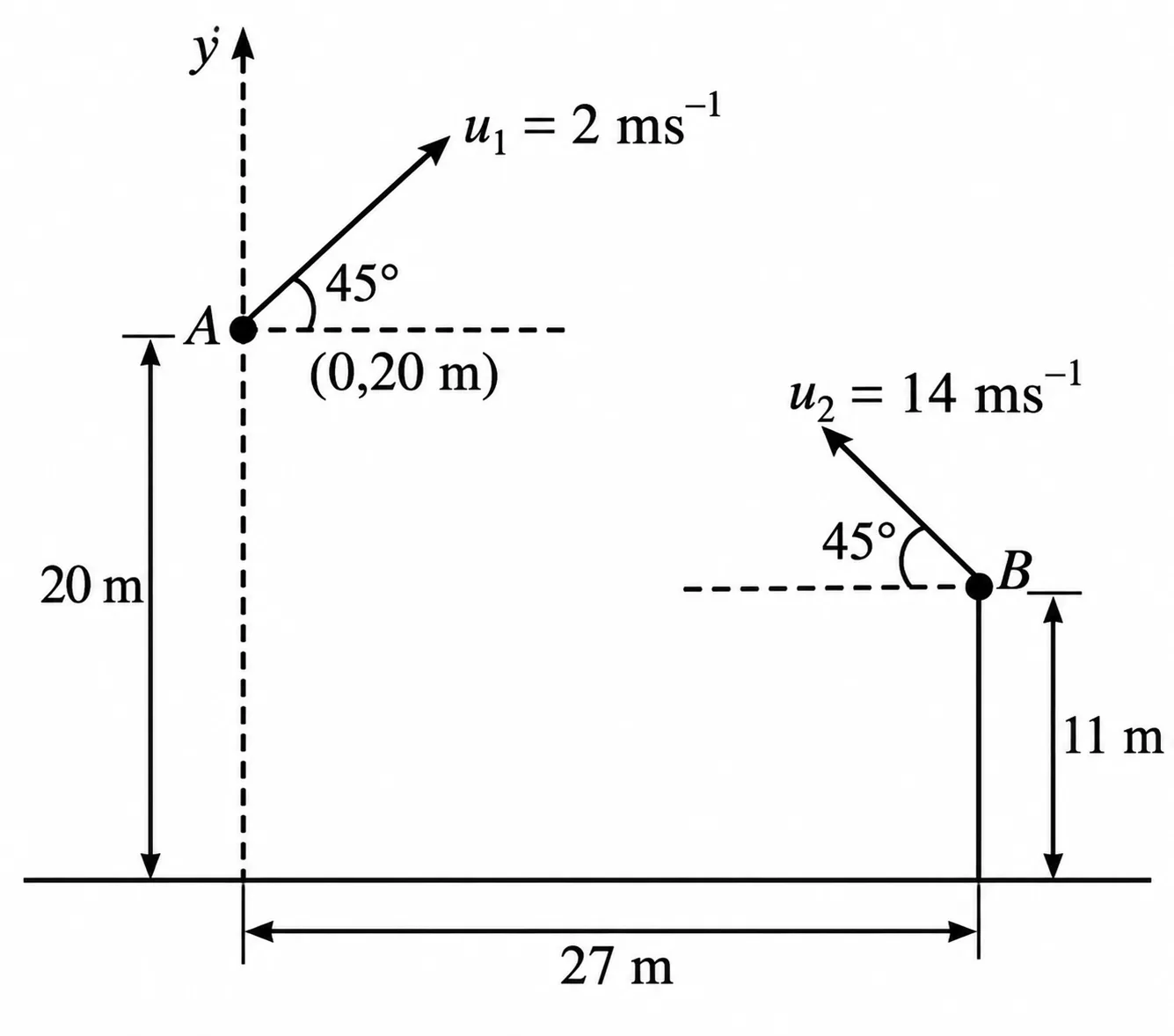
Two particles are thrown simultaneously from points A and B with constant velocities u₁=2 m s⁻¹ and u₂=14 m s⁻¹ respectively, as shown in the figure.
Sub-question 1
The relative velocity of B as seen from A is:
Options
Sub-question 2
The acute angle with the horizontal at which B appears to move as seen from A is:
Options
Sub-question 3
The minimum separation between A and B is:
Options
JEE MainsJEE Advanced
Open question & full solution → - Multi-correctdifficultKinematics part-3 Relative motion
An object has velocity magnitude v₁ with respect to ground. An observer moving with constant velocity magnitude v₀ with respect to ground measures the object's velocity magnitude as v₂. Which relation must be true?
Select all that apply
JEE MainsJEE Advanced
Open question & full solution → - MCQmediumKinematics part-3 Relative motion
Ship A moves due east at 5 km h⁻¹. Ship B heads 30° east of north. What should be B's speed so that B remains always due north of A?
Options
JEE MainsNEET
Open question & full solution →