Free physics question bank
Newtons law of motion and Friction questions with solutions
Practice Newtons law of motion and Friction for JEE Main, JEE Advanced, NEET, and Classes 11–12. Attempt each question, then open it for the full solution.
Showing 1–10 of 109 questions
- MCQeasyNewtons law of motion and Friction
A wooden block, initially at rest on the ground, is pushed by a force which increases linearly with time t. Which of the following curve best describes acceleration of the block with time:
Options
JEE Mains 2024 04 Apr Morning Shift
Open question & full solution → - MCQdifficultNewtons law of motion and FrictionOpen question & full solution →
A block of mass m is placed on a block of mass 2m. The lower block rests on a smooth floor. Coefficient of static friction between blocks is μ. A horizontal force F is applied to the upper block. The friction required to make the blocks move together is 4μmg/3. Which statement is correct?
Options
- MCQdifficultNewtons law of motion and FrictionOpen question & full solution →
Three blocks of masses 2 kg, 3 kg and 5 kg are kept in contact in that order on a smooth horizontal surface. A horizontal force of 40 N is applied on the 2 kg block. The contact force between the 3 kg and 5 kg blocks is:
Options
- MCQmediumNewtons law of motion and FrictionOpen question & full solution →
A movable pulley of negligible mass carries a block of mass m. One end of a light inextensible string is fixed to the roof of a lift; the string passes under the movable pulley and its other end is attached to the lower end of a vertical spring of force constant k whose upper end is also fixed to the lift. The lift accelerates vertically upward with acceleration a. The equilibrium extension of the spring is:
Options
- MCQmediumNewtons law of motion and Friction
Three masses are connected by two light strings and a fixed smooth pulley. A 4 kg mass hangs on the left side of the upper string. On the right side of the same string hangs another 4 kg mass, and a 6 kg mass is suspended below it by a second string. Let T₁ be the tension in the upper string and T₂ the tension in the lower string. Taking g = 10 m·s⁻², what is the ratio T₁/T₂?
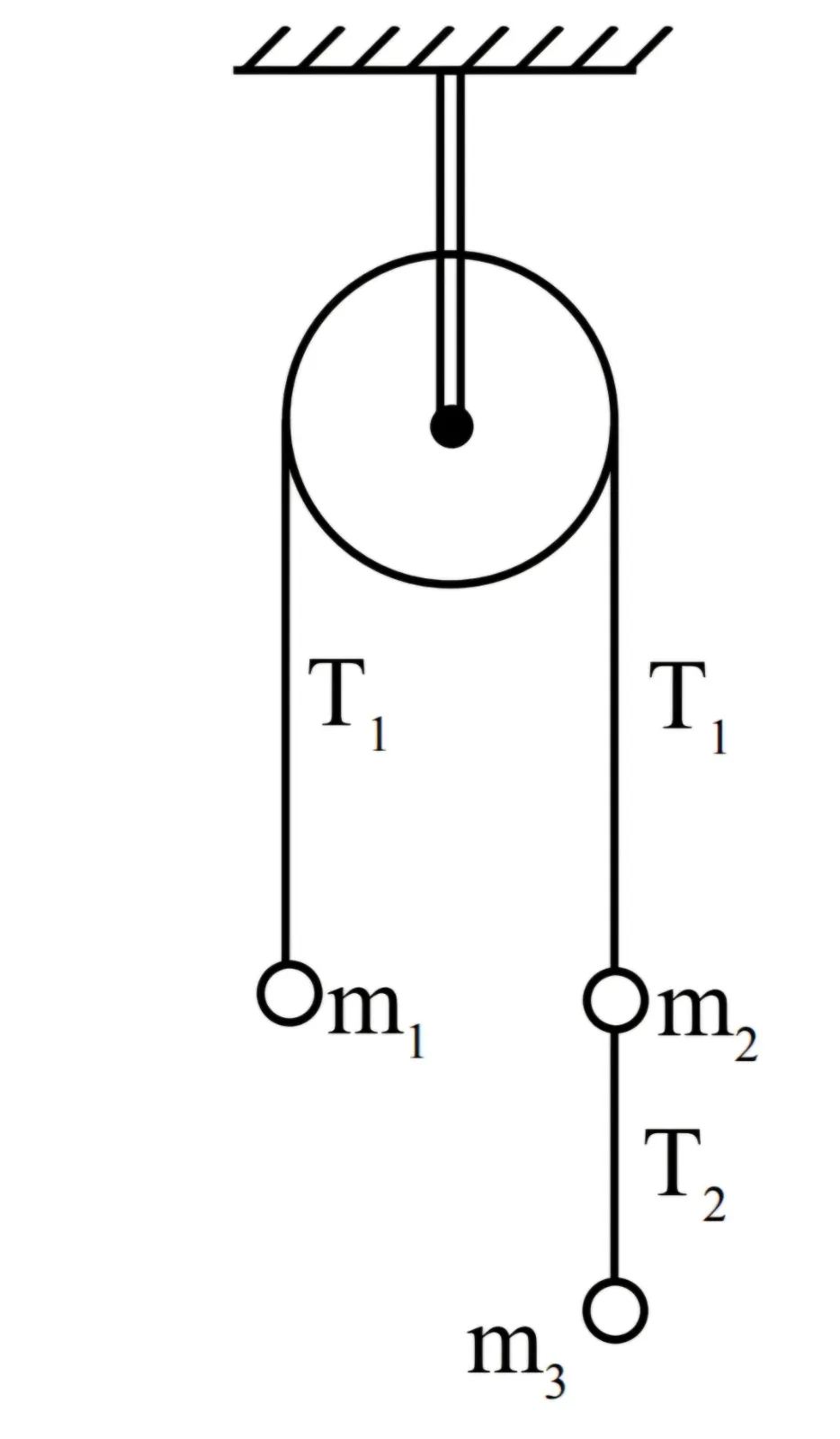
Options
JEE Mains 2026 5 April Morning Shift
Open question & full solution → - MCQeasyNewtons law of motion and Friction
At t = 0, a body of mass 100 g starts from rest under the action of a constant force F = (5î+10ĵ) N. After 2 s, its position vector is r = (2x î+5y ĵ) m. What is the ratio x:y?
Options
JEE Mains 2026 4 April Evening Shift
Open question & full solution → - MCQeasyNewtons law of motion and Friction
Given below are two statements : Statement (I) : The limiting force of static friction depends on the area of contact and independent of materials. Statement (II) : The limiting force of kinetic friction is independent of the area of contact and depends on materials. In the light of the above statements, choose the most appropriate answer from the options given below :
Options
JEE Mains 2024 27 Jan Evening Shift
Open question & full solution → - MCQdifficultNewtons law of motion and FrictionOpen question & full solution →
A block of mass m is on a rough horizontal surface with coefficient of static friction μ. A force F is applied at an adjustable angle θ above the horizontal. The minimum magnitude of F required to initiate motion is:
Options
- MCQdifficultNewtons law of motion and FrictionOpen question & full solution →
An incline of angle θ rises towards the right and accelerates horizontally towards the right with acceleration a. A block remains stationary relative to it. If g sinθ > a cosθ, the minimum coefficient of friction required is:
Options
- MCQdifficultNewtons law of motion and FrictionOpen question & full solution →
Two blocks m₁ and m₂ are in contact on a horizontal rough floor. Their coefficients of kinetic friction with the floor are μ₁ and μ₂, respectively. A horizontal force F is applied to m₁, pushing both blocks towards m₂. Assuming both slide while remaining in contact, the contact force on m₂ is:
Options