Six identical positive charges q are placed at the six vertices A, B, C, D, E and F of a regular hexagon of circumradius R. The magnitude of the net electrostatic force on the charge at vertex A is F. First, the charge
Physics · Electrostatic · Electric Charge & Coulomb’s Law
Six identical positive charges q are placed at the six vertices A, B, C, D, E and F of a regular hexagon of circumradius R. The magnitude of the net electrostatic force on the charge at vertex A is F. First, the charge at A is moved to the centre; let the force magnitude on it there be F₁. Then the charge at E is also moved to the centre, so that the charge present at the centre becomes 2q; let the force magnitude on this central charge due to the charges remaining at the vertices be F₂. Which ordered pair (F₁,F₂) is correct?
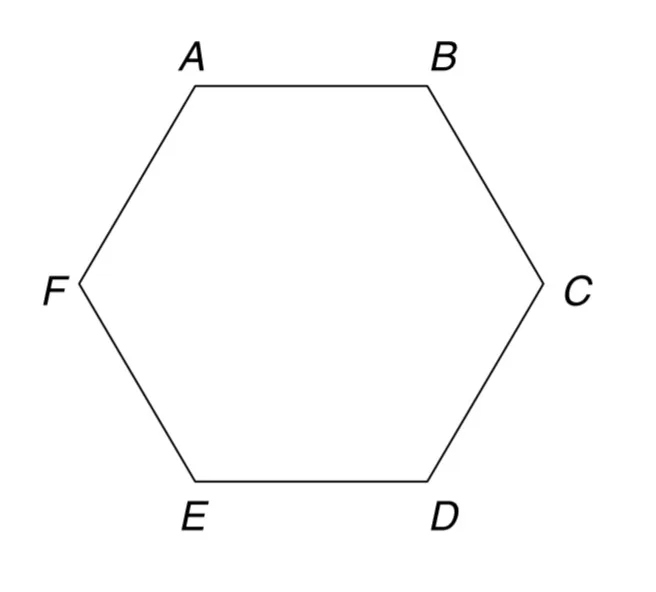
Options
Related questions
- Three positive and three negative charges, all of equal magnitude, occupy the six vertices P, Q, R, S, T and U in cyclic order around a reg…
- Identical conducting spheres A and B, each carrying charge q, repel with force F. A third identical uncharged sphere C first touches A, the…
- An electric dipole of moment 5 × 10⁻⁶ C·m is initially aligned with a uniform electric field 4 × 10⁵ N/C. It is rotated to 60° relative to…
- Which statements about an electrostatically charged conductor are correct? A. Electric field inside the conducting material is zero. B. Ele…
- A unit positive test charge is slowly moved from point A at distance 2R to point B at distance 3R from the centre of a uniformly positively…
- A point charge Q is located in a cavity within an isolated conducting sphere. Point A is inside the cavity; B and C are outside the sphere…