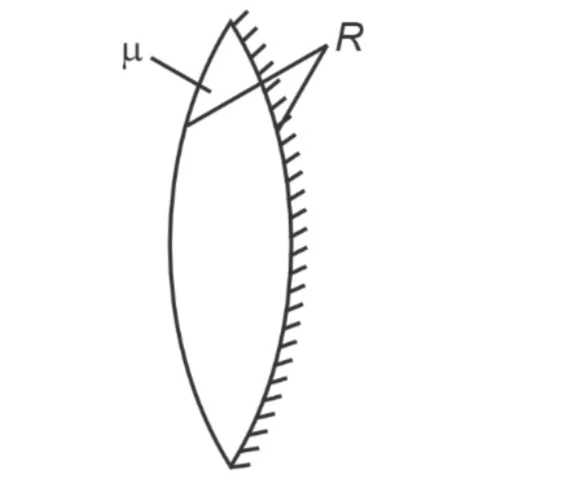
The equiconvex lens shown in the original figure is silvered on one side. Its μ and the radius magnitude of each curved surface is R. For what object distance from the lens will the image be formed on the object itself.
Physics · Geometrical optics · Lenses, Lens Combinations & Silvered Lenses
The equiconvex lens shown in the original figure is silvered on one side. Its μ and the radius magnitude of each curved surface is R. For what object distance from the lens will the image be formed on the object itself.
Options
Related questions
- A prism has refractive index √2 and apex angle 60°. What is the angle of incidence at minimum deviation?
- The convex surface of a thin plano-convex lens of refractive index 1.5 has radius 10 cm. If its plane surface is silvered, what is the magn…
- Match the corresponding entries of Column I with Column II.( Here m is mirror magnification.)
- Statement I: Image formation needs regular reflection and/or refraction. Statement II: The variety in colours of objects around us is due t…
- A small coin is resting on the bottom of a beaker filled with liquid. A ray of light from the coin strikes the surface of the liquid and mo…
- In the figure shown, what is the equivalent focal length of the combination of lenses? (Assume that all lenses are thin.)