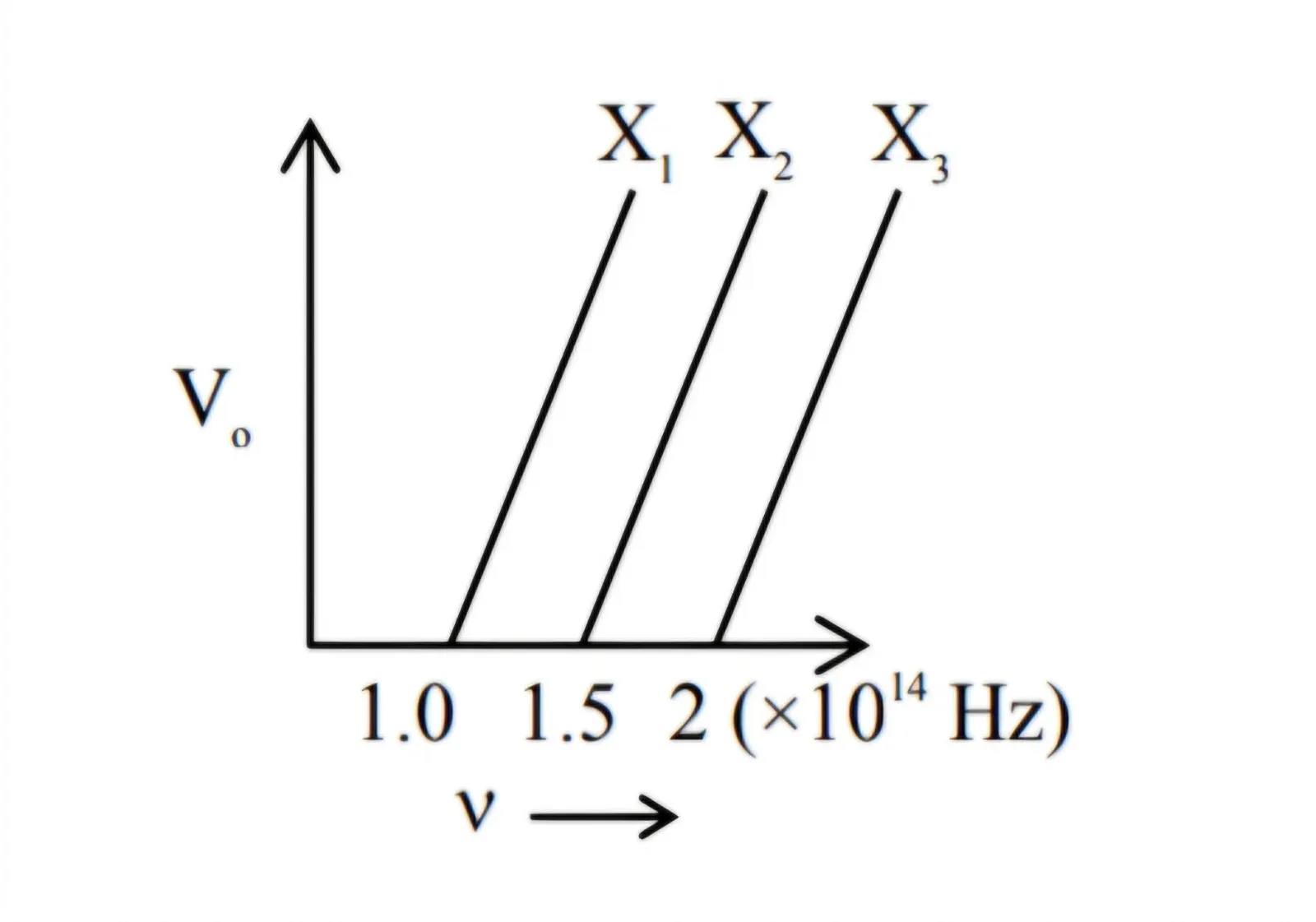
The graph in the figure shows stopping potential V₀ as a function of the frequency ν of incident radiation for three photosensitive metals X₁, X₂ and X₃. Their threshold frequencies increase in the order X₁, X₂, X₃. If
Physics · Photoelectric effect and dual nature · Photoelectric Effect & Einstein's Equation
The graph in the figure shows stopping potential V₀ as a function of the frequency ν of incident radiation for three photosensitive metals X₁, X₂ and X₃. Their threshold frequencies increase in the order X₁, X₂, X₃. If all three metals are illuminated with radiation of the same wavelength whose frequency is above all three thresholds, which metal emits photoelectrons with the greatest maximum kinetic energy?
Options
Related questions
- An electron of mass m has nonrelativistic kinetic energy E. What is its de Broglie wavelength?
- A photon and a nonrelativistic electron of mass m each have the same energy E. Find the ratio of their de Broglie wavelengths λₚₕₒₜₒₙ/λₑₗₑ꜀…
- Which of the following options represent the variation photoelectric current with property of light shown on t x-axis?
- A metal has a work function of 6.6 eV. Which wavelength of incident radiation will NOT cause photoelectric emission? Take h = 6.6 × 10⁻³⁴ J…
- Photoelectrons are emitted from a metal when illuminated by light of fixed frequency above threshold. The optical power begins to decrease…
- Light of wavelength λ is incident on three photoelectric cells having threshold wavelengths λ₁, λ₂ and λ₃. The stopping potentials are V₁,…