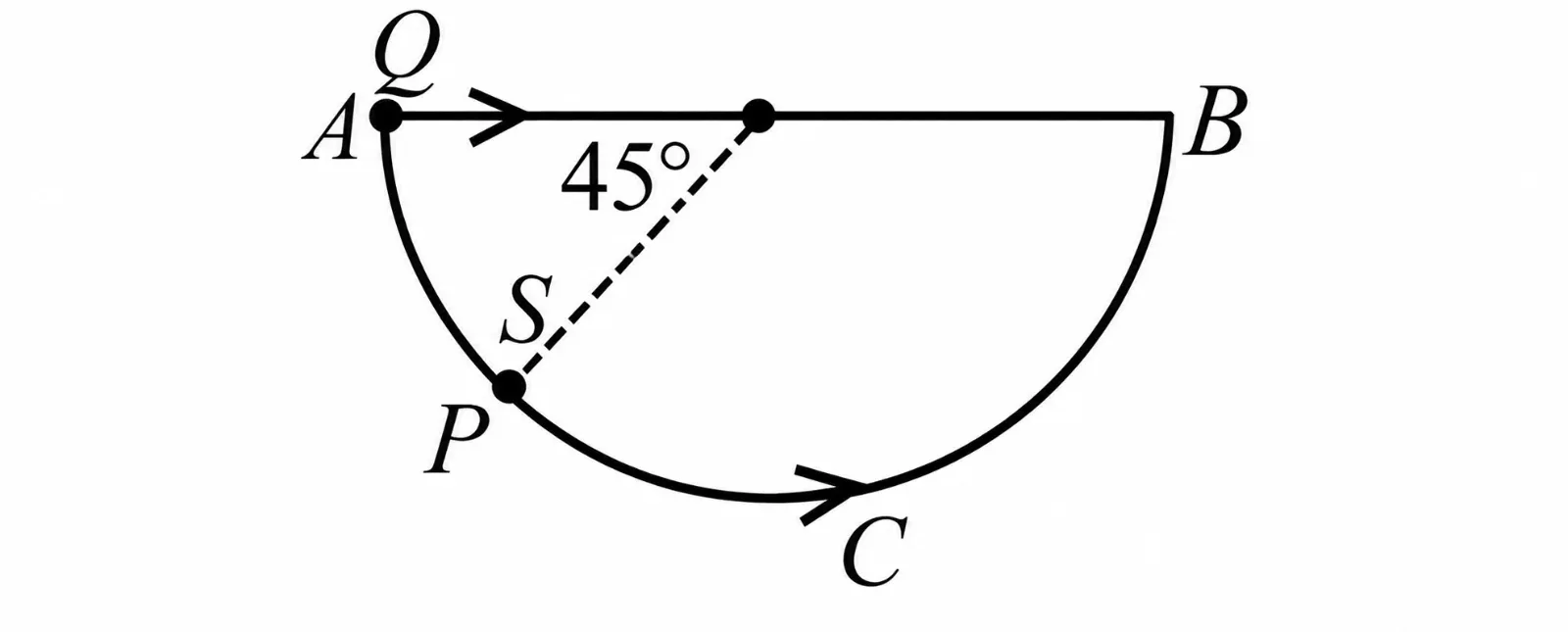
A bead P sliding on a frictionless semi-circular string (ACB) and it is at point S at t = 0 and at this instant the horizontal component of its velocity is v. Another bead Q of the same mass as P is ejected from point
Physics · Kinematics Part-1 (one dimension) · Motion under gravity
A bead P sliding on a frictionless semi-circular string (ACB) and it is at point S at t = 0 and at this instant the horizontal component of its velocity is v. Another bead Q of the same mass as P is ejected from point A at t = 0 along the horizontal string AB, with the speed v, friction between the beads and the respective strings may be neglected in both cases. Let and be the respective times taken by beads P and Q to reach the point B, then the relation between and is
Options
Related questions
- A body moving vertically downward covers the same distance S in the first 2 s and in the third second. If g = 10 m/s², find S.
- A particle moves in one dimension according to t = x² + x (in consistent units). Find acceleration a as a function of position x.
- Five graphs (labelled A–E in the source figure) represent possible variations of velocity v against time t for a ball thrown vertically upw…
- A ruler is dropped vertically and caught after different reaction times. A. Person A has reaction time of 0.20 s B. Person B has reaction t…
- A particle moves along a line with position s(t) = αt² - βt + γ, where α = 1 m s⁻², β = 6 m s⁻¹ and γ = 5 m. Find its average speed (m s⁻¹)…
- A body moves 6 m north, 8 m east and 10 m vertically upwards. What is its resultant displacement from the initial position?