A concave mirror of focal length 50 cm is placed at origin as shown in diagram. A point sized object is placed at O (x = 152 cm). A glass slab of thickness 4 cm, μ = 2, is placed symmetrically around C. Light can not
Physics · Geometrical optics · Apparent Depth & Lateral Shift
A concave mirror of focal length 50 cm is placed at origin as shown in diagram. A point sized object is placed at O (x = 152 cm). A glass slab of thickness 4 cm, μ = 2, is placed symmetrically around C. Light can not reach from object to mirror without passing through slab. Choose the CORRECT option(s) :
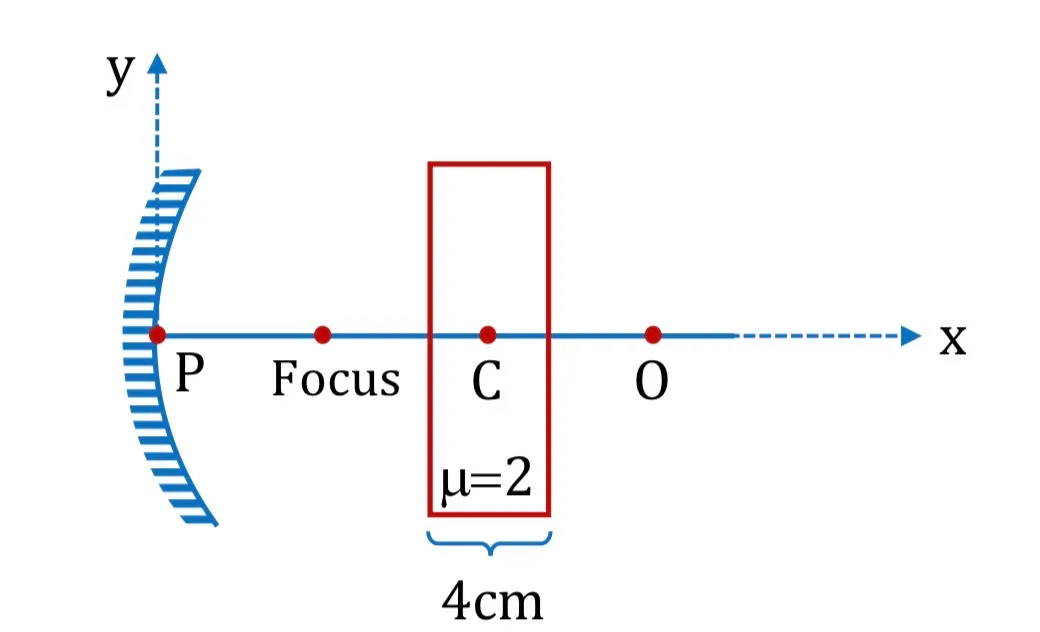
Select all that apply
Related questions
- A prism has refractive index √2 and apex angle 60°. What is the angle of incidence at minimum deviation?
- The convex surface of a thin plano-convex lens of refractive index 1.5 has radius 10 cm. If its plane surface is silvered, what is the magn…
- Match the corresponding entries of Column I with Column II.( Here m is mirror magnification.)
- Statement I: Image formation needs regular reflection and/or refraction. Statement II: The variety in colours of objects around us is due t…
- A small coin is resting on the bottom of a beaker filled with liquid. A ray of light from the coin strikes the surface of the liquid and mo…
- In the figure shown, what is the equivalent focal length of the combination of lenses? (Assume that all lenses are thin.)