A parallel plate capacitor is connected from a cell and then isolated from it. Two dielectric slabs of dielectric constant K and 2K are now introduce in the region between upper half and lower half of the plate (as shown in figure). The electric field intensity in upper half of dielectric is E₁ and lower half is E₂ then
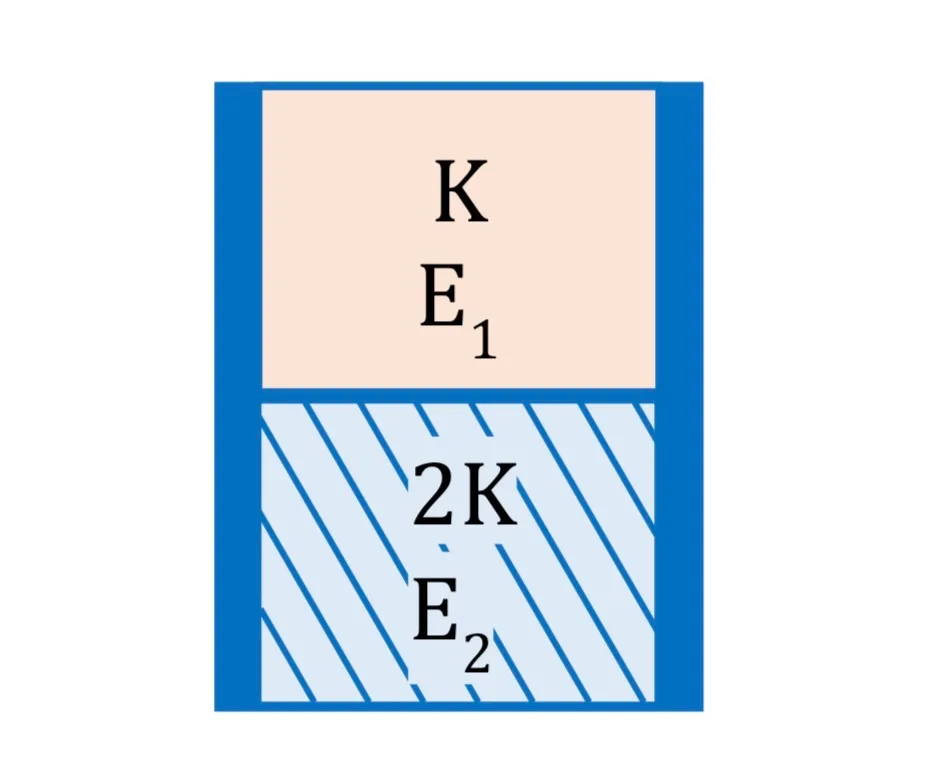
Options
Related questions
- Find the steady-state current through the 2 Ω resistor in the circuit shown. Across the two rails there are three branches: a 2 Ω and 3 Ω p…
- The plates of a charged, isolated parallel-plate capacitor are pulled farther apart. What happens?
- A charged air-gap capacitor is disconnected from its source. A dielectric completely fills the gap. What happens to the stored energy?
- A parallel-plate capacitor has plate gap d. Two dielectric slabs of constants K₁ and K₂, with thicknesses 3d/8 and d/2, are inserted; the r…
- Two initially uncharged capacitors each have capacitance 200 pF. One is charged to 100 V by a supply, disconnected and connected in paralle…
- Five capacitors are connected across a 50 V battery as in the diagram. Four capacitors C₁ = C₂ = C₃ = C₄ = 10 μF form a series branch, whil…