A certain series RC circuit is formed using a resistance R, a capacitor without dielectric having a capacitance C = 2 F and a battery of emf E = 3V. The circuit is completed and it is allowed to attain the steady
Physics · Capacitor · Capacitors with Dielectrics
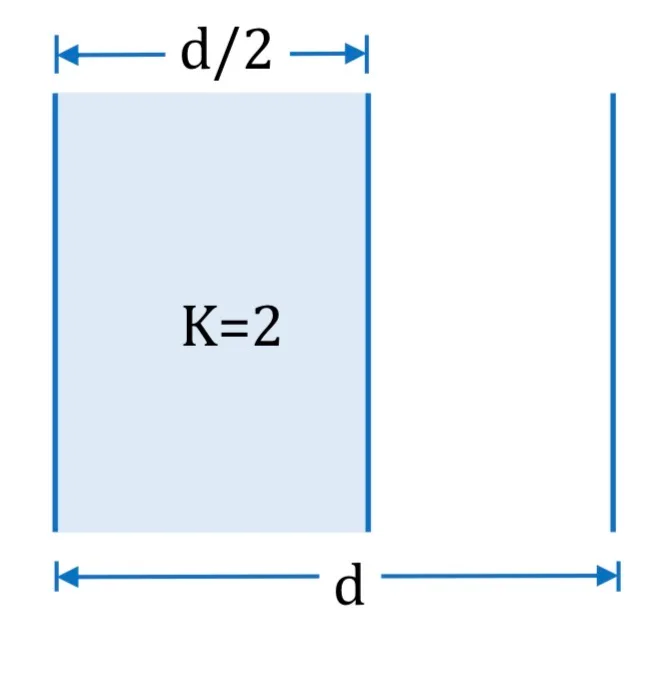
A certain series RC circuit is formed using a resistance R, a capacitor without dielectric having a capacitance C = 2 F and a battery of emf E = 3V. The circuit is completed and it is allowed to attain the steady state. After this, at t = 0, half the thickness of the capacitor is filled with a dielectric of constant K = 2 heat generated (in joule) in the circuit between t = 0 and t = ∞?
Related questions
- Find the steady-state current through the 2 Ω resistor in the circuit shown. Across the two rails there are three branches: a 2 Ω and 3 Ω p…
- The plates of a charged, isolated parallel-plate capacitor are pulled farther apart. What happens?
- A charged air-gap capacitor is disconnected from its source. A dielectric completely fills the gap. What happens to the stored energy?
- A parallel-plate capacitor has plate gap d. Two dielectric slabs of constants K₁ and K₂, with thicknesses 3d/8 and d/2, are inserted; the r…
- Two initially uncharged capacitors each have capacitance 200 pF. One is charged to 100 V by a supply, disconnected and connected in paralle…
- Five capacitors are connected across a 50 V battery as in the diagram. Four capacitors C₁ = C₂ = C₃ = C₄ = 10 μF form a series branch, whil…