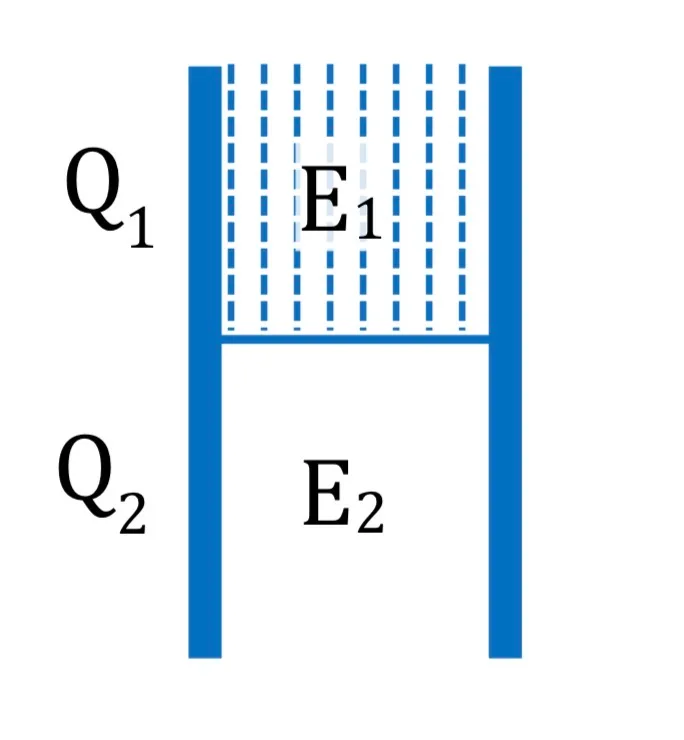
A parallel-plate capacitor has a dielectric slab of dielectric constant K covering one-third of the plate area, as shown. The total capacitance is C and the capacitance of the dielectric-covered portion is C₁. When
Physics · Capacitor · Capacitors with Dielectrics
A parallel-plate capacitor has a dielectric slab of dielectric constant K covering one-third of the plate area, as shown. The total capacitance is C and the capacitance of the dielectric-covered portion is C₁. When charged, charges Q₁ and Q₂ appear on the dielectric-covered and air-filled portions respectively. Choose the correct option(s), ignoring edge effects.
Select all that apply
Related questions
- Find the steady-state current through the 2 Ω resistor in the circuit shown. Across the two rails there are three branches: a 2 Ω and 3 Ω p…
- The plates of a charged, isolated parallel-plate capacitor are pulled farther apart. What happens?
- A charged air-gap capacitor is disconnected from its source. A dielectric completely fills the gap. What happens to the stored energy?
- A parallel-plate capacitor has plate gap d. Two dielectric slabs of constants K₁ and K₂, with thicknesses 3d/8 and d/2, are inserted; the r…
- Two initially uncharged capacitors each have capacitance 200 pF. One is charged to 100 V by a supply, disconnected and connected in paralle…
- Five capacitors are connected across a 50 V battery as in the diagram. Four capacitors C₁ = C₂ = C₃ = C₄ = 10 μF form a series branch, whil…