A long jumper has clockwise angular momentum after take-off. In air, external torque about the center of mass is negligible, so total angular momentum is conserved. The athlete rotates the arms to transfer angular momentum. During a 0.7 sec flight, one arm makes 1/2 revolution and the other makes 1 revolution. Each arm is a thin rod of mass 4 kg and length 0.6 m rotating about one end.
Physics · Rotational Motion · angular momentum in pure rotation and its conservation
A long jumper has clockwise angular momentum after take-off. In air, external torque about the center of mass is negligible, so total angular momentum is conserved. The athlete rotates the arms to transfer angular momentum. During a 0.7 sec flight, one arm makes 1/2 revolution and the other makes 1 revolution. Each arm is a thin rod of mass 4 kg and length 0.6 m rotating about one end.
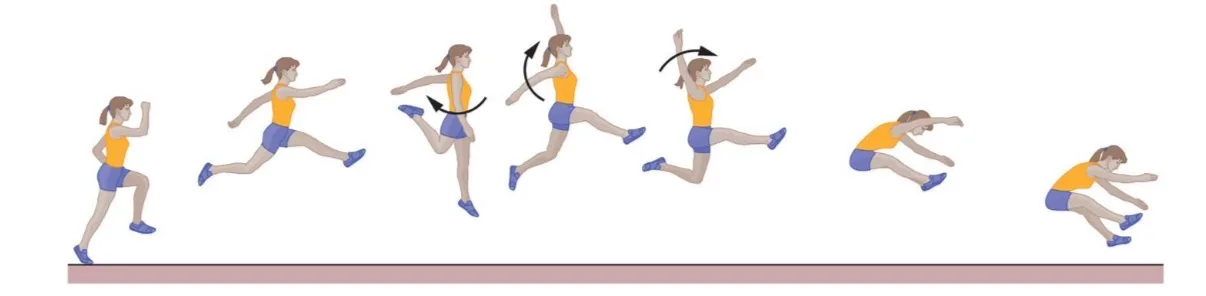
Sub-question 1
What is the angular momentum of both arms in athelete's frame (in SI units)
Options
Sub-question 2
If rest of the athelete's body is assumed to be a rigid body having a moment of inertia of 18 kg·m² about its centre of mass, what is its change in angular velocity due to this rotation of arms?
Options