A long jumper has clockwise angular momentum after take-off. In air, external torque about the center of mass is negligible, so total angular momentum is conserved. The athlete rotates the arms to transfer angular
Physics · Rotational Motion · Angular Momentum & Its Conservation
A long jumper has clockwise angular momentum after take-off. In air, external torque about the center of mass is negligible, so total angular momentum is conserved. The athlete rotates the arms to transfer angular momentum. During a 0.7 sec flight, one arm makes 1/2 revolution and the other makes 1 revolution. Each arm is a thin rod of mass 4 kg and length 0.6 m rotating about one end.
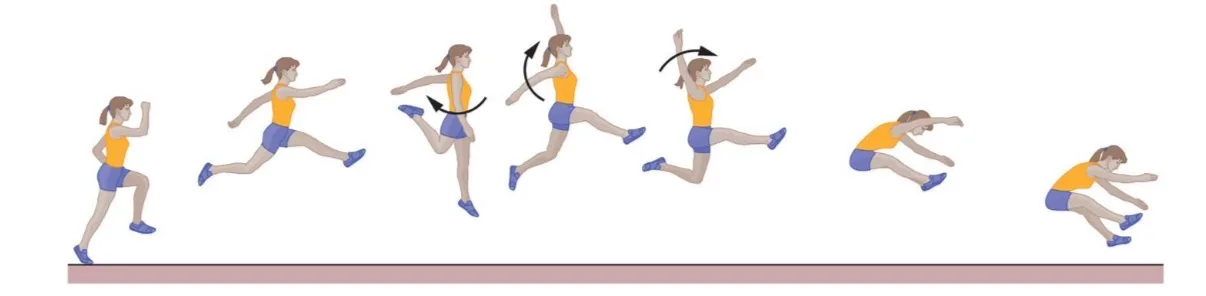
Sub-question 1
What is the angular momentum of both arms in athelete's frame (in SI units)
Options
Sub-question 2
If rest of the athelete's body is assumed to be a rigid body having a moment of inertia of 18 kg·m² about its centre of mass, what is its change in angular velocity due to this rotation of arms?
Options
Related questions
- A metre rule has a wooden half and a denser steel half. In case (i) it is pivoted near the wooden end and a perpendicular force F is applie…
- A uniform rod of mass 20 kg and length 5 m leans against a smooth vertical wall, making 60° with the wall. Its lower end rests on a rough f…
- A smaller solid sphere of radius R is removed from a solid sphere of radius 2R as shown. Both have uniform density. Find the ratio of momen…
- A thin wire of length L and linear mass density m is bent into a circular ring lying in the x–y plane as shown. Find its moment of inertia…
- Two touching solid spheres A (mass M, radius R) and B (mass m, radius r) have their centres separated by R + r. Let I A I_A I A and I B I…
- A thin horizontal disc rotates about a vertical axis through its fixed centre O. Its angular momentum about points A and B, both in the pla…