A special metal S conducts electricity without any resistance. A closed wire loop, made of S, does not allow any change in flux through itself by inducing a suitable current to generate a compensating flux. The induced current in the loop cannot decay due to its zero resistance. This current gives rise to a magnetic moment which in turn repels the source of magnetic field or flux. Consider such a loop, of radius a, with its center at the origin. A magnetic dipole of moment m is brought along the axis of this loop from infinity to a point at distance r (>> a) from the center of the loop with its north pole always facing the loop, as shown in the figure below. The magnitude of magnetic field of a dipole m, at a point on its axis at distance r, is He m 2n rs, where Mo is the permeability of free space. The magnitude of the force between two magnetic dipoles with moments, m1 and mz, separated by a distance r on the common axis, with their north poles facing each other, is km,m,, where k is a constant of appropriate dimensions. The direction of this force is along the line joining the two dipoles. When magnetic dipole m is placed at distance r from the centre of the superconducting loop described in the stem, the induced current in the loop is proportional to:
Physics · Electromagnetic Induction
A special metal S conducts electricity without any resistance. A closed wire loop, made of S, does not allow any change in flux through itself by inducing a suitable current to generate a compensating flux. The induced current in the loop cannot decay due to its zero resistance. This current gives rise to a magnetic moment which in turn repels the source of magnetic field or flux.
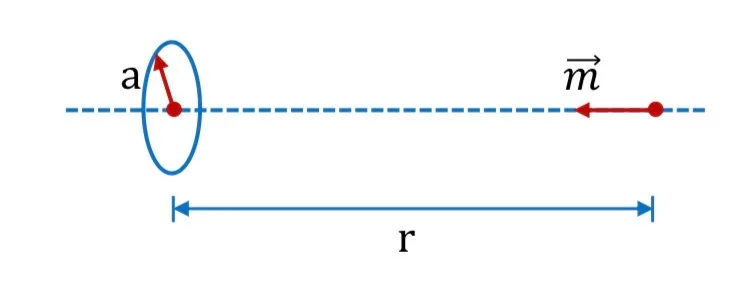
Consider such a loop, of radius a, with its center at the origin. A magnetic dipole of moment m is brought along the axis of this loop from infinity to a point at distance r (>> a) from the center of the loop with its north pole always facing the loop, as shown in the figure below.
The magnitude of magnetic field of a dipole m, at a point on its axis at distance r, is He m 2n rs, where Mo
is the permeability of free space. The magnitude of the force between two magnetic dipoles with moments, m1 and mz, separated by a distance r on the common axis, with their north poles facing each other, is km,m,, where k is a constant of appropriate dimensions. The direction of this force is along the line joining the two dipoles.
When magnetic dipole m is placed at distance r from the centre of the superconducting loop described in the stem, the induced current in the loop is proportional to:
Options