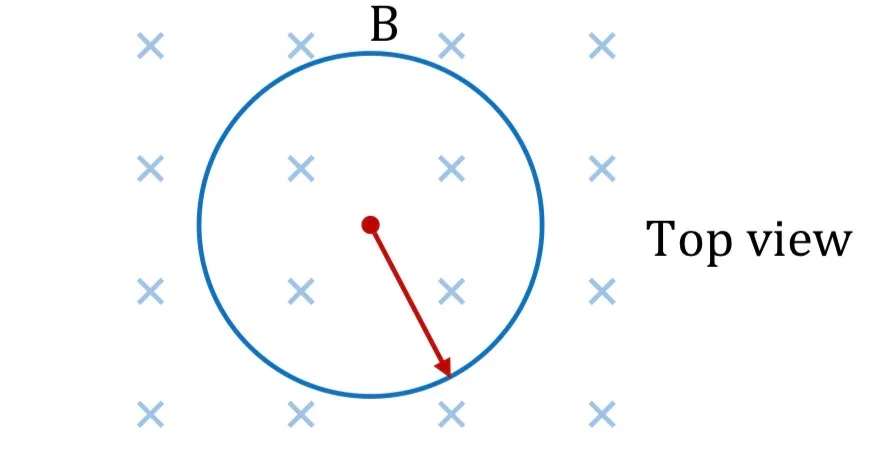
A non-conducting ring of mass m, radius r and charge Q rests on a rough horizontal surface in a transverse magnetic field whose magnitude increases at rate R. For the ring to remain in equilibrium, the coefficient of
Physics · Electromagnetic Induction
A non-conducting ring of mass m, radius r and charge Q rests on a rough horizontal surface in a transverse magnetic field whose magnitude increases at rate R. For the ring to remain in equilibrium, the coefficient of friction µ must be greater than:
Options
Related questions
- A capacitor C initially charged to q₀ is connected to an ideal inductor L at t = 0. At what earliest positive time are the energies in the…
- A coil produces a self-induced emf of magnitude 5 V when its current changes from 3 A to 2 A in 1 ms. What is its self-inductance?
- The graph shows the magnetic flux Φ(t) through a coil. Φ rises linearly from A to B, drops abruptly from B to C, then follows a curved arc…
- A uniform magnetic field is restricted within a region of radius r. The magnetic field changes with time at a rate d B d t \frac{dB}{dt} d…
- A thin semicircular conducting ring PQR of radius r falls with its plane vertical in a horizontal uniform magnetic field B, as shown. When…
- In the above diagram, a strong bar magnet is moving towards solenoid-2 from solenoid-1. The direction of induced current in solenoid-1 and…