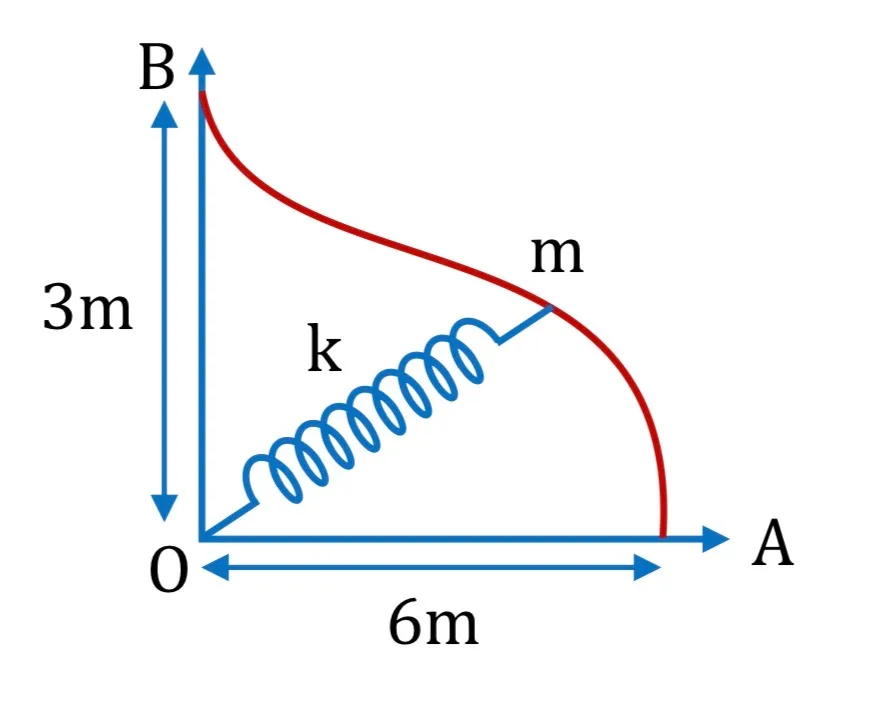
A small object with mass m = 2 kg is attached to the free end of an ideal spring with k = 10 N m⁻¹. The other end of the spring is connected to a fixed frictionless pivot located at the origin O as shown in the Figure.
Physics · Work , Power and Energy · Kinetic Energy & Work-Energy Theorem
A small object with mass m = 2 kg is attached to the free end of an ideal spring with k = 10 N m⁻¹. The other end of the spring is connected to a fixed frictionless pivot located at the origin O as shown in the Figure. The relaxed length of the spring is 1 m. An unspecified force F carries the object at rest from point A to point B. At point B, the object has the speed 5 m s⁻¹. The work done by the force F is (Neglect gravity) :-
Options
Related questions
- A particle travels along a circular path of radius 0.15 m and has speed 5.29 m/s at the bottom. Which listed value is closest to its angula…
- A ball of mass m starts a height h above the free end of a vertical spring of force constant k. It falls onto the spring and compresses it…
- A bob of mass m on a light string of length ℓ is given horizontal speed v₀ at the bottom of a vertical circle. At point P, where OP makes a…
- A crane lifts a 1000 kg mass vertically to a height of 20 m in 10 s. Find the average mechanical power of the crane. Take g = 9.8 m·s⁻².
- Two blocks with masses 100g and 200g are attached to the ends of springs A and B as shown in figure. The energy stored in A is E. The energ…
- If a rubber ball falls from a height h and rebounds upto the height of h/2. The percentage loss of total energy of the initial system as we…