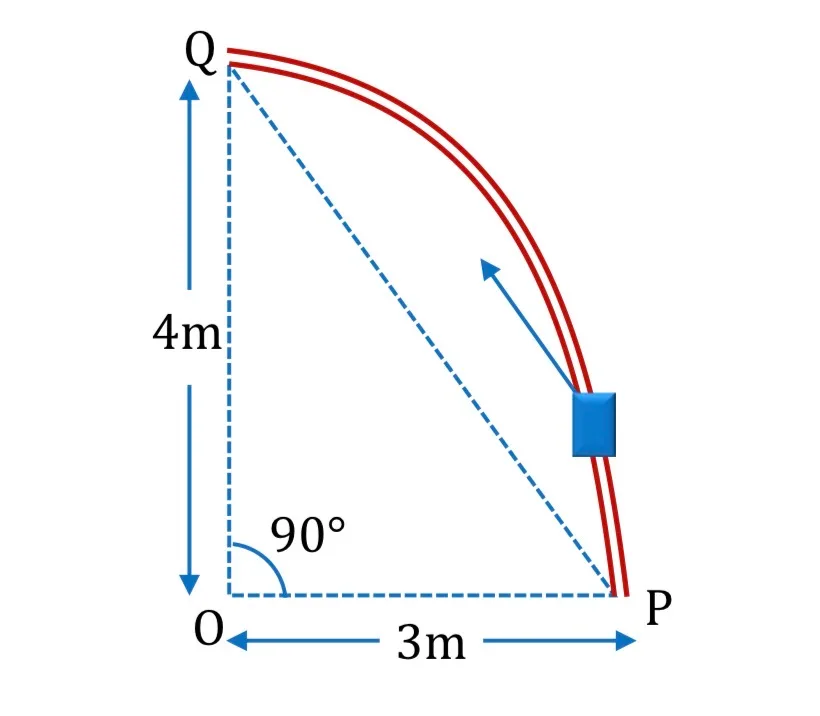
Consider an elliptically shaped rail PQ in the vertical plane with OP = 3 m and OQ = 4m. A block of mass 1 kg is pulled along the rail from P to Q with a force of 18 N, which is always parallel to line PQ (see the
Physics · Work , Power and Energy · Kinetic Energy & Work-Energy Theorem
Consider an elliptically shaped rail PQ in the vertical plane with OP = 3 m and OQ = 4m. A block of mass 1 kg is pulled along the rail from P to Q with a force of 18 N, which is always parallel to line PQ (see the figure given). Assuming no frictional losses, the kinetic energy of the block when it reaches Q is (n × 10) Joules. The value of n is (Take acceleration due to gravity = 10 ms–2)
Related questions
- A particle travels along a circular path of radius 0.15 m and has speed 5.29 m/s at the bottom. Which listed value is closest to its angula…
- A ball of mass m starts a height h above the free end of a vertical spring of force constant k. It falls onto the spring and compresses it…
- A bob of mass m on a light string of length ℓ is given horizontal speed v₀ at the bottom of a vertical circle. At point P, where OP makes a…
- A crane lifts a 1000 kg mass vertically to a height of 20 m in 10 s. Find the average mechanical power of the crane. Take g = 9.8 m·s⁻².
- Two blocks with masses 100g and 200g are attached to the ends of springs A and B as shown in figure. The energy stored in A is E. The energ…
- If a rubber ball falls from a height h and rebounds upto the height of h/2. The percentage loss of total energy of the initial system as we…