A convex lens of focal length 10 cm is cut through the optical axis into two semicircular halves. During cutting, 0.5 mm of glass is lost. The halves are rejoined and placed symmetrically 5 cm in front of an illuminated slit of wavelength 5000 Å. A screen is 90 cm beyond the lens.
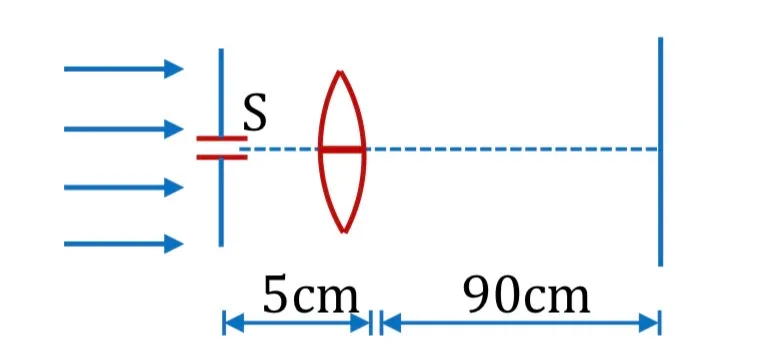
Sub-question 1
What is the separation between the two images of slit S?
Options
Sub-question 2
What is the fringe width on the screen?
Options
Sub-question 3
How many maxima are obtained on the screen?
Options
Related questions
- In Young’s double slit experiment we get 60 fringes in the field of view of monochromatic light of wavelength 4000Å. If we use monochromati…
- Unpolarized light in air strikes a material of refractive index 1.73 at Brewster’s angle. Which statement about reflected light and angle o…
- A third ideal polaroid is inserted between two crossed polaroids with its transmission axis at 22.5° to the first. If I₀ is the light inten…
- In interference and diffraction, energy is redistributed: some regions become darker and others brighter. Consider: A. This is consistent w…
- In Young’s double-slit experiment using wavelength λ, the intensity at a point where path difference is λ is K units. What is the intensity…
- Interference pattern can be observed due to superposition of the following waves: (I) y = a sin ωt (II) y = a sin 2ωt (III) y = a sin(ωt -…