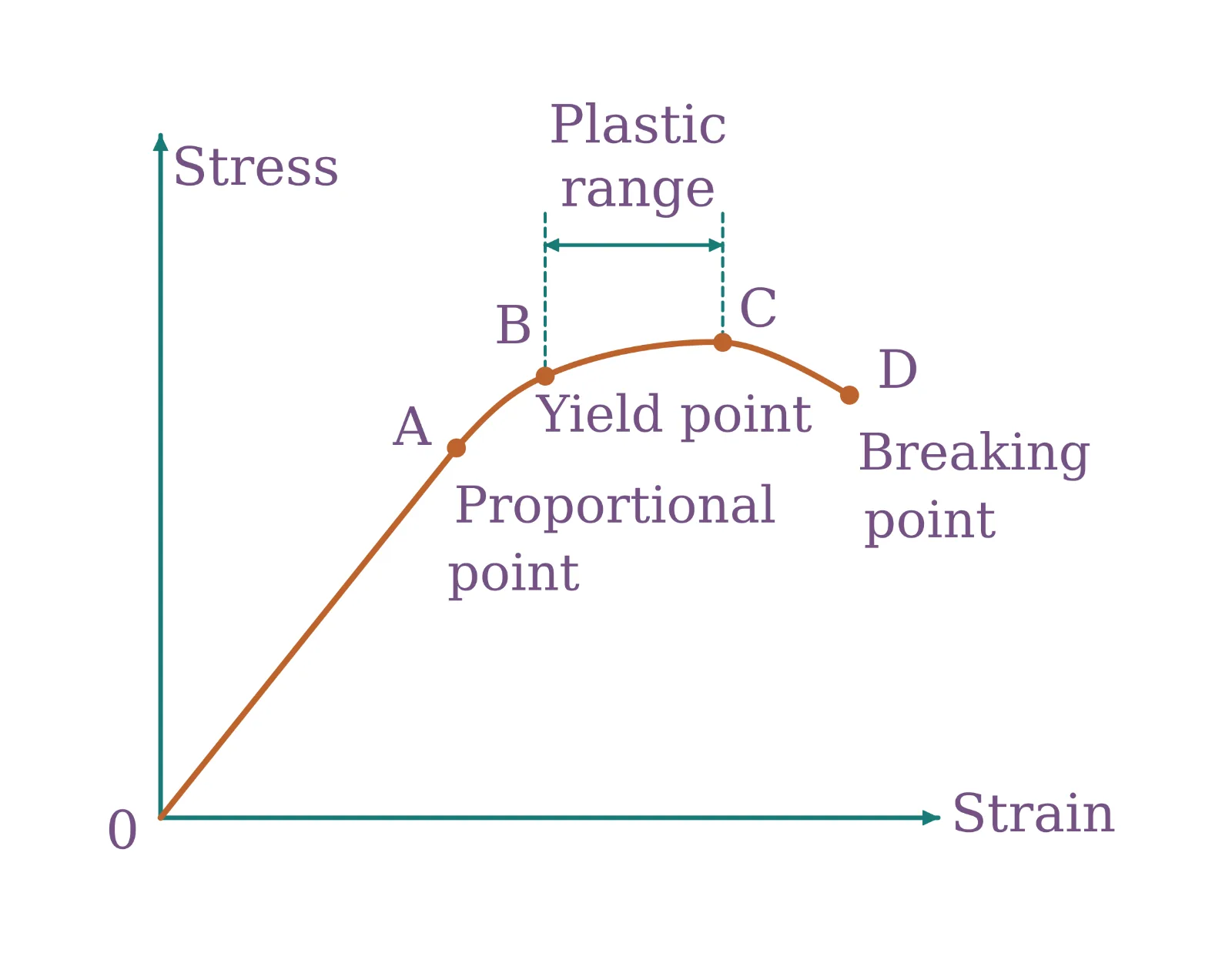
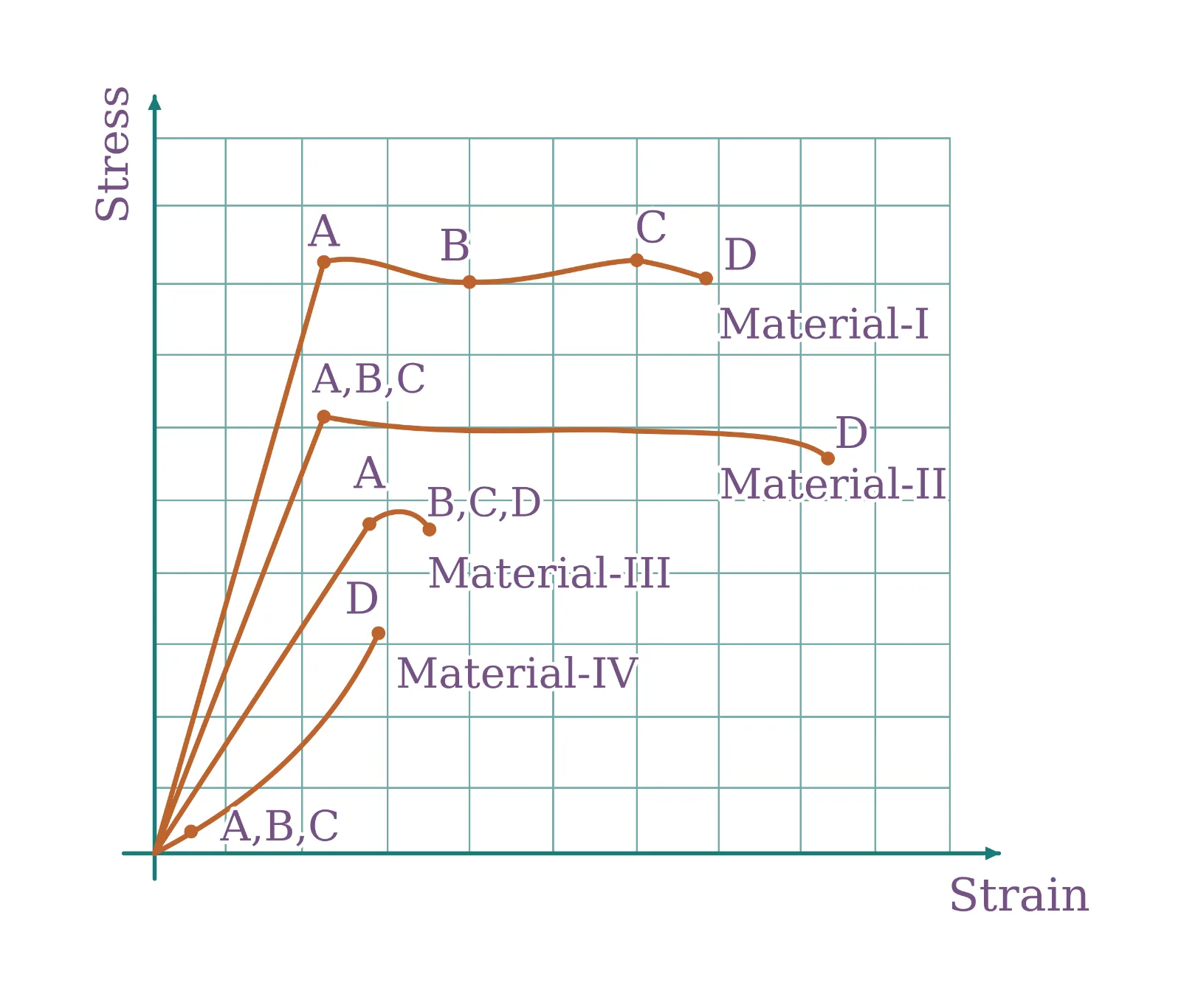
The figure shows a typical stress-strain curve and compares four materials. Below the proportional point, stress is proportional to strain. Below the yield point the material returns to its original dimensions; beyond
Physics · Properties of solid and fluid
The figure shows a typical stress-strain curve and compares four materials. Below the proportional point, stress is proportional to strain. Below the yield point the material returns to its original dimensions; beyond it, plastic deformation occurs. The material finally fractures at the breaking point.
Sub-question 1
Material which is good for making wires by stretching is
Options
Sub-question 2
Material which is most brittle is
Options
Sub-question 3
If you bought a new shoe which bites in the beginning and later on fits perfectly, then the material used to making the shoe is
Options
Related questions
- Two soap bubbles of radii 4 cm and 5 cm touch and form a common soap film AB. The surface tension is the same throughout. What is the radiu…
- The breaking stress of a wire depends upon
- Consider a very wide water tank with a vertical wall at x = L (see figure). A liquid of surface tension S and density ρ has a surface y(x)…
- Same-radius spherical balls of different densities σ fall through a liquid of density ρ. Which plot correctly shows their terminal velocity…
- Find the maximum weight of a needle of length 4 cm that can float on water of surface tension 0.073 N/m.
- A soap bubble of radius 1 mm is formed with detergent surface tension 2.5 × 10⁻² N/m. Its internal pressure equals the pressure of water at…