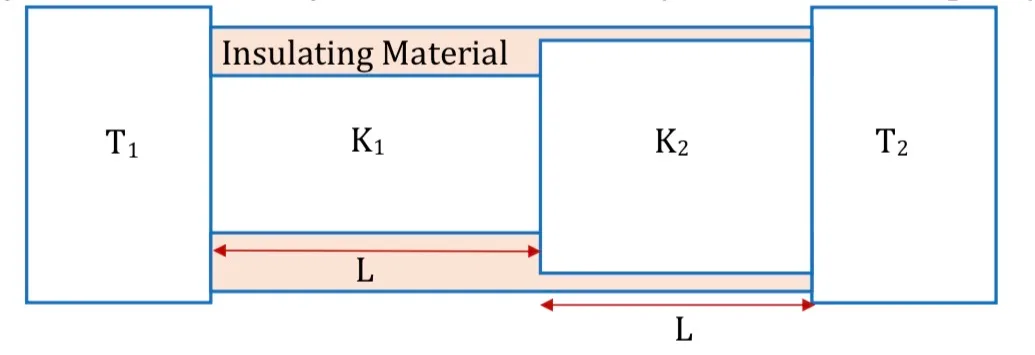
Two conducting cylinders of equal length but different radii are connected in series between two heat baths kept at temperatures T₁ = 300 K and T₂ = 100 K, as shown in the figure. The radius of the bigger cylinder is
Physics · Thermodynamics
Two conducting cylinders of equal length but different radii are connected in series between two heat baths kept at temperatures T₁ = 300 K and T₂ = 100 K, as shown in the figure. The radius of the bigger cylinder is twice that of the smaller one and the thermal conductivities of the materials of the smaller and the larger cylinders are K₁ and K₂ respectively. If the temperature at the junction of the two cylinders in the steady state is 200 K, then K₁/K₂ is to be determined.
Related questions
- The average kinetic energy of hydrogen molecules at 300 K is E. At the same temperature, the average kinetic energy of oxygen molecules wil…
- A system does 333 cal of work and its internal energy increases by 167 cal. How much heat is supplied to the system?
- If amount of heat given to a system be 50 J and work done on the system be 15 J, then change in internal energy of the system is
- The blackbody spectrum per unit wavelength at temperature T peaks at wavelength λ₀. At which wavelength does it peak at temperature 2T?
- A 30 L oxygen cylinder initially contains 18.20 mol of O₂. After some gas is withdrawn, its gauge pressure is 11 atm at 27°C. Calculate the…
- Three identical rods are thermally connected in series. The left and right rods have conductivity 2K and the middle rod conductivity K. The…