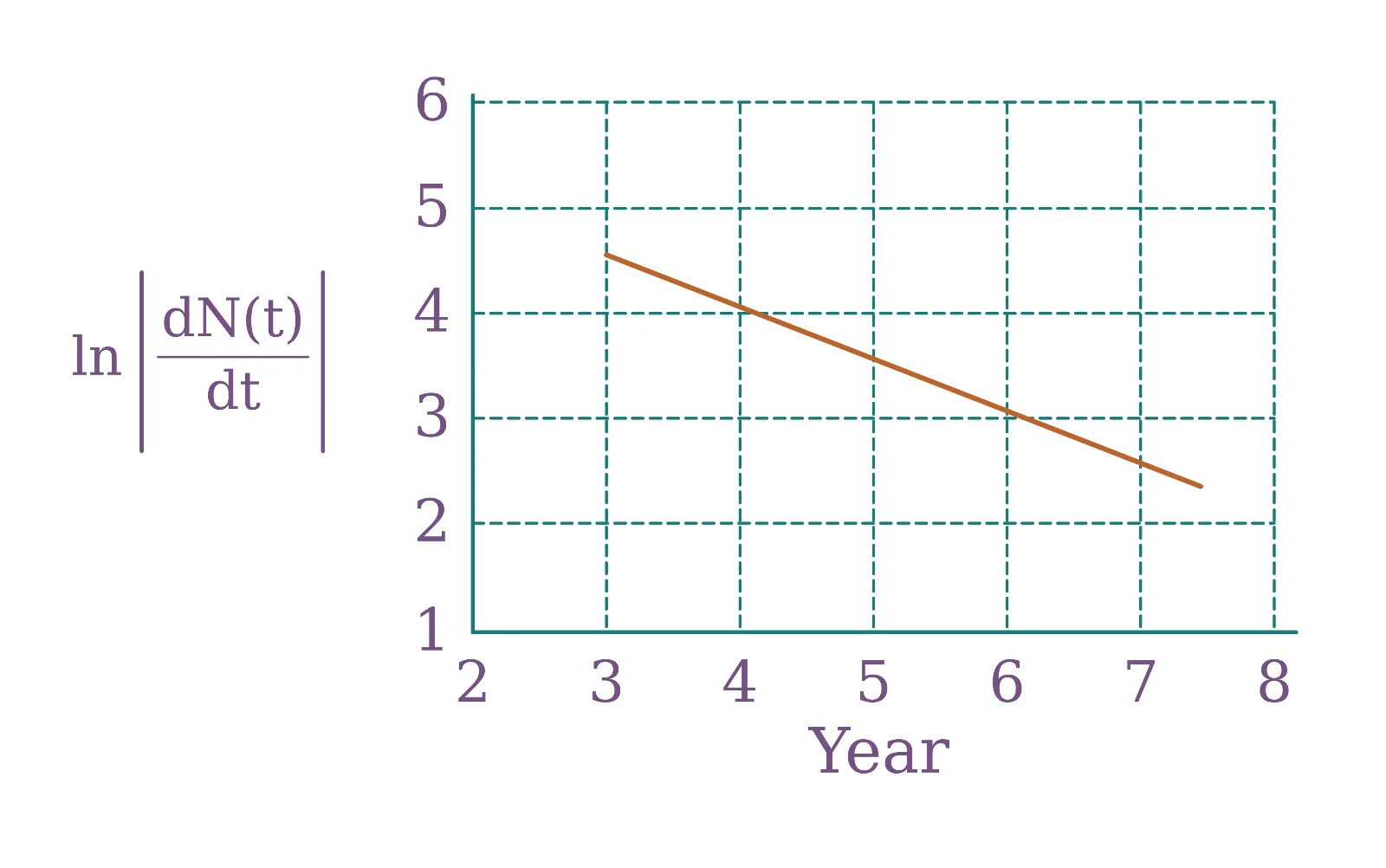
To determine a half-life, a student plots ln ∣ d N ( t ) d t ∣ dN (t ) dt ln d t d N ( t ) versus time t. Here d N ( t ) d t dN (t ) dt d t d N ( t ) is the rate of radioactive decay at time t.The graph shown
Physics · Nuclear physics · Radioactivity & Radioactive Decay Law
To determine a half-life, a student plots versus time t. Here is the rate of radioactive decay at time t.The graph shown is obtained. Find the half-life in years.
Options
Related questions
- A nucleus with mass number A and atomic number Z emits three α particles and two positrons. What is the ratio of neutrons to protons in the…
- Radium has a half-life of 1,600 years. What is its mean life, to the nearest 10 years?
- Which particles make up the nucleus of a typical atom, excluding hydrogen-1?
- A nucleus has density 2.29 × 10¹⁷ kg·m⁻³ and mass 19.926 × 10⁻²⁷ kg. Estimate its mass number A, given nuclear radius R = R₀A¹ᐟ³ with R₀ =…
- Four statements about nuclear volume and mass defect are given (A denotes mass number): A. Nuclear volume is proportional to A¹ᐟ³. B. Nucle…
- For the alpha-decay reaction ²³⁸U → ²³⁴Th + ⁴He, the respective atomic masses are 238.050 u, 234.043 u, and 4.003 u. Calculate the energy r…