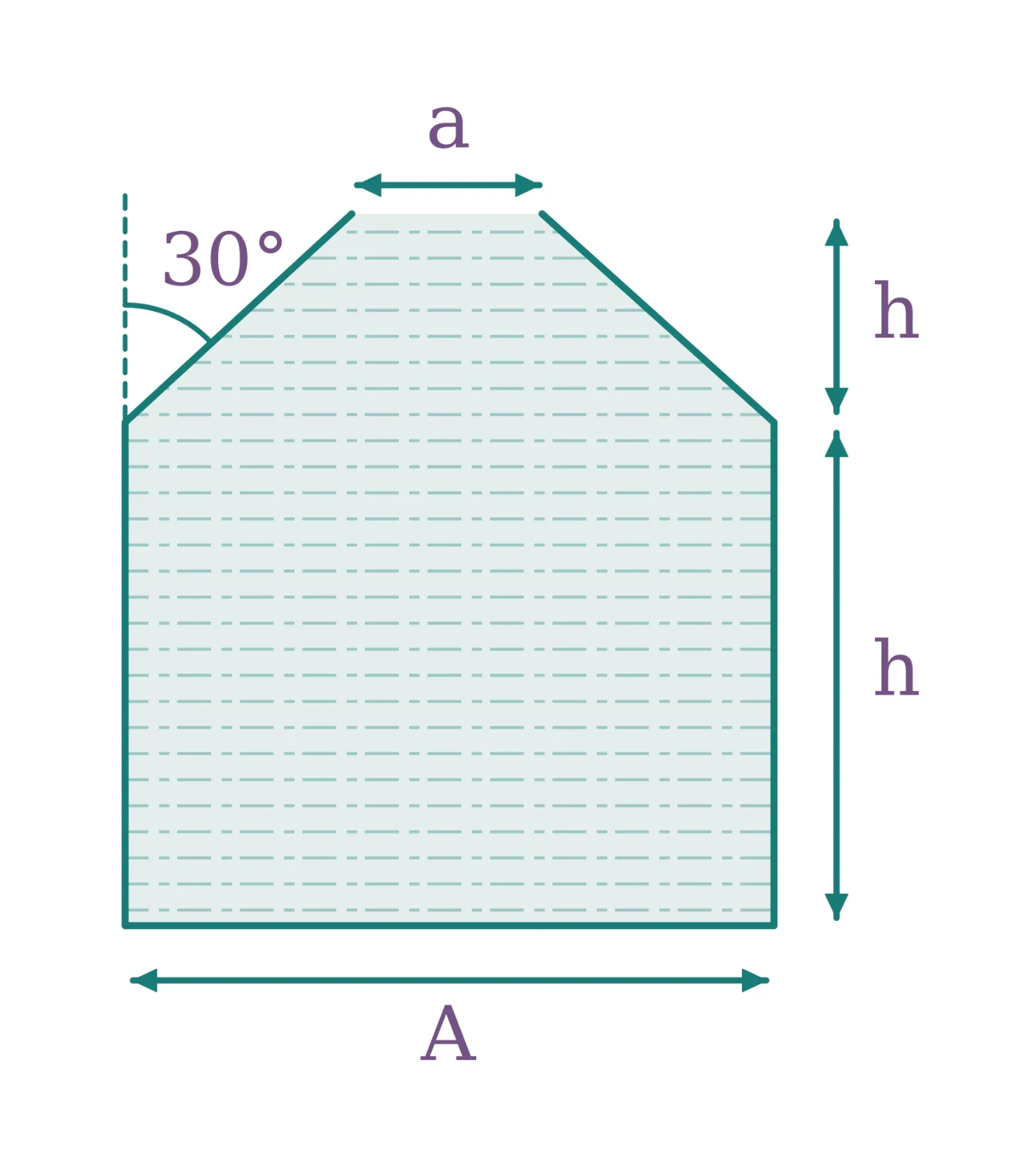
The vessel shown in the figure has two sections. The lower part is a rectangular vessel with area of cross-section A and height h. The upper part is a conical vessel of height h with base area ‘A’ and top area ‘a’ and the walls of the vessel are inclined at an angle 30° with the vertical. A liquid of density ρ fills both the sections up to a height 2h. Neglecting atmospheric pressure.
Options
Related questions
- A tank of height H is filled with water up to its top and rests on the floor. At what depth below the free surface should a small hole be m…
- A submarine can tolerate a maximum absolute pressure of 100 atm. What is the maximum depth below the surface of water? Use ρ = 1000 kg·m⁻³,…
- Water flows steadily through a horizontal pipe: cross-sectional areas at P and Q are 40 cm² and 20 cm². The pressure at P exceeds that at Q…
- A small hole of cross-sectional area 2 mm² is near the bottom of a fully filled open water tank of depth 2 m. Taking g = 10 m/s², find the…
- A U-tube open to air contains water. Immiscible oil is poured into one arm until its free surface stands 10 mm above the final water level…
- Two immiscible liquids of densities ρ and nρ (n > 1) each have height h in a container. A uniform solid cylinder of length L and density d…