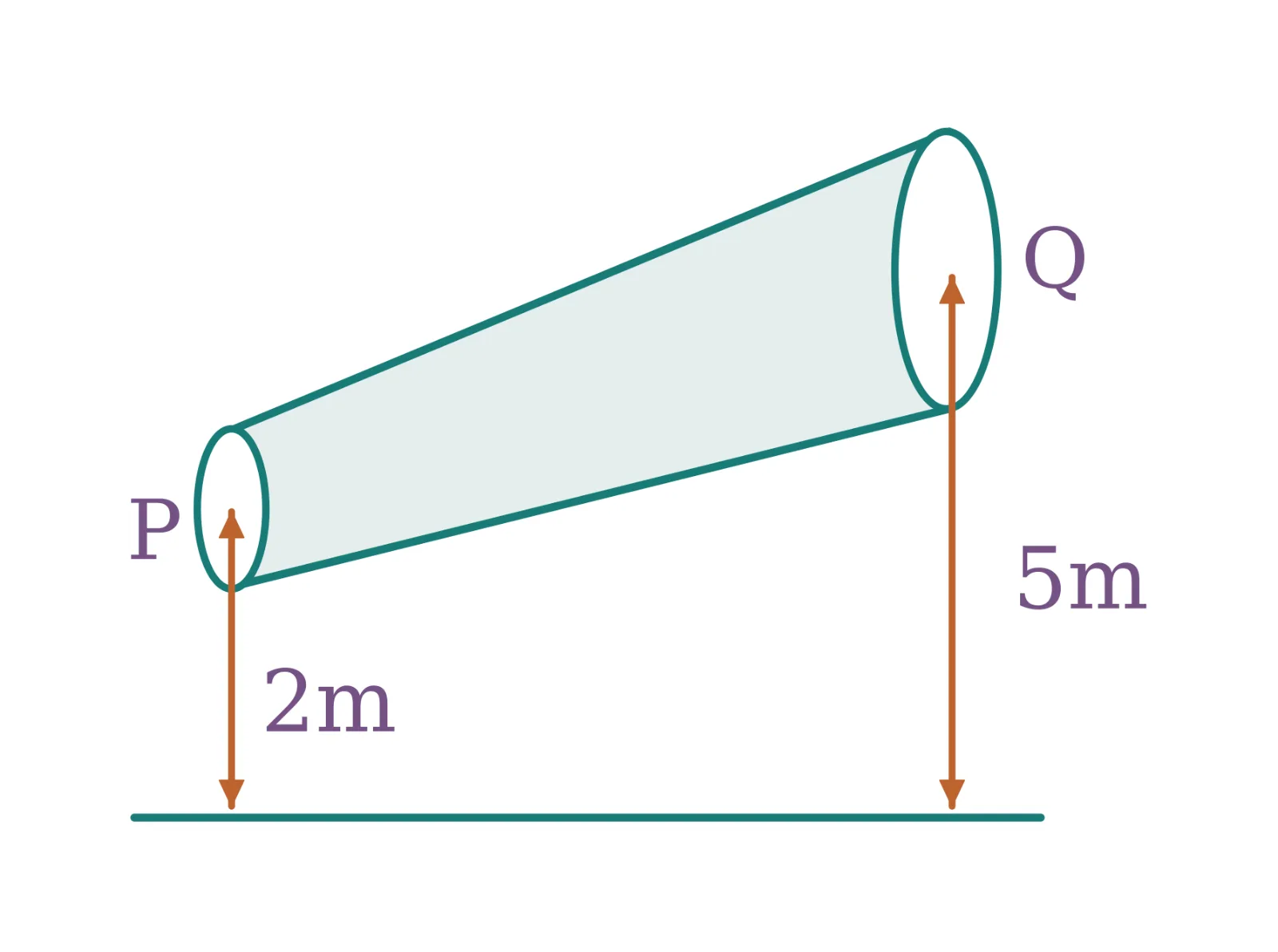
A non-viscous liquid of density 1000 kg m⁻³ flows steadily through an inclined tube. At P: height 2 m, area 4 × 10⁻³ m², speed 1 m s⁻¹. At Q: height 5 m, area 8 × 10⁻³ m². Find the work done per unit volume by pressure
Physics · Fluid Mechanics · Equation of Continuity and Bernoulli's Principle
A non-viscous liquid of density 1000 kg m⁻³ flows steadily through an inclined tube. At P: height 2 m, area 4 × 10⁻³ m², speed 1 m s⁻¹. At Q: height 5 m, area 8 × 10⁻³ m². Find the work done per unit volume by pressure force and by gravity as the fluid moves from P to Q.
Options
Related questions
- A tank of height H is filled with water up to its top and rests on the floor. At what depth below the free surface should a small hole be m…
- A submarine can tolerate a maximum absolute pressure of 100 atm. What is the maximum depth below the surface of water? Use ρ = 1000 kg·m⁻³,…
- Water flows steadily through a horizontal pipe: cross-sectional areas at P and Q are 40 cm² and 20 cm². The pressure at P exceeds that at Q…
- A small hole of cross-sectional area 2 mm² is near the bottom of a fully filled open water tank of depth 2 m. Taking g = 10 m/s², find the…
- A U-tube open to air contains water. Immiscible oil is poured into one arm until its free surface stands 10 mm above the final water level…
- Two immiscible liquids of densities ρ and nρ (n > 1) each have height h in a container. A uniform solid cylinder of length L and density d…