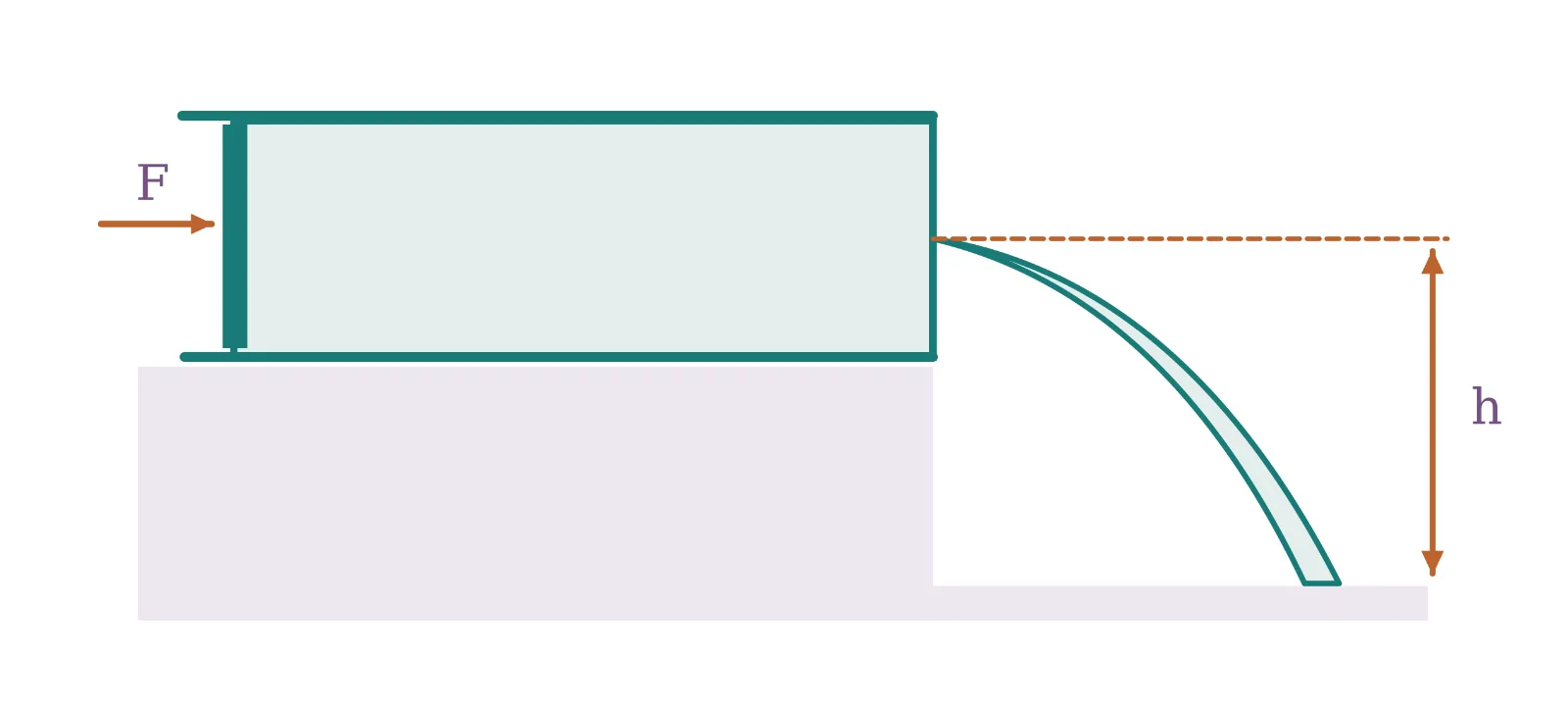
An ideal liquid of density ρ is filled in a horizontally fixed syringe fitted with piston. There is no friction between the piston and the inner surface of the syringe. Cross-section area of the syringe is A. At one
Physics · Fluid Mechanics · Equation of Continuity and Bernoulli's Principle
An ideal liquid of density ρ is filled in a horizontally fixed syringe fitted with piston. There is no friction between the piston and the inner surface of the syringe. Cross-section area of the syringe is A. At one end of the syringe, an orifice of negligible cross-section area is made. When the piston is pushed into the syringe, the liquid comes out of the orifice following parabolic path and falls on the ground. With what speed the liquid strikes the ground? Neglect the air drag :-
Options
Related questions
- A tank of height H is filled with water up to its top and rests on the floor. At what depth below the free surface should a small hole be m…
- A submarine can tolerate a maximum absolute pressure of 100 atm. What is the maximum depth below the surface of water? Use ρ = 1000 kg·m⁻³,…
- Water flows steadily through a horizontal pipe: cross-sectional areas at P and Q are 40 cm² and 20 cm². The pressure at P exceeds that at Q…
- A small hole of cross-sectional area 2 mm² is near the bottom of a fully filled open water tank of depth 2 m. Taking g = 10 m/s², find the…
- A U-tube open to air contains water. Immiscible oil is poured into one arm until its free surface stands 10 mm above the final water level…
- Two immiscible liquids of densities ρ and nρ (n > 1) each have height h in a container. A uniform solid cylinder of length L and density d…