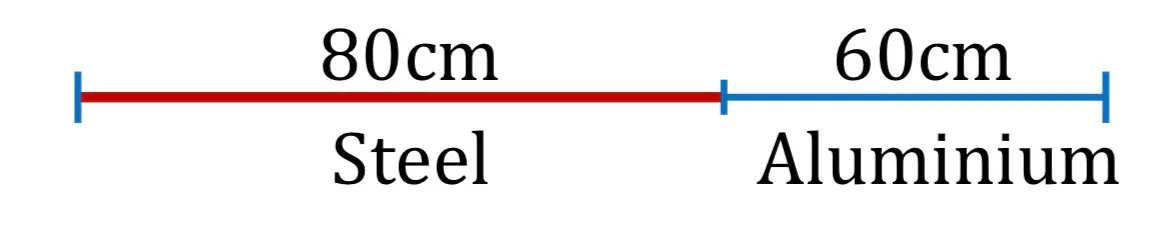
Figure shows an aluminium wire of length 60 cm joined to a steel wire of length 80 cm and stretched between two fixed supports. The tension produced is 40 N. The cross-sectional area of the steel wire is 1.0 mm² and that of the aluminium wire is 3.0 mm². What could be the minimum frequency of a tuning fork which can produce standing waves in the system with the joint as a node? The density of aluminium is 2.6 g cm⁻³ and that of steel is 7.8 g cm⁻³.
Related questions
- The minimum intensity of sound is zero at a point due to two sources of nearly equal frequencies, when
- A pipe open at both ends has fundamental frequency f. The pipe is placed vertically into water until half its length is submerged. What is…
- A travelling harmonic wave is y(x,t) = 2.0 cos[2π(10t - 0.0080x + 0.35)], where x and y are in cm and t is in seconds. Find the phase diffe…
- For sound waves, let n be the number of displacement nodes in the 5th harmonic of an open-ended pipe. Let m be the number of nodes in the 9…
- Two semi-infinite strings of linear mass densities μ₁ and μ₂ are joined and maintained under the same tension. A transverse wave is inciden…
- A transverse wave travels from a heavier string segment to a lighter string segment. The two strings are joined smoothly and remain under t…