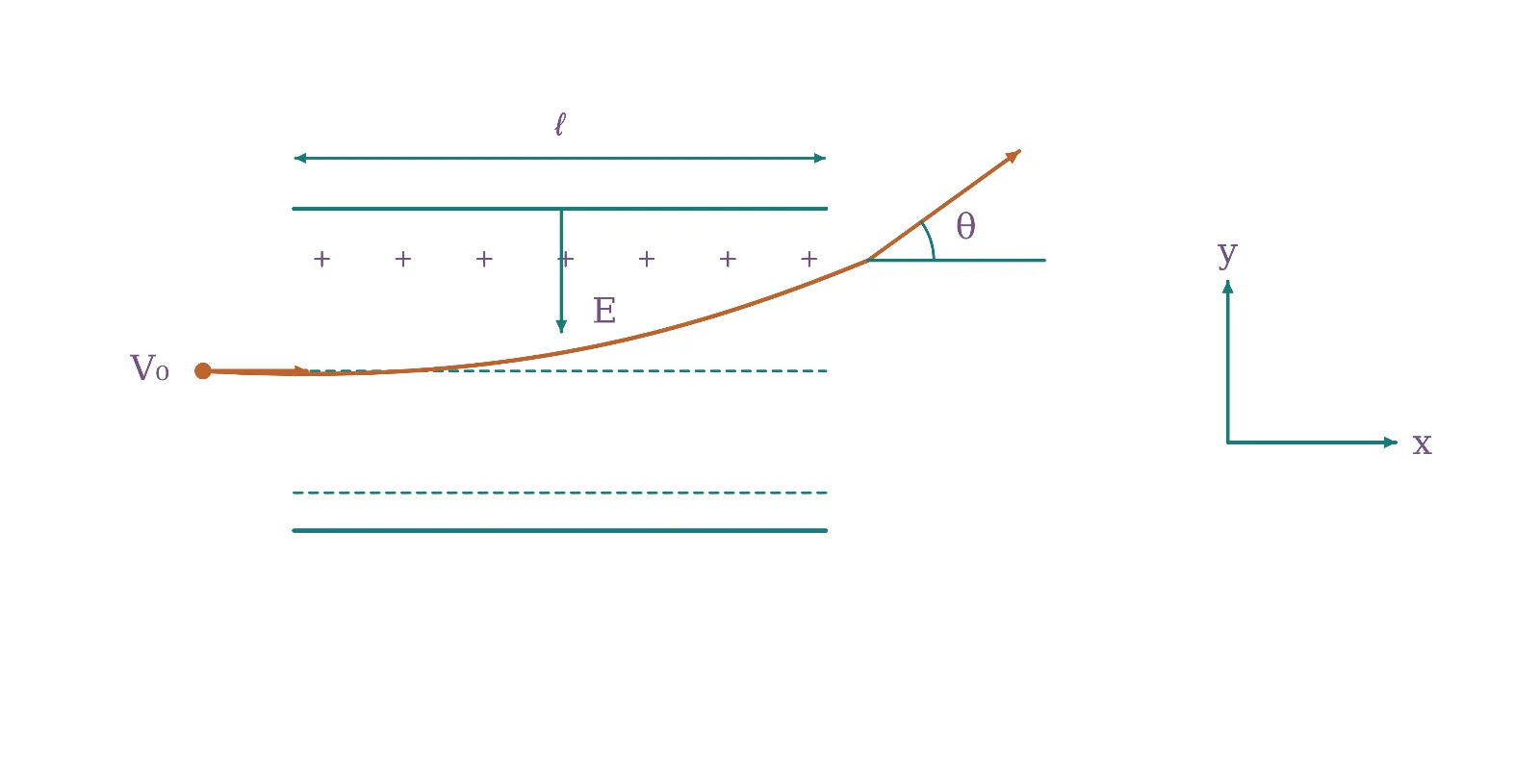
A uniform electric field E = 91 × 10⁻⁶ V m⁻¹ is created between two parallel, charged plates as shown in figure. An electron enters the field symmetrically between the plates with a speed v₀ = 4 × 10³ m s⁻¹. The length
Physics · Electrostatic · Electric Field & Superposition Principle
A uniform electric field E = 91 × 10⁻⁶ V m⁻¹ is created between two parallel, charged plates as shown in figure. An electron enters the field symmetrically between the plates with a speed v₀ = 4 × 10³ m s⁻¹. The length of each plate is l = 1m. Find the angle of deviation of the path of the electron as it comes out of the field. (Mass of the electron is m = 9.1 × 10⁻³¹ kg and its charge is e = -1.6 × 10⁻¹⁹ C).
Options
Related questions
- Three positive and three negative charges, all of equal magnitude, occupy the six vertices P, Q, R, S, T and U in cyclic order around a reg…
- Identical conducting spheres A and B, each carrying charge q, repel with force F. A third identical uncharged sphere C first touches A, the…
- An electric dipole of moment 5 × 10⁻⁶ C·m is initially aligned with a uniform electric field 4 × 10⁵ N/C. It is rotated to 60° relative to…
- Which statements about an electrostatically charged conductor are correct? A. Electric field inside the conducting material is zero. B. Ele…
- A unit positive test charge is slowly moved from point A at distance 2R to point B at distance 3R from the centre of a uniformly positively…
- A point charge Q is located in a cavity within an isolated conducting sphere. Point A is inside the cavity; B and C are outside the sphere…