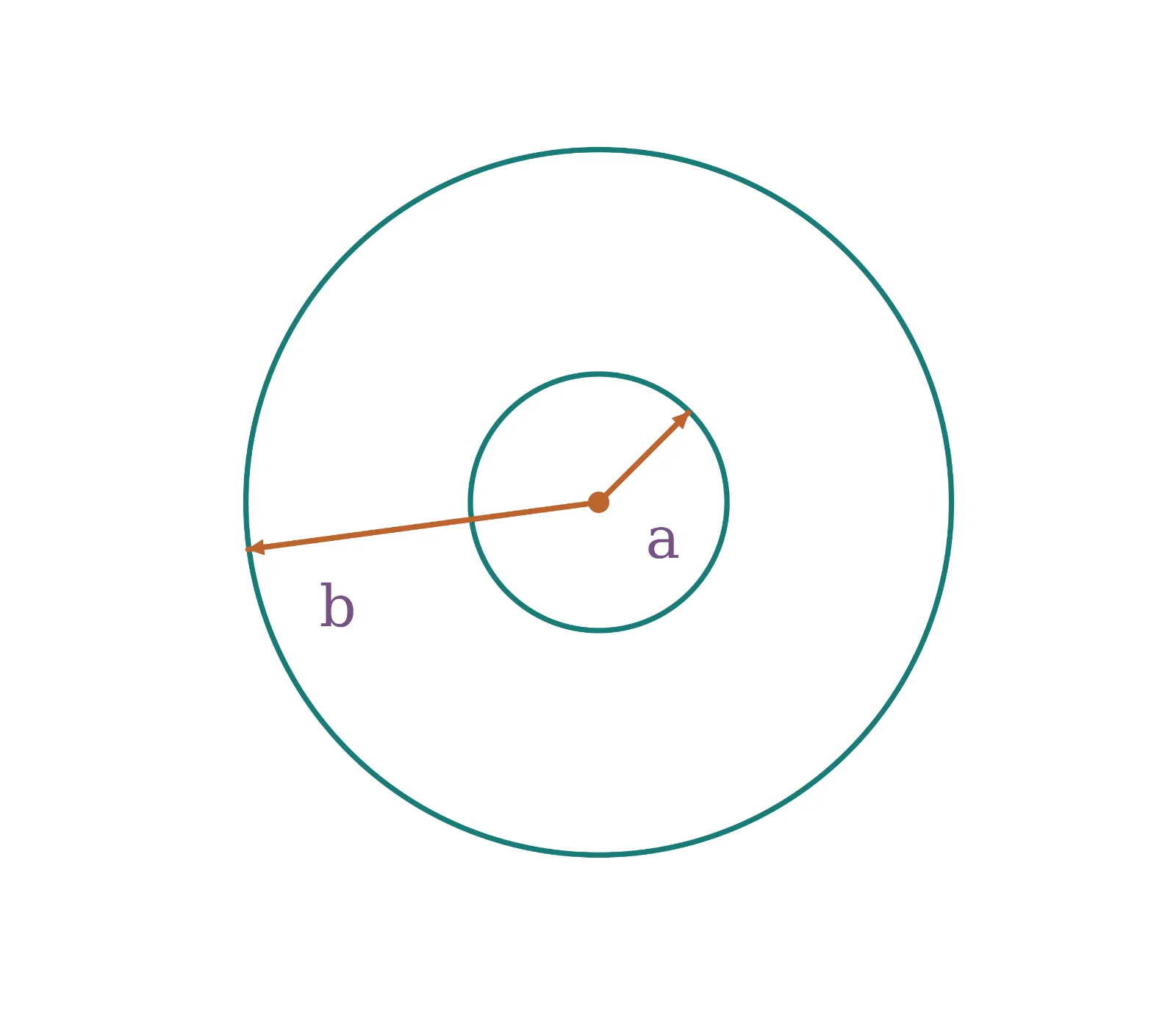
Outer cylinder of the coaxial non-conductor of radius ‘b’ is given a positive potential V relative to the inner cylinder of radius ‘a’ as shown in the figure (charge distribution is uniform). A charge q (mass = m) is set free with negligible velocity at the surface of the inner cylinder. Find the velocity (in m s⁻¹), when it hits the outer cylinder. [Consider V = 10, q = -20, m = 1 all in S.I. Units]
Physics · Electrostatic
Outer cylinder of the coaxial non-conductor of radius ‘b’ is given a positive potential V relative to the inner cylinder of radius ‘a’ as shown in the figure (charge distribution is uniform). A charge q (mass = m) is set free with negligible velocity at the surface of the inner cylinder. Find the velocity (in m s⁻¹), when it hits the outer cylinder. [Consider V = 10, q = -20, m = 1 all in S.I. Units]