An infinitely long thin non-conducting wire is parallel to the z-axis and carries a uniform line charge density λ. It pierces a thin non-conducting spherical shell of radius R in such a way that the arc PQ subtends an
Physics · Electrostatic · Electric Flux & Gauss’s Law
An infinitely long thin non-conducting wire is parallel to the z-axis and carries a uniform line charge density λ. It pierces a thin non-conducting spherical shell of radius R in such a way that the arc PQ subtends an angle 120° at the centre O of the spherical shell, as shown in the figure. The permittivity of free space is ε₀. Which of the following statements is (are) true ?
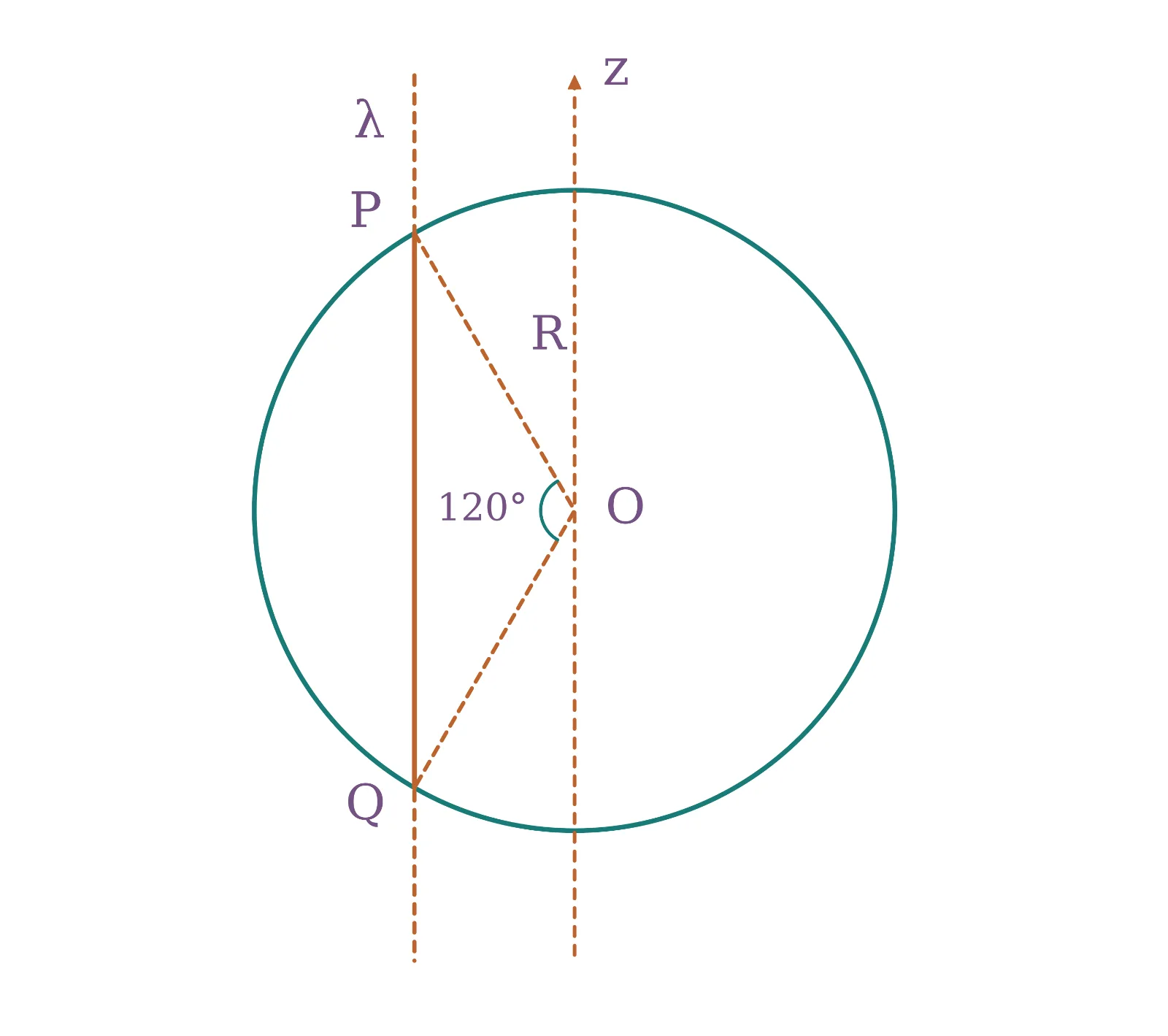
Select all that apply
Related questions
- Three positive and three negative charges, all of equal magnitude, occupy the six vertices P, Q, R, S, T and U in cyclic order around a reg…
- Identical conducting spheres A and B, each carrying charge q, repel with force F. A third identical uncharged sphere C first touches A, the…
- An electric dipole of moment 5 × 10⁻⁶ C·m is initially aligned with a uniform electric field 4 × 10⁵ N/C. It is rotated to 60° relative to…
- Which statements about an electrostatically charged conductor are correct? A. Electric field inside the conducting material is zero. B. Ele…
- A unit positive test charge is slowly moved from point A at distance 2R to point B at distance 3R from the centre of a uniformly positively…
- A point charge Q is located in a cavity within an isolated conducting sphere. Point A is inside the cavity; B and C are outside the sphere…