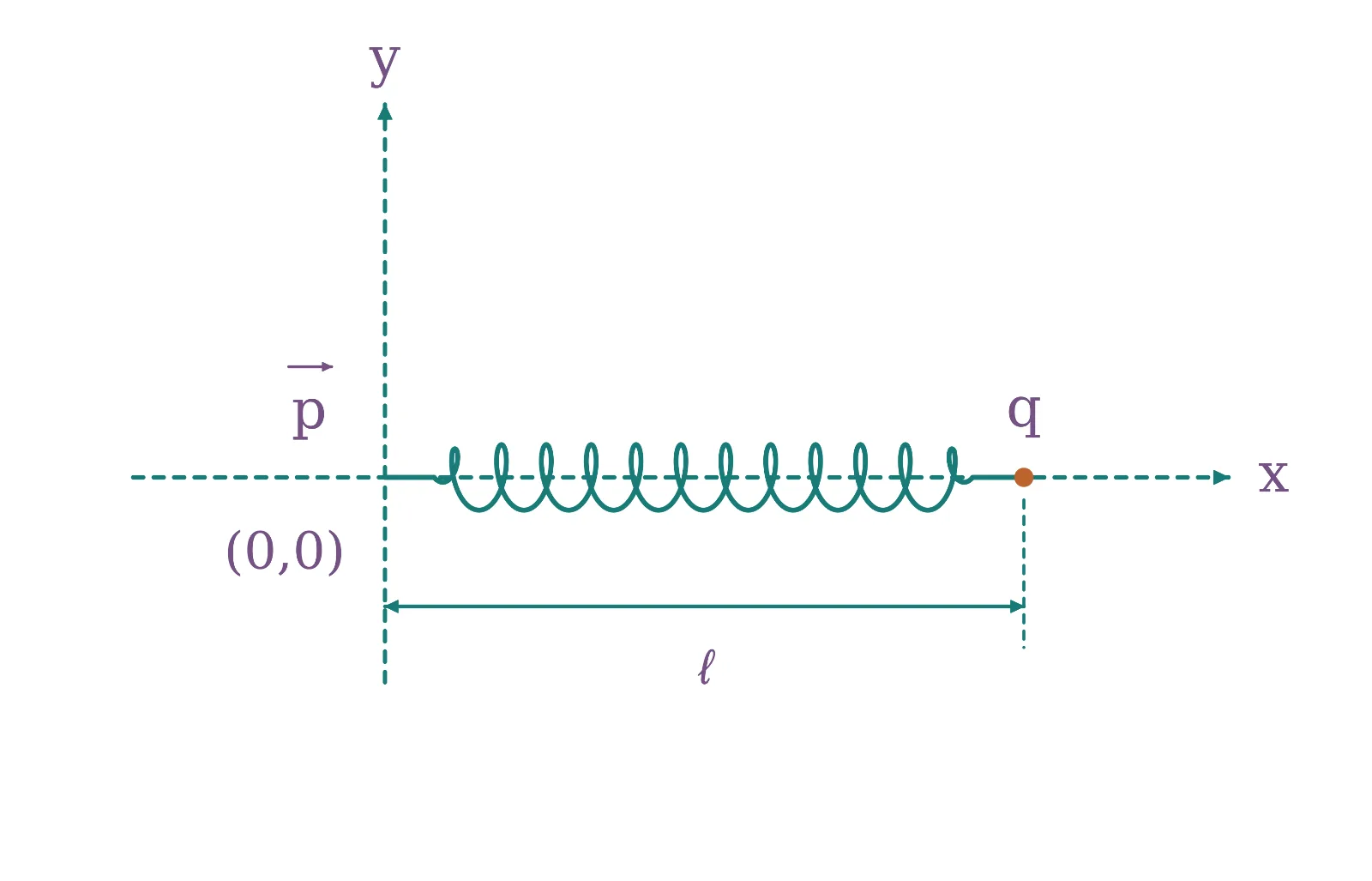
One end of a spring of negligible unstretched length and spring constant k is fixed at the origin (0, 0). A point particle of mass m carrying a positive charge q is attached at its other end. The entire system is kept
Physics · Electrostatic · Electric Dipole & Dipole Moment
One end of a spring of negligible unstretched length and spring constant k is fixed at the origin (0, 0). A point particle of mass m carrying a positive charge q is attached at its other end. The entire system is kept on a smooth horizontal surface. When a point dipole 𝐩 pointing towards the charge q is fixed at the origin, the spring gets stretched to a length λ and attains a new equilibrium position (see figure below). If the point mass is now displaced slightly by Δλ << λ from its equilibrium position and released, it is found to oscillate at frequency . The value of δ is.
Related questions
- Three positive and three negative charges, all of equal magnitude, occupy the six vertices P, Q, R, S, T and U in cyclic order around a reg…
- Identical conducting spheres A and B, each carrying charge q, repel with force F. A third identical uncharged sphere C first touches A, the…
- An electric dipole of moment 5 × 10⁻⁶ C·m is initially aligned with a uniform electric field 4 × 10⁵ N/C. It is rotated to 60° relative to…
- Which statements about an electrostatically charged conductor are correct? A. Electric field inside the conducting material is zero. B. Ele…
- A unit positive test charge is slowly moved from point A at distance 2R to point B at distance 3R from the centre of a uniformly positively…
- A point charge Q is located in a cavity within an isolated conducting sphere. Point A is inside the cavity; B and C are outside the sphere…