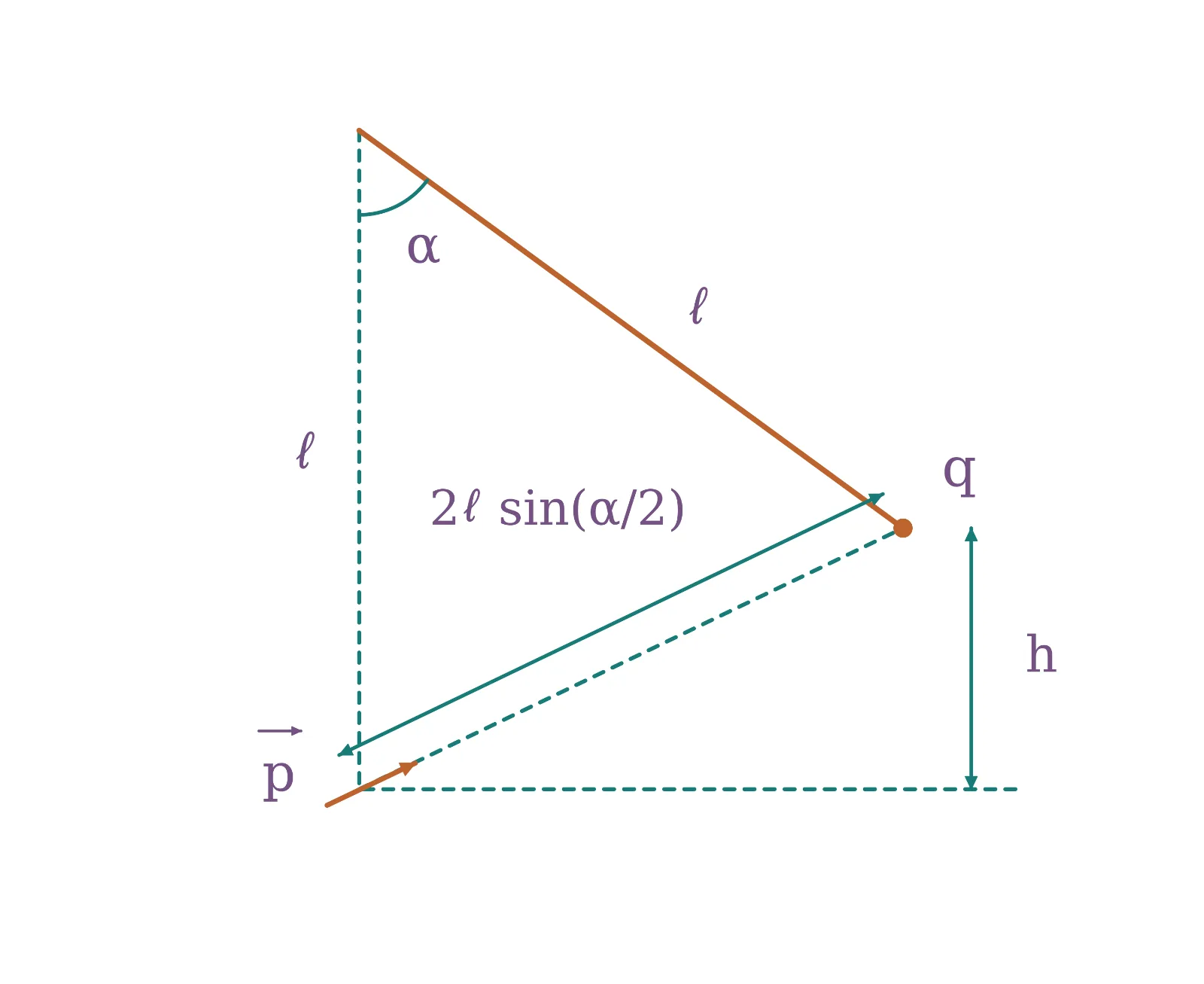
A point charge q of mass m is suspended vertically by a string of length λ. A point dipole of dipole moment 𝐩 is now brought towards q from infinity so that the charge moves away. The final equilibrium position of the
Physics · Electrostatic · Electric Dipole & Dipole Moment
A point charge q of mass m is suspended vertically by a string of length λ. A point dipole of dipole moment 𝐩 is now brought towards q from infinity so that the charge moves away. The final equilibrium position of the system including the direction of the dipole, the angles and distances is shown in the figure below. If the work done in bringing the dipole to this position is N × (mgh), where g is the acceleration due to gravity, then the value of N is . (Note that for three coplanar forces keeping a point mass in equilibrium, is the same for all forces, where F is any one of the forces and θ is the angle between the other two forces)
Related questions
- Three positive and three negative charges, all of equal magnitude, occupy the six vertices P, Q, R, S, T and U in cyclic order around a reg…
- Identical conducting spheres A and B, each carrying charge q, repel with force F. A third identical uncharged sphere C first touches A, the…
- An electric dipole of moment 5 × 10⁻⁶ C·m is initially aligned with a uniform electric field 4 × 10⁵ N/C. It is rotated to 60° relative to…
- Which statements about an electrostatically charged conductor are correct? A. Electric field inside the conducting material is zero. B. Ele…
- A unit positive test charge is slowly moved from point A at distance 2R to point B at distance 3R from the centre of a uniformly positively…
- A point charge Q is located in a cavity within an isolated conducting sphere. Point A is inside the cavity; B and C are outside the sphere…