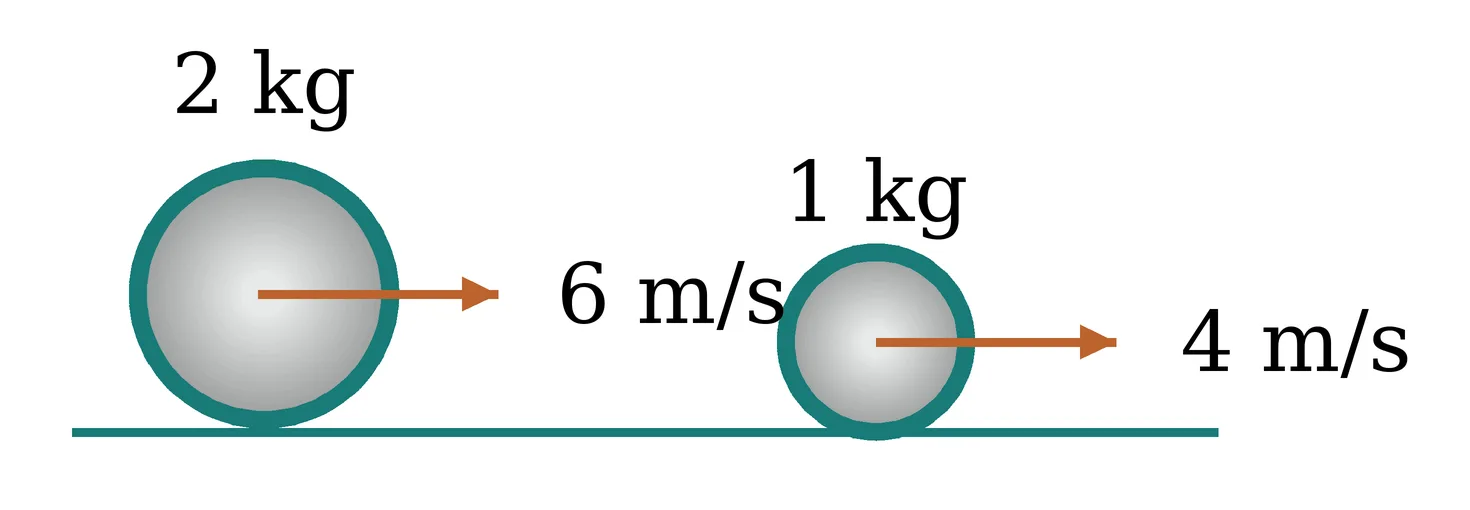
For a normal one-dimensional collision, impulse on each body is equal and opposite and e = |relative speed of separation|/|relative speed of approach|. In the shown case a 2 kg block moves at 6 m s⁻¹ and a 1 kg block
Physics · Center of maas , Momentum and Collision · Collisions: Elastic & Inelastic
For a normal one-dimensional collision, impulse on each body is equal and opposite and e = |relative speed of separation|/|relative speed of approach|. In the shown case a 2 kg block moves at 6 m s⁻¹ and a 1 kg block at 4 m s⁻¹ in the same direction before collision.
Sub-question 1
If the collision is elastic, the impulse magnitude J is:
Options
Sub-question 2
For what value of J will the 2 kg block change direction?
Options
Related questions
- A ball of mass 0.5 kg is dropped from a height of 40 m. The ball hits the ground and rises to a height of 10 m. The impulse imparted to the…
- Two equal point masses (each 1 unit) move with equal constant angular speed in opposite directions on a frictionless circular wire of unit…
- Bob B of mass m hangs initially at rest on a light string of length 10 m. Another point mass A of equal mass m strikes B horizontally at 10…
- The centre of mass of a body ........
- A uniform wire of length ℓ is bent into the shape of a V as shown, with angle 60° at vertex A. The distance of its centre of mass from A is:
- The centre of mass of a non-uniform rod of length L has linear mass density λ = kx²/L, where x is measured from one end. The distance of it…