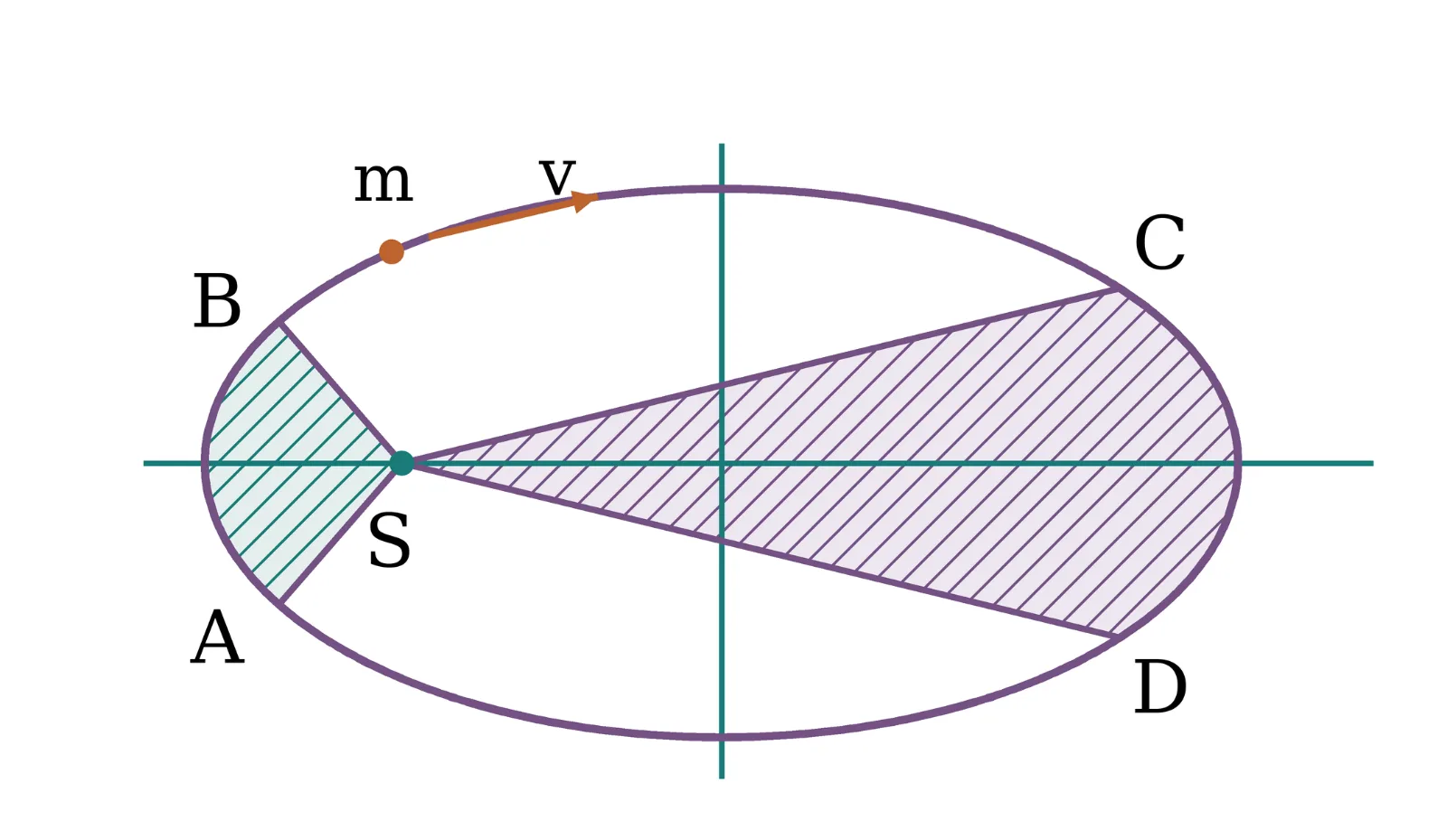
The figure shows an elliptical orbit of a planet around the Sun S. The shaded area SCD is twice the shaded area SAB. If t₁ is the time to move from C to D and t₂ is the time to move from A to B, then:
Physics · Gravitation · Satellites, Orbital Motion & Kepler’s Laws
The figure shows an elliptical orbit of a planet around the Sun S. The shaded area SCD is twice the shaded area SAB. If t₁ is the time to move from C to D and t₂ is the time to move from A to B, then:
Options
Related questions
- A particle of mass m is a distance r from the centre of a uniform thin spherical shell of mass M and radius R. Which graph represents the m…
- The Sun rotates once every 27 days. Assuming it remains a uniform-density sphere and doubles its radius without any external torque, calcul…
- The radius of Mars’s orbit around the Sun is about four times the radius of Mercury’s orbit. If Mars takes 687 Earth days per revolution, e…
- A body weighs 48 N at Earth’s surface. What gravitational force acts on it at height h = R/3 above the surface (R is Earth’s radius)?
- Find the work required to raise a mass m from the Earth’s surface to an altitude equal to the Earth’s radius R. Let g denote surface gravit…
- Planets P₁ and P₂ have equal masses and radii R₁ and R₂, with R₂ = R₁/2. If their escape speeds are v₁ and v₂, find v₂/v₁.