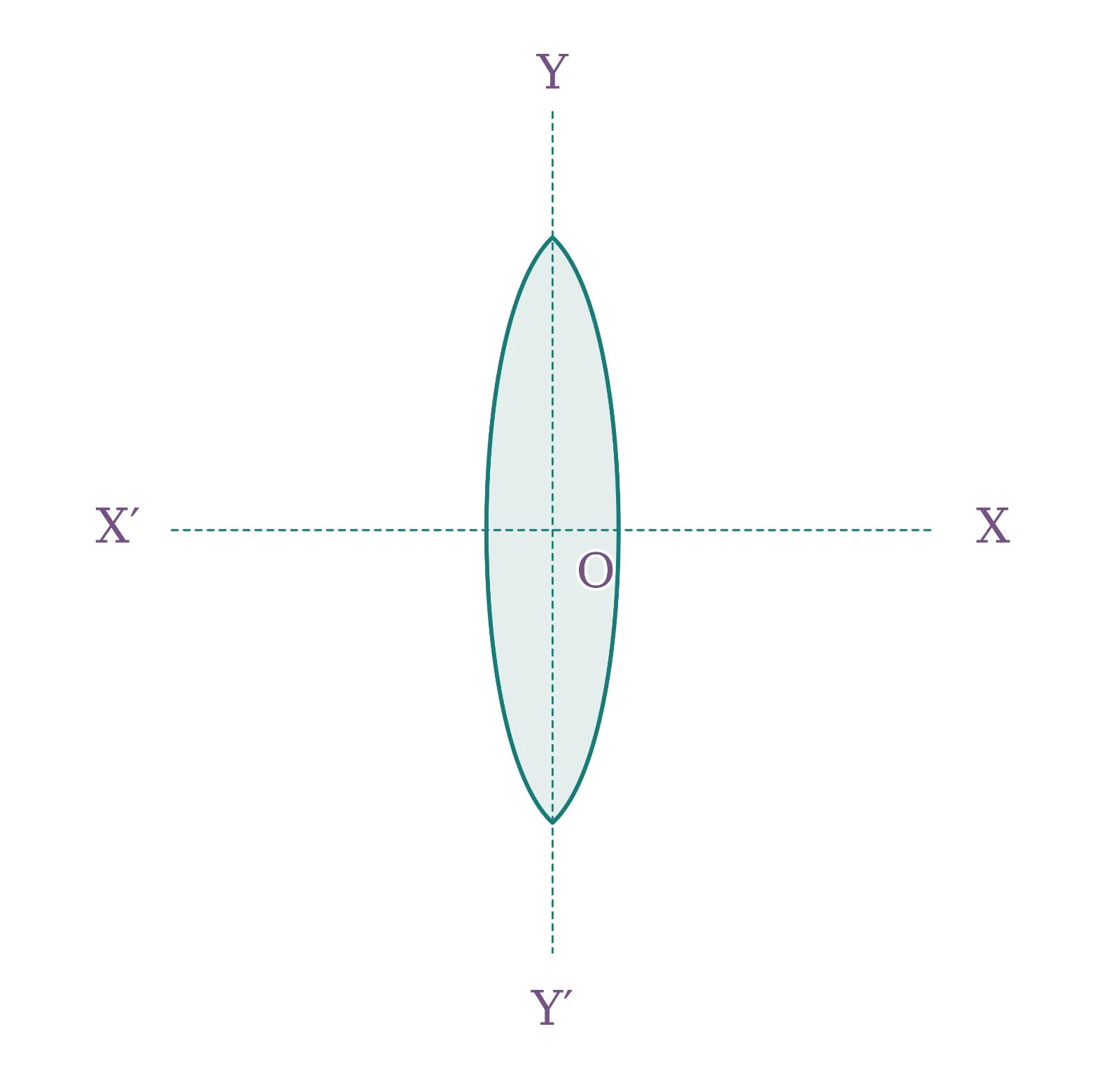
An equiconvex lens is cut into halves along (i) XX′ and (ii) YY′ as shown in the figure. Let f, f′, f″ denote focal lengths of the complete lens, each half in case (i), and each half in case (ii), respectively. Which
Physics · Geometrical optics · Lenses, Lens Combinations & Silvered Lenses
An equiconvex lens is cut into halves along (i) XX′ and (ii) YY′ as shown in the figure. Let f, f′, f″ denote focal lengths of the complete lens, each half in case (i), and each half in case (ii), respectively. Which relation is correct?
Options
Related questions
- A prism has refractive index √2 and apex angle 60°. What is the angle of incidence at minimum deviation?
- The convex surface of a thin plano-convex lens of refractive index 1.5 has radius 10 cm. If its plane surface is silvered, what is the magn…
- Match the corresponding entries of Column I with Column II.( Here m is mirror magnification.)
- Statement I: Image formation needs regular reflection and/or refraction. Statement II: The variety in colours of objects around us is due t…
- A small coin is resting on the bottom of a beaker filled with liquid. A ray of light from the coin strikes the surface of the liquid and mo…
- In the figure shown, what is the equivalent focal length of the combination of lenses? (Assume that all lenses are thin.)