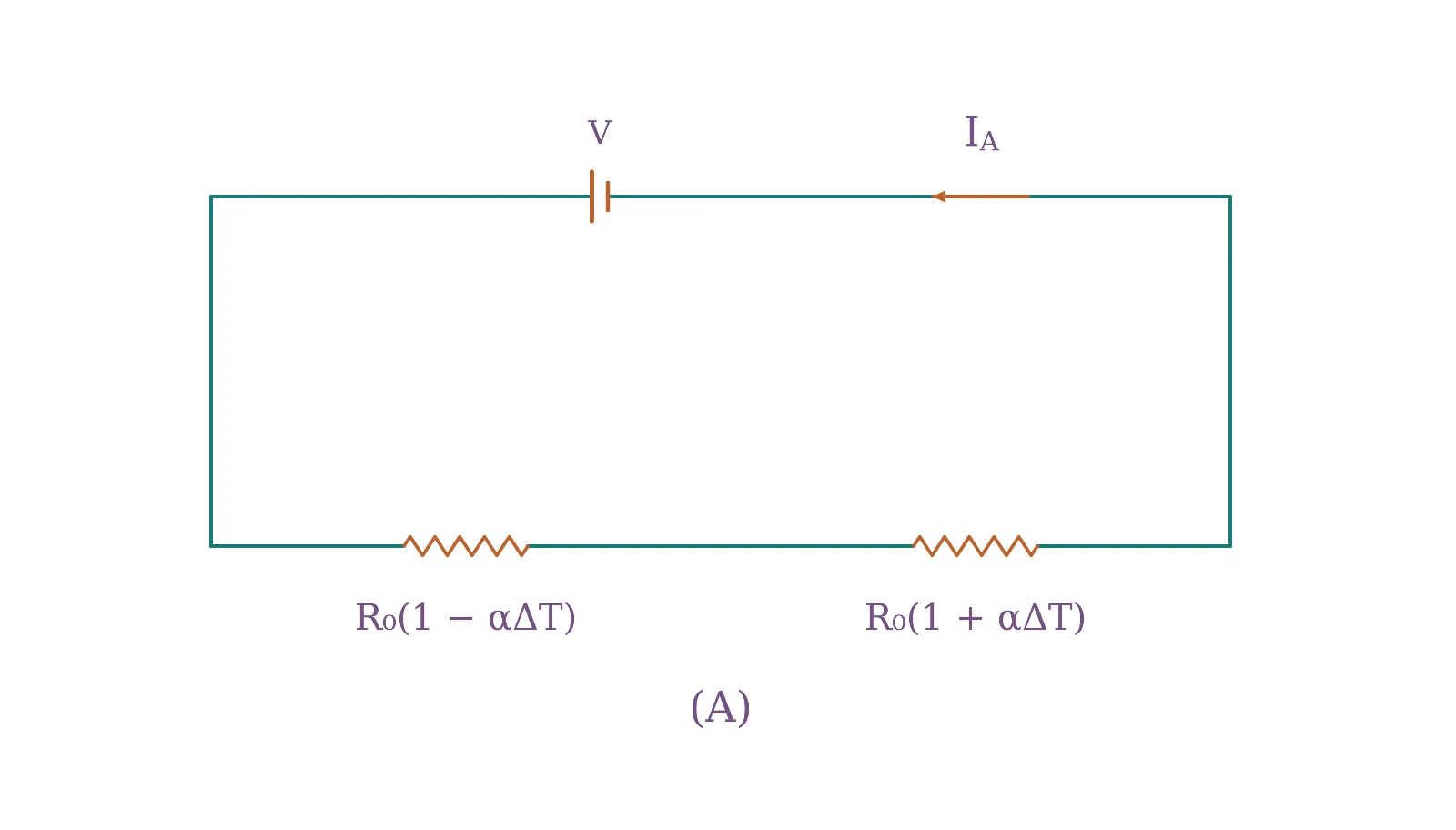
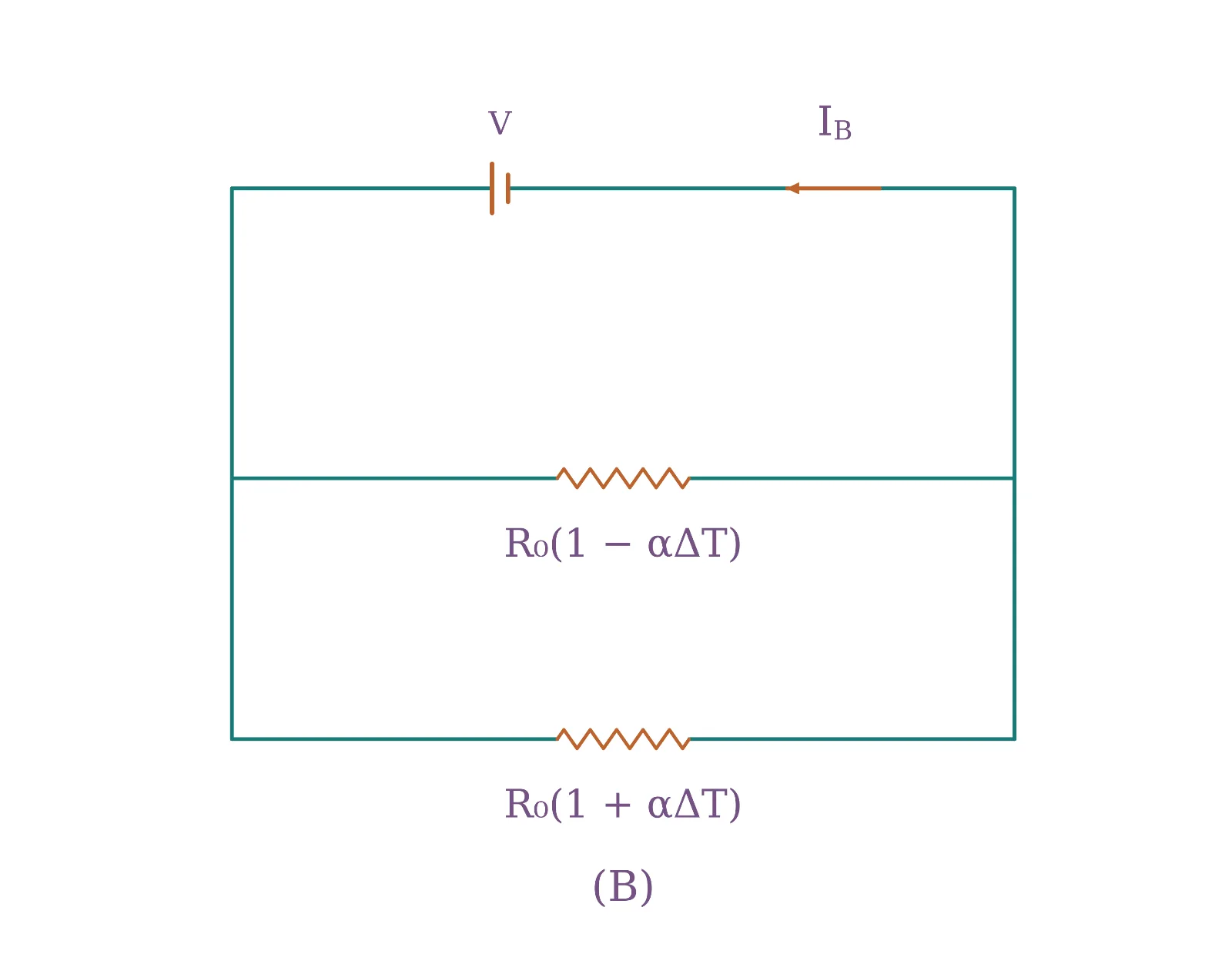
Two circuits each contain resistors whose temperature coefficients are +α and -α, both initially R₀. Circuit A has them in series and circuit B has them in parallel, both on fixed-voltage supplies. What happens to
Physics · Current electricity · Circuit Theory & Kirchhoff’s Laws
Two circuits each contain resistors whose temperature coefficients are +α and -α, both initially R₀. Circuit A has them in series and circuit B has them in parallel, both on fixed-voltage supplies. What happens to currents Iₐ and as the temperature rises?
Options
Related questions
- For a fixed charge passed in electrolysis, the mass deposited or liberated is directly proportional to which quantity?
- A battery of emf 5 V and internal resistance 0.5 Ω is connected to a 4.5 Ω load. What is the terminal voltage?
- Find the current supplied by the 5 V battery in the resistor network shown in the original circuit.
- A wire has total resistance R and is cut into 8 equal lengths. Make two groups of 4 pieces; connect the four pieces in each group in parall…
- A 50 V source is applied across terminals A and B as shown in figure.Find current in the short link CD.
- A uniform metallic wire of total resistance 4 Ω is bent into a square loop ABCD. A 2 Ω resistor is connected between B and D, and a 2 V bat…