In a positive-barrier energy profile, the transition state lies above each endpoint. The forward barrier is Eₐ,f = E‡ − E(reactants); the reverse barrier is Eₐ,r = E‡ − E(products). Hence ΔH = Eₐ,f − Eₐ,r. A catalyst
Chemistry · Chemical Kinetics · Temperature Dependence of Rate: Arrhenius equation, activation energy, collision theory, and catalyst effects.
In a positive-barrier energy profile, the transition state lies above each endpoint. The forward barrier is Eₐ, f = E‡ - E(reactants); the reverse barrier is Eₐ, r = E‡ - E(products). Hence ΔH = Eₐ, f - Eₐ, r. A catalyst changes the pathway barriers, not the reactant–product enthalpy difference.
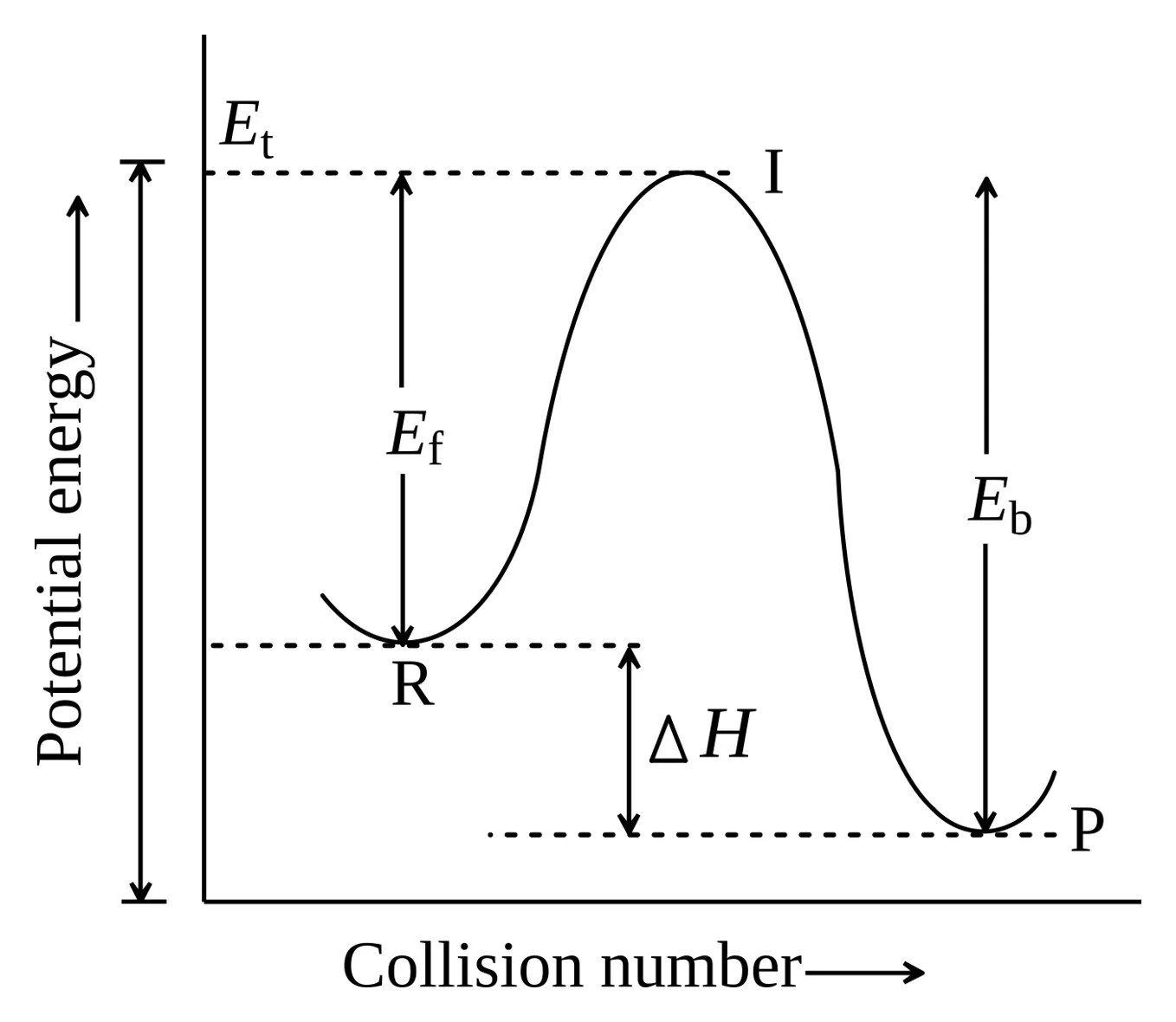
Sub-question 1
If a reaction A+B→C is exothermic to the extent of 30 kJ mol⁻¹ and the forward reaction has an activation energy of 249 kJ mol⁻¹ the activation energy for reverse reaction in kJ mol⁻¹ is
Options
Related questions
- For 3A → 2B, initially [A]₀ = 20 mol L⁻¹ and [B]₀ = 0. At the intersection of the concentration–time curves shown, [A] = [B]. Find [B] at t…
- If a unimolecular reaction, A(g)→ Products, takes place according to the mechanism Where k₁,k₋₁ and k₂ are the rate constants and P, A and…
- A reactant disappears through two independent parallel first-order pathways with individual half-lives 4 h and 12 h, as shown. Find the eff…
- Following is the graph between log₁₀ t₁⁄₂ and log₁₀ a (a initial concentration) for a given reaction at 27°C Find the order of reaction ck_…
- For an elementary step aA + bB → products, the rate law is r = k[A]ᵃ[B]ᵇ. A multistep mechanism requires the rate-determining step or an ap…
- A second-order reaction obeys dx/dt = k(a − x)², where a is the initial concentration. What is its half-life?