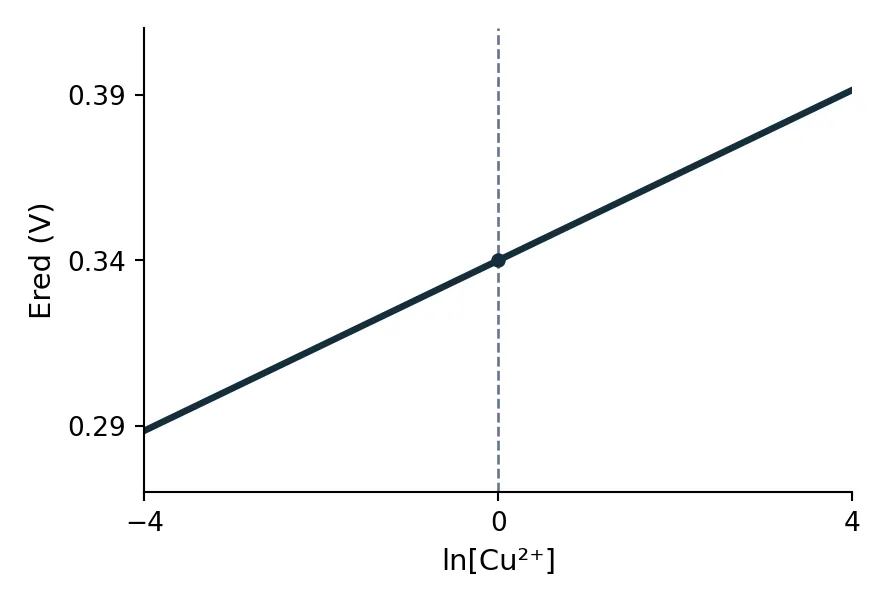
Cu²⁺+2e⁻→Cu. For this, graph between E(red) versus ln[Cu²⁺] is a straight line of intercept 0.34 V, then the electrode oxidation potential of the half cell Cu|Cu²⁺ (0.1 M) will be ec r047 q.png
Chemistry · Electrochemistry · Nernst Equation: Electrode potential, cell potential, concentration dependence, and Gibbs energy relationship.
Cu²⁺+2e⁻→Cu. For this, graph between E(red) versus ln[Cu²⁺] is a straight line of intercept 0.34 V, then the electrode oxidation potential of the half cell Cu|Cu²⁺ (0.1 M) will be
Options
Related questions
- For the displayed hydroquinone oxidation QH₂ ⇌ Q + 2H⁺ + 2e⁻, a hypothetical formal E°ox = +1.30 V. At 25 °C and pH 2, find Eox when the qu…
- 20 mL of KOH solution was titrated with 0.20 M H₂SO₄ solution in a conductivity cell. The data obtained were plotted to give the graph show…
- Zn+Cu²⁺(aq)⇌Cu+Zn²⁺(aq) Reaction quotient is Q=([Zn²⁺])/([Cu²⁺]). Variation of E(cell) with log₁₀ Q is of the type with OA=1.10 V. E(cell)…
- The electrical conductivity of a solution serves as a means of determining the end point in a chemical reaction, involved in the titration…
- Two compartments of an electrolytic cell each contain 100 mL buffer with 1 M NH₃ and 1 M NH₄⁺. The left electrode is the anode and the righ…
- For I₂+2e⁻→2I⁻, standard reduction potential =+0.54 V. For 2Br⁻→Br₂+2e⁻, standard oxidation potential =-1.09 V. For Fe→Fe²⁺+2e⁻, standard o…