Free physics question bank
Morning Shift physics questions with solutions
Browse Morning Shift Physics questions with solutions. Useful for JEE, NEET, and school exam revision.
Showing 1–10 of 336 questions
- MatcheasyThermodynamics
Match List I with List II:
List 1
A. 3 translational degrees of freedom
B. 3 translational and 2 rotational degrees of freedom
C. 3 translational, 2 rotational and 1 vibrational degree of freedom
D. 3 translational, 3 rotational and more than one vibrational degree of freedom
List 2
I. Monoatomic gases
II. Polyatomic gases
III. Rigid diatomic gases
IV. Non-rigid diatomic gases
Options
JEE Mains10 April 2023Shift 1Morning Shift
Open question & full solution → - MCQeasyThermodynamics
Heat is given to an ideal gas in an isothermal process.
A. Internal energy of the gas will decrease.
B. Internal energy of the gas will increase.
C. Internal energy of the gas will not change.
D. The gas will do positive work. E. The gas will do negative work. Choose the correct answer from the options given below:Options
JEE Mains30 January 2023Shift 1Morning Shift
Open question & full solution → - MCQmediumKinematics Part-1 (one dimension)
A particle is moving with constant speed in a circular path. When the particle turns by an angle , the ratio of instantaneous velocity to its average velocity is π: x . The value of x will be -
Options
JEE Mains6 April 2023Shift 1Morning Shift
Open question & full solution → - MCQeasyKinematics Part-1 (one dimension)
A ball is thrown vertically upward with initial speed 150 m s⁻¹. The ratio of its velocities after 3 s and 5 s is (x+1)/x. Find x. Take g = 10 m s⁻².
Options
JEE Mains12 April 2023Shift 1Morning Shift
Open question & full solution → - IntegermediumElectromagnetic Induction
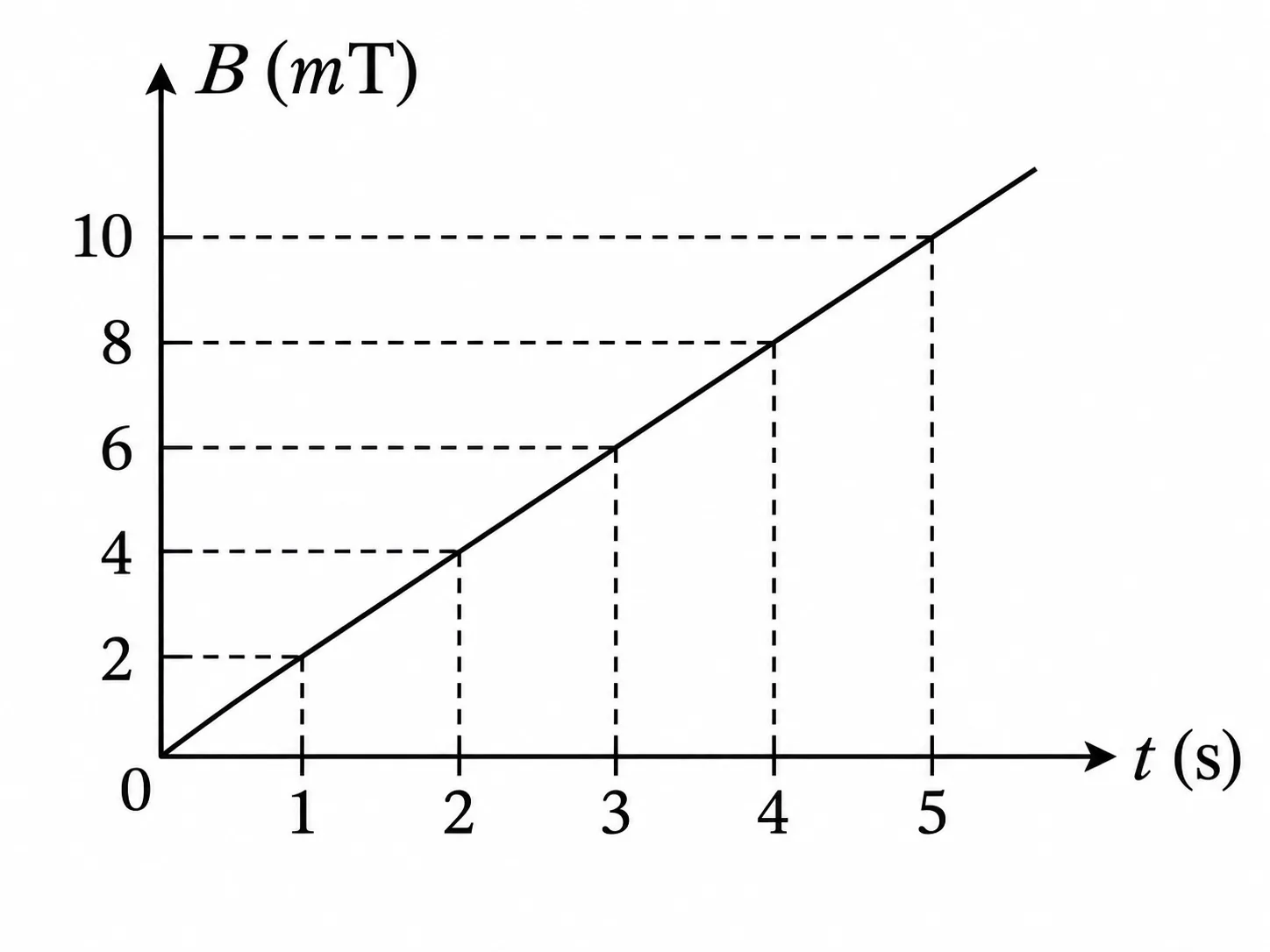
A magnetic field normal to a square metallic plate of area 4 m² varies linearly as shown. During t = 2 s to 4 s, the field changes from 4 × 10⁻³ T to 8 × 10⁻³ T. The induced emf is ______ mV.
JEE Mains11 April 2023Shift 1Morning Shift
Open question & full solution → - MCQmediumMagnetic effect of current
Given below are two statements:
Statement I: If the number of turns in the coil of a moving-coil galvanometer is doubled, then the current sensitivity becomes double.
Statement II: Increasing current sensitivity of a moving-coil galvanometer only by increasing the number of turns in the coil will also increase its voltage sensitivity in the same ratio. Choose the correct answer.
Options
JEE Mains10 April 2023Shift 1Morning Shift
Open question & full solution → - MCQeasyElectromagnetic wave
Which of the following are true?
A. Speed of light in vacuum is dependent on the direction of propagation.
B. Speed of light in a medium is independent of the wavelength of light.
C. The speed of light is independent of the motion of the source.
D. The speed of light in a medium is independent of intensity. Choose the correct answer from the option given below:Options
JEE Mains29 January 2023Shift 1Morning Shift
Open question & full solution → - MCQmediumWave Motion
A person observes two moving trains, A reaching the station and B leaving the station with equal speed of 30 m/s. If both trains emit sounds with frequency 300 Hz, (speed of sound = 330 m/s) approximate difference of frequencies heard by the person will be:
Options
JEE Mains29 January 2023Shift 1Morning Shift
Open question & full solution → - NumericmediumProperties of solid and fluid
A steel rod has a radius of 20 mm and a length of 2.0 m. A force of 62.8 kN stretches it along its length. Young's modulus of steel is 2.0 × 10¹¹ N m⁻². The longitudinal strain produced in the wire is ______ × 10⁻⁵.
JEE Mains6 April 2023Shift 1Morning Shift
Open question & full solution → - MCQmediumAC Circuits
In a series LR circuit with X(L) = R, power factor is P₁. If a capacitor of capacitance C with X(C) = X(L) is added to the circuit the power factor becomes P₂. The ratio P₁ to P₂ will be:
Options
JEE Mains30 January 2023Shift 1Morning Shift
Open question & full solution →