Free physics question bank
Electric Dipole & Dipole Moment questions with solutions
Practice Electrostatic for JEE Main, JEE Advanced, NEET, and Classes 11–12. Attempt each question, then open it for the full solution.
Showing 1–10 of 51 questions
- MCQmediumElectrostaticOpen question & full solution →
An electric dipole of moment p is placed in the field E(x)=E₀(1+αx) î with its dipole moment parallel to î. At x=0, the net force and torque on the dipole are:
Options
- MCQeasyElectrostatic
A short electric dipole has a dipole moment of 16 × 10⁻⁹ C m. The electric potential due to the dipole at a point at distance 0.6 m from the centre of the dipole, situated on a line making an angle of 60° with the dipole axis, is (1/(4πε₀) = 9 × 10⁹ N m² C⁻²):
Options
NEET 2020NEET Previous Year
Open question & full solution → - MCQmediumElectrostatic
Two small spherical balls, each of mass 10 g and carrying charges -2 μC and +2 μC, are attached to the ends of a very light rigid rod of length 20 cm. The rod is placed near an infinite non-conducting sheet having uniform surface charge density 100 μC/m², with the rod making an angle 30° with the electric field. Take ε₀ = 8.85×10⁻¹² C²/(N·m²). The magnitude of net torque on the rod is:
Options
JEE Mains 2025 4 April Morning Shift
Open question & full solution → - MCQmediumElectrostatic
For an electric dipole, the electric field and potential at an axial point a distance r from its centre are E₀ and V₀. What are the electric field magnitude and potential at an equatorial point a distance 2r from the centre?
Options
JEE Mains 2025 22 Jan Evening Shift
Open question & full solution → - MCQmediumElectrostatic
The electric field due to a short electric dipole at a large distance r from its centre on the equatorial plane varies with r as:
Options
15 April 2023 Morning Shift
Open question & full solution → - MCQmediumElectrostaticOpen question & full solution →
A dipole of moment p is placed on the axis of a fixed point charge Q at distance r, with p parallel to the electric field. Assuming r is much larger than the dipole size, the magnitude of the net force on the dipole is:
Options
- NumericmediumElectrostatic
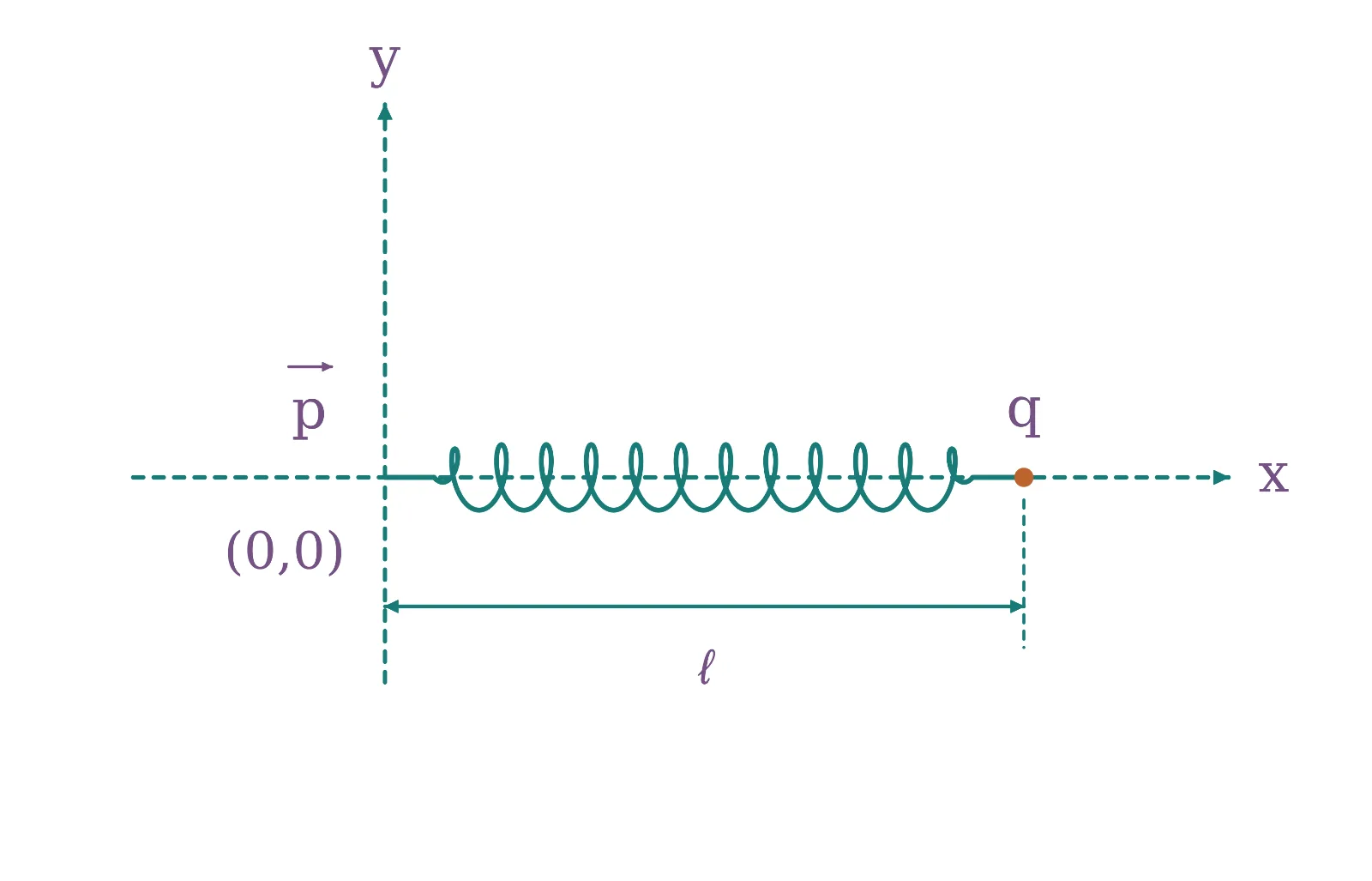
One end of a spring of negligible unstretched length and spring constant k is fixed at the origin (0, 0). A point particle of mass m carrying a positive charge q is attached at its other end. The entire system is kept on a smooth horizontal surface. When a point dipole 𝐩 pointing towards the charge q is fixed at the origin, the spring gets stretched to a length λ and attains a new equilibrium position (see figure below). If the point mass is now displaced slightly by Δλ << λ from its equilibrium position and released, it is found to oscillate at frequency . The value of δ is.
JEE Advanced 2020
Open question & full solution → - Multi-correctmediumElectrostatic
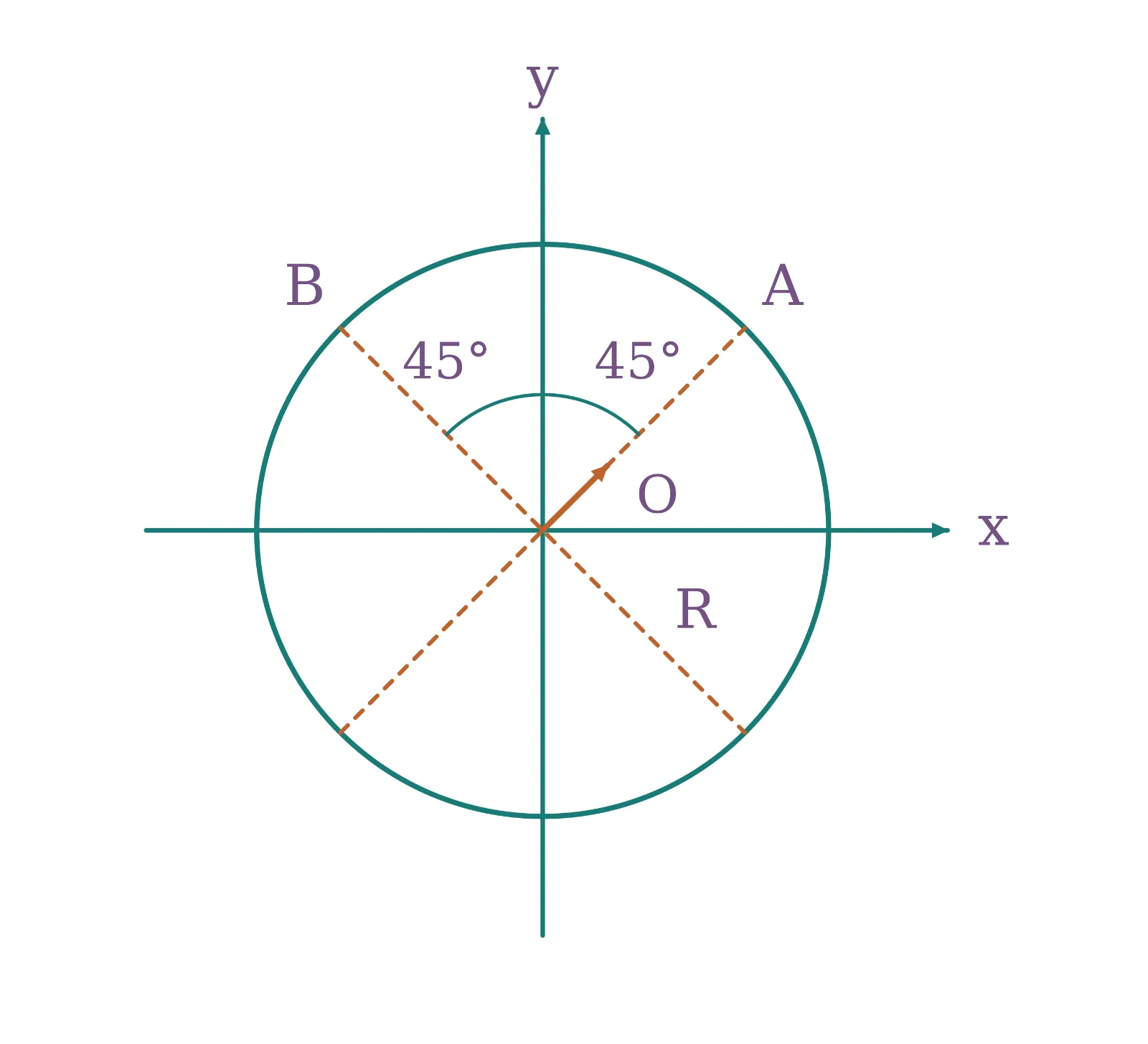
An electric dipole with dipole moment 𝐩 = (p₀/√2)() is fixed at the origin O in a uniform electric field of magnitude E₀. If the potential is constant on a circle of radius R centred at O as shown, which statement(s) is/are correct? (R is much larger than dipole size.)
Select all that apply
JEE Advanced 2019
Open question & full solution → - MCQeasyElectrostatic
The electrostatic potential due to an electric dipole at a distance ‘r’ varies as :
Options
JEE Mains 2024 30 Jan Morning Shift
Open question & full solution → - MatchmediumElectrostatic
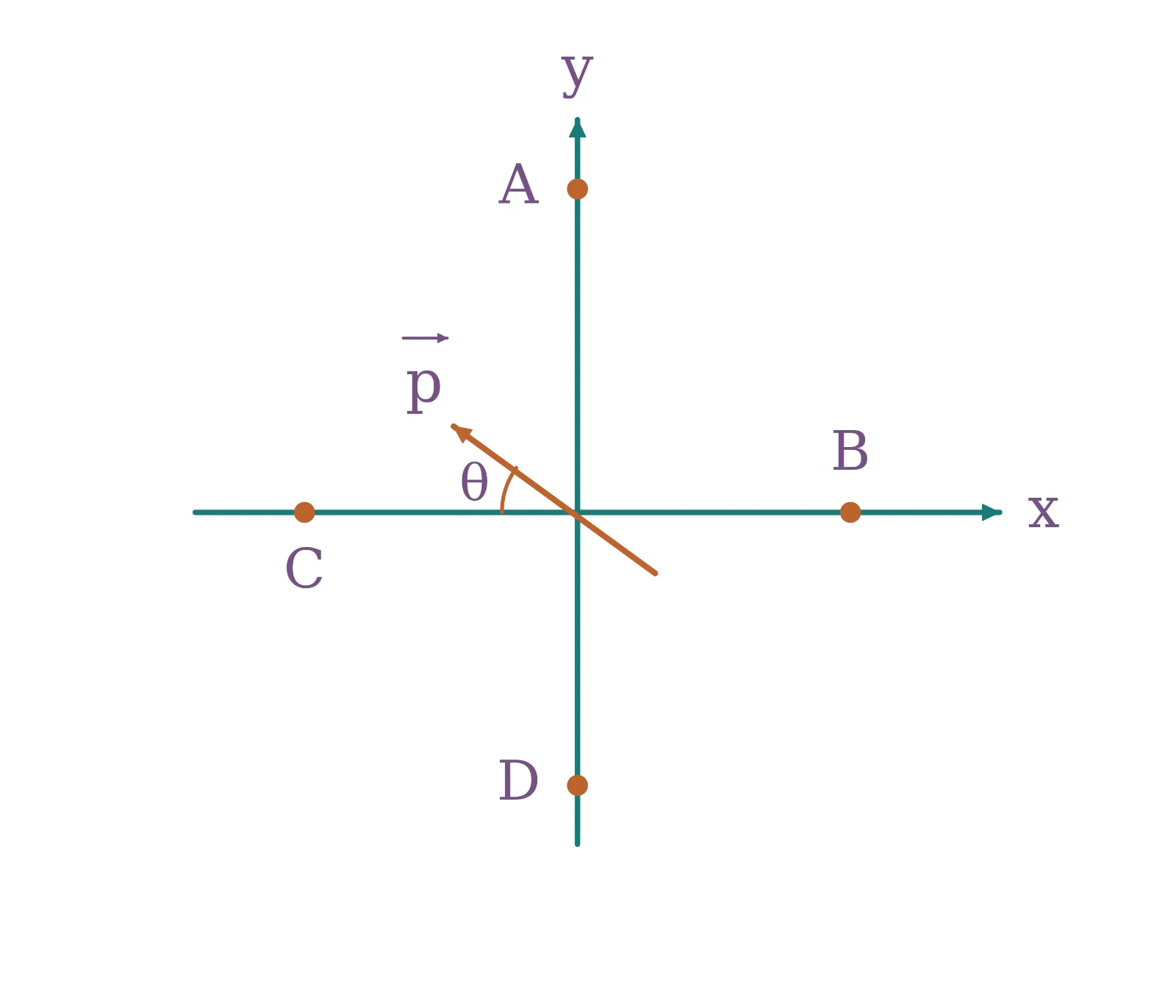
An electric dipole is placed at the origin as shown. Points A, B, C and D are at distance r from the origin. Match List I with List II.
List 1
(P) Electric potential at A
(Q) Electric potential at B
(R) Electric potential at C
(S) Electric potential at D
List 2
(1) -kP sinθ/r²
(2) kP cosθ/r²
(3) kP sinθ/r²
(4) -kP cosθ/r²
Options
JEE MainsAdvanced
Open question & full solution →