Free question bank
Nucleophilic Substitution Reactions: SN1 and SN2 mechanisms, factors affecting reactivity, and stereochemical aspects. questions with solutions
Practice Haloalkanes and Haloarenes questions for NEET and JEE Main. Attempt each question, then open the solution. Full revision programs are in the Physics courses.
Showing 1–10 of 41 questions
- MCQmediumHaloalkanes and HaloarenesOpen solution
Tertiary alkyl halides are practically inert to substitution by SN2mechanism because of
Options
- MCQeasyHaloalkanes and HaloarenesOpen solution
Ethyl chloride on heating with AgCN forms a compound X. The functional isomer of X is
Options
- MCQmediumHaloalkanes and HaloarenesOpen solution
Which of the following statements regarding the SN1reaction shown by alkyl halide is not correct?
Options
- MCQmediumHaloalkanes and HaloarenesOpen solution
Which of the following is least reactive in a nucleophilic substitution reaction?
Options
- MCQmediumHaloalkanes and HaloarenesOpen solution
Which reagent system is used for the conventional copper-assisted ammonolysis of chlorobenzene?
Options
- MCQmediumHaloalkanes and HaloarenesOpen solution
RX + A → RNC A is
Options
- MCQmediumHaloalkanes and HaloarenesOpen solution
The major product of the following reaction is
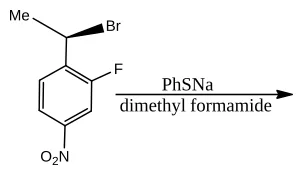
HAH_1_0286_Q.png
Options
- MCQmediumHaloalkanes and HaloarenesOpen solution
The given reaction is an example of, C₂H₅Br+KCN(aq.)⟶C₂H₅CN+KBr:
Options
- MCQeasyHaloalkanes and HaloarenesOpen solution
Correct order of reactivity for halides is:
Options
- MCQmediumHaloalkanes and HaloarenesOpen solution
Sodium ethoxide reacts with ethyl iodide to yield:
Options