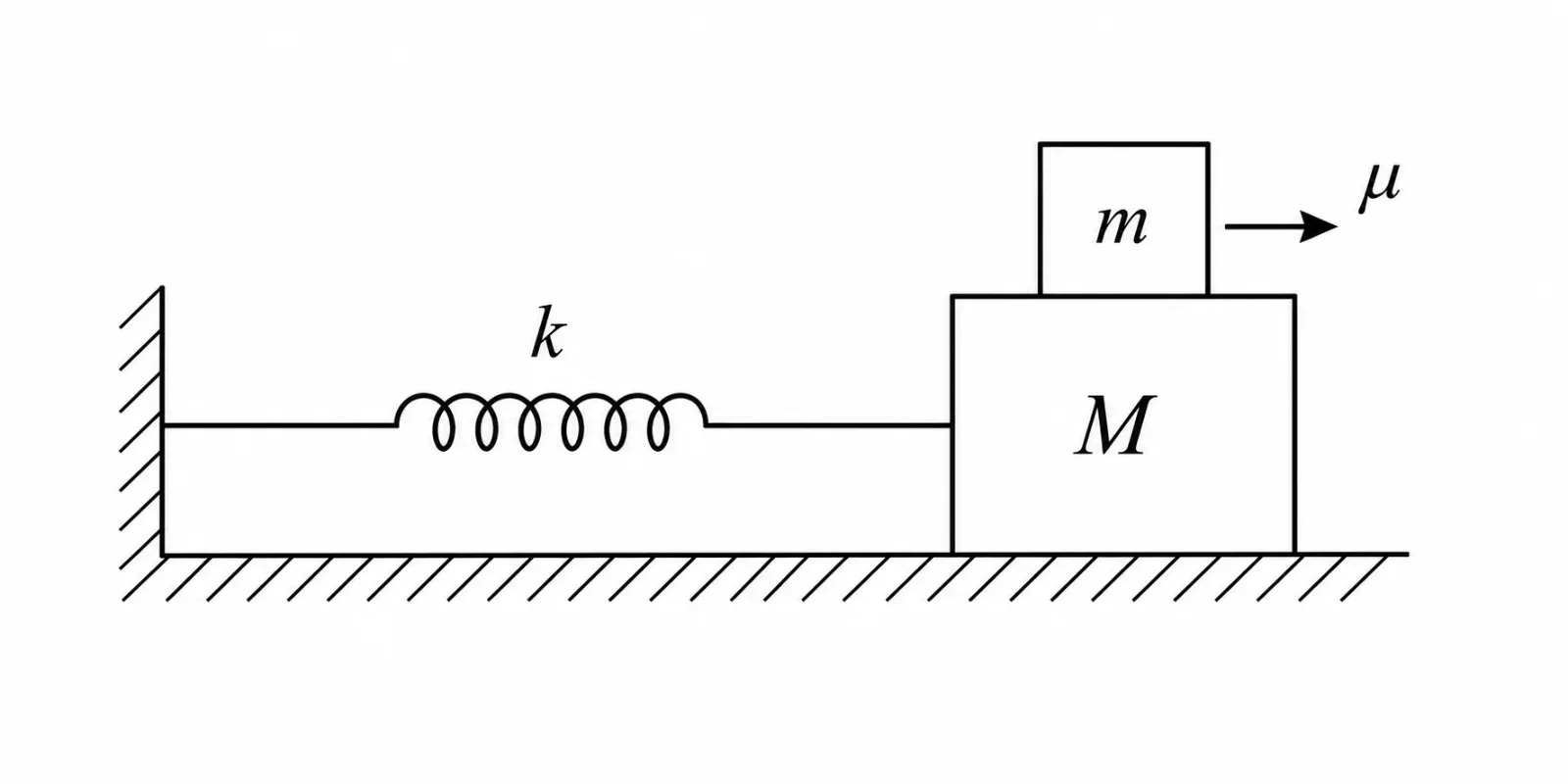
Two blocks of masses m and M (M > m) are placed one over the other on a frictionless horizontal table. The lower block M is attached to a spring of constant k, and the coefficient of friction between the blocks is
Physics · Simple Harmonic Motion · Time Period of Linear Simple Harmonic Motion
Two blocks of masses m and M (M > m) are placed one over the other on a frictionless horizontal table. The lower block M is attached to a spring of constant k, and the coefficient of friction between the blocks is μ. The system is slightly displaced and released. Consider: (A) T = 2π√[(M+m)/k]; (B) a = -kx/(M+m); (C) the friction magnitude on the upper block is mμ|x|/(M+m); (D) maximum amplitude without slipping is μ(M+m)g/k; (E) maximum frictional force can be μ(M+m)g. Choose the correct set.
Options
Related questions
- For a particle executing SHM with amplitude a, at what displacement magnitude are its kinetic and potential energies equal?
- What is the potential energy, measured from equilibrium, of a particle of mass m executing SHM with angular frequency ω and amplitude a at…
- A spring–mass oscillator contains sand that leaks gradually from the attached box. Which pair of schematic graphs shows how angular frequen…
- Identical point masses P and Q oscillate vertically on springs of constants k₁ and k₂. If both oscillators have equal maximum speeds, find…
- Savitha, a XI standard student, while conducting an experiment to determine the effective length of a simple pendulum L, notes down the dat…
- A simple pendulum bob of mass 20 g has total mechanical energy (kinetic plus potential) 0.02 J. Find the approximate speed when it passes t…