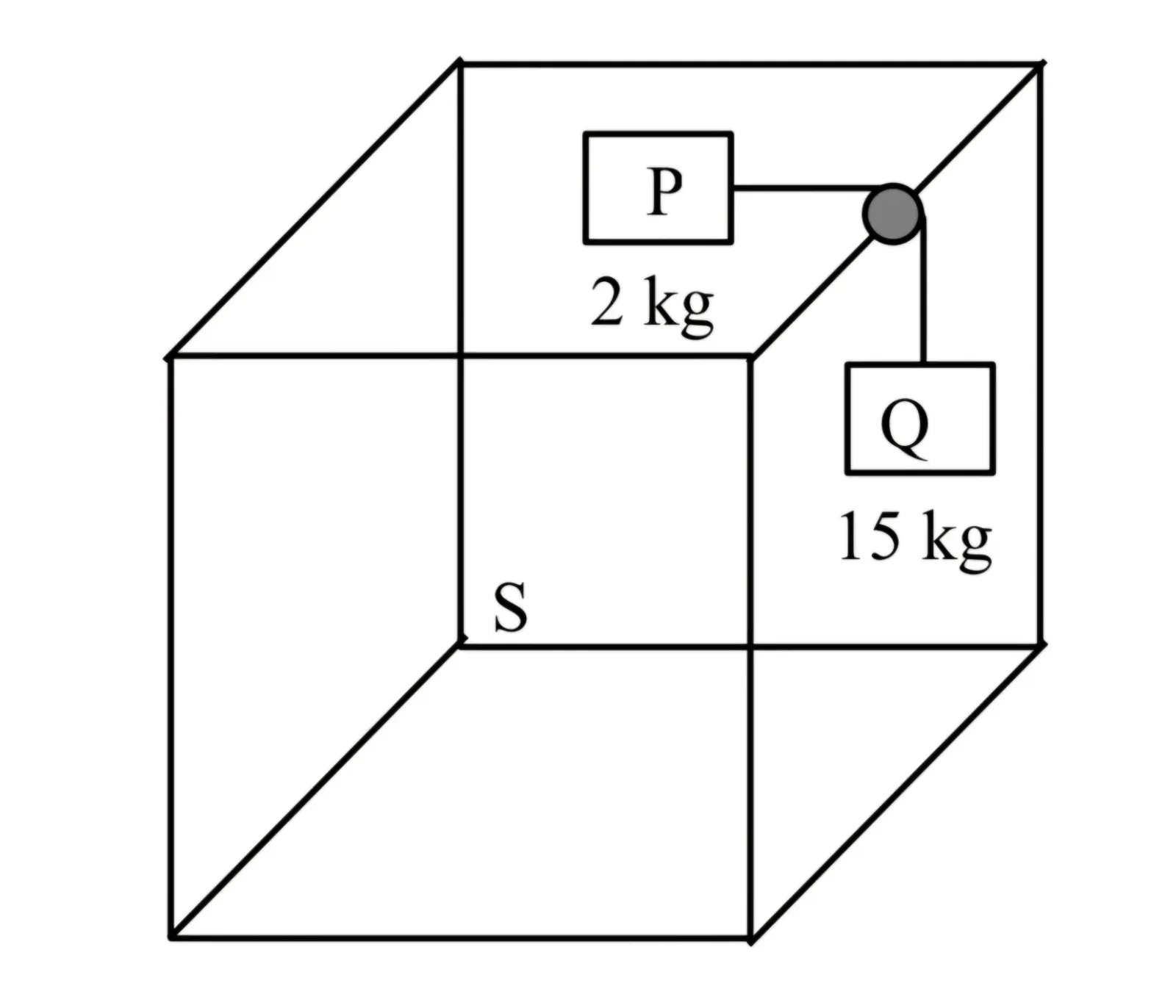
Two blocks P and Q of masses 2 kg and 1.5 kg, respectively, are connected by a massless string passing over a frictionless pulley fixed at the upper edge of a cube S, as shown in the figure. Block P lies on the frictionless horizontal top surface of the cube, while block Q remains in contact with the vertical side surface, where the coefficient of friction is μ. The cube accelerates horizontally to the right with acceleration g/2. During this motion both P and Q remain stationary relative to the cube. Taking g = 10 m·s⁻², find μ.
Physics · Newtons law of motion and Friction · two and more than two block problem in friction
Two blocks P and Q of masses 2 kg and 1.5 kg, respectively, are connected by a massless string passing over a frictionless pulley fixed at the upper edge of a cube S, as shown in the figure. Block P lies on the frictionless horizontal top surface of the cube, while block Q remains in contact with the vertical side surface, where the coefficient of friction is μ. The cube accelerates horizontally to the right with acceleration g/2. During this motion both P and Q remain stationary relative to the cube. Taking g = 10 m·s⁻², find μ.
Options