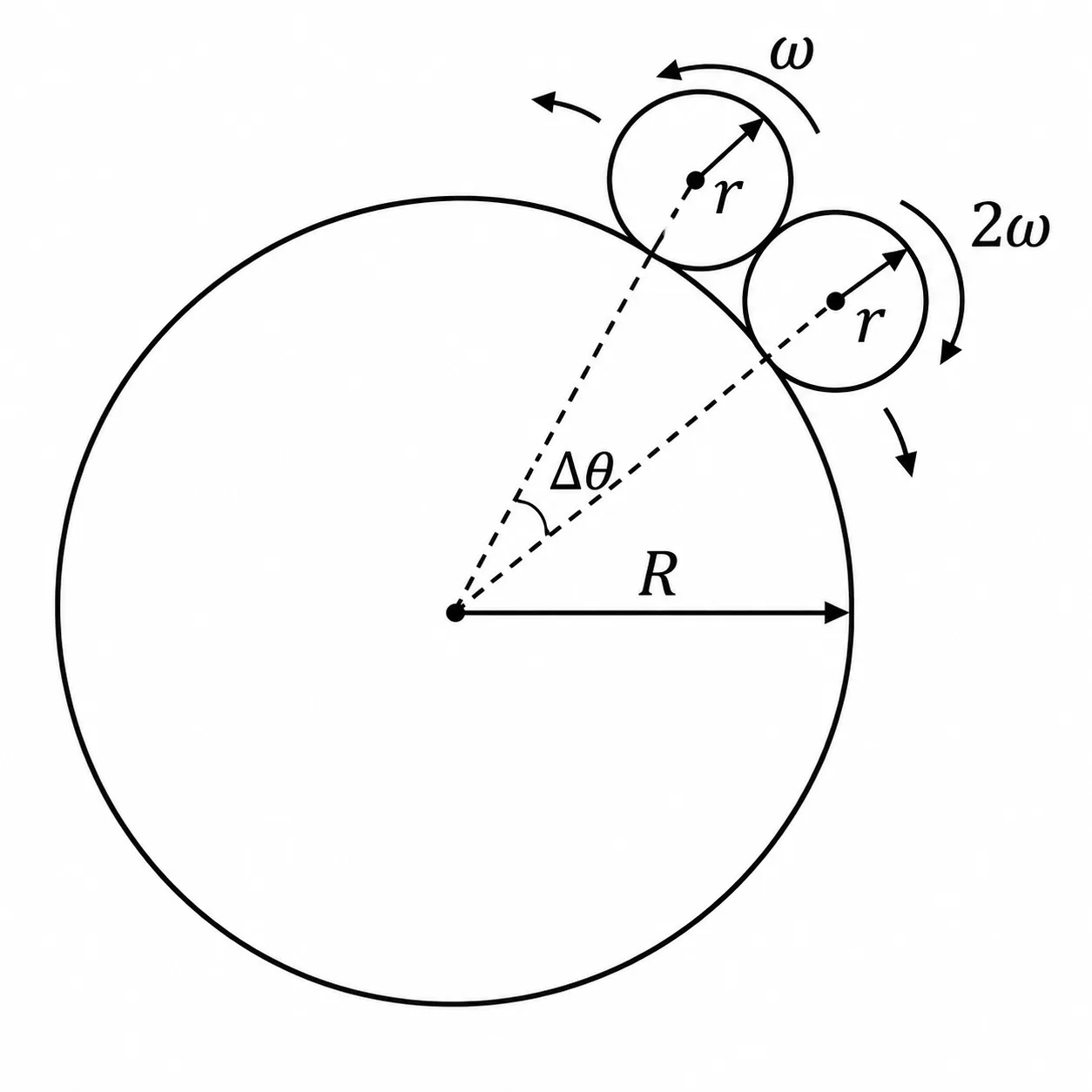
Consider a large disk of radius R and two smaller disks, each of radius r = R/50, lying on its circumference, as shown in the figure. The smaller disks are initially in contact with each other, with an angular separation Δθ between their centers. They are made to roll without slipping in opposite directions, with constant angular velocities ω and 2ω while the large disk is held stationary. The time τ at which the smaller disks are again in contact is: [Use sin(Δθ) = Δθ and ignore gravity.]
Physics · Rotational Motion · combined translatory and rotatory motion ,Pure rolling motion
Consider a large disk of radius R and two smaller disks, each of radius r = R/50, lying on its circumference, as shown in the figure. The smaller disks are initially in contact with each other, with an angular separation Δθ between their centers. They are made to roll without slipping in opposite directions, with constant angular velocities ω and 2ω while the large disk is held stationary. The time τ at which the smaller disks are again in contact is: [Use sin(Δθ) = Δθ and ignore gravity.]
Options