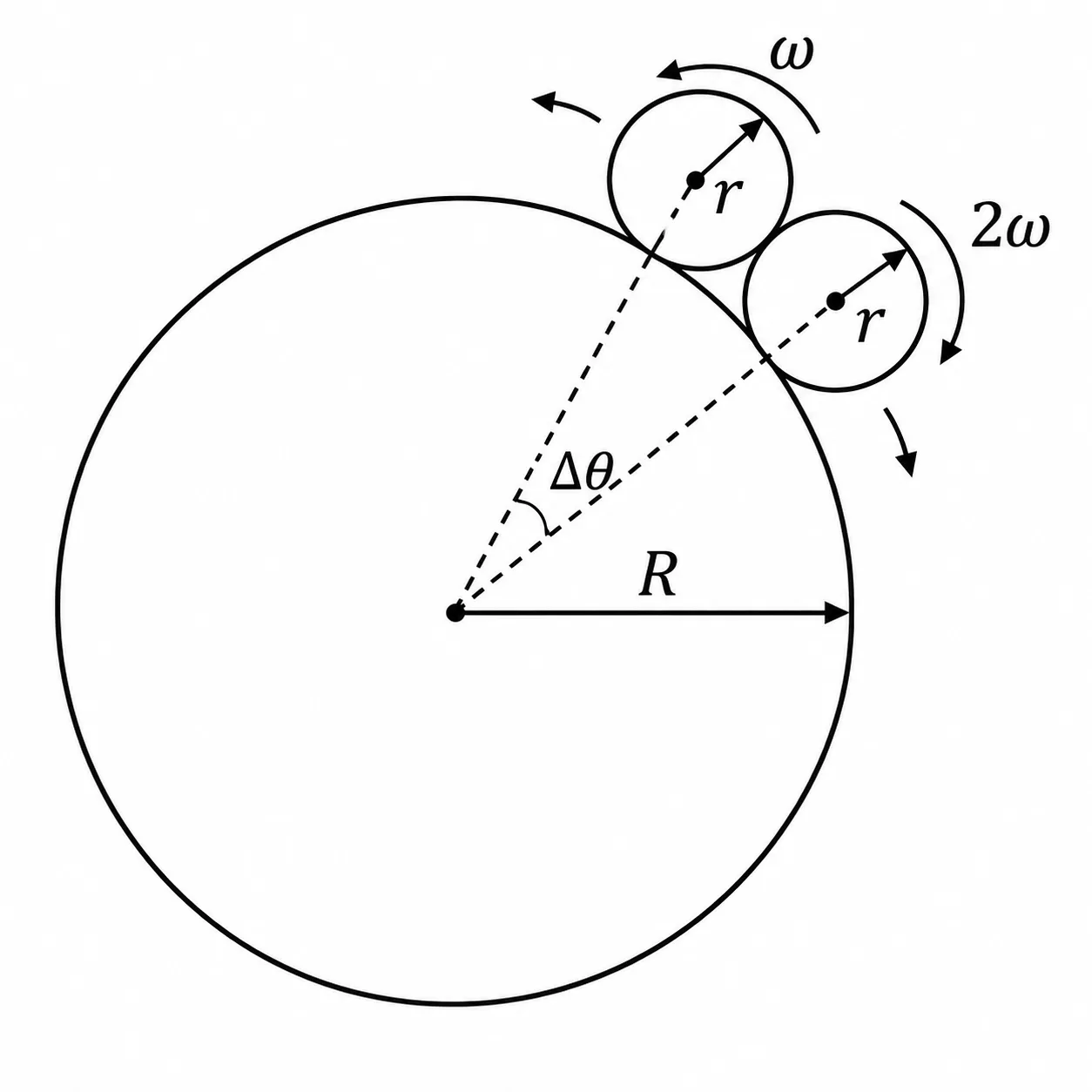
Consider a large disk of radius R and two smaller disks, each of radius r = R/50, lying on its circumference, as shown in the figure. The smaller disks are initially in contact with each other, with an angular
Physics · Rotational Motion · Combined Translational & Rotational Motion
Consider a large disk of radius R and two smaller disks, each of radius r = R/50, lying on its circumference, as shown in the figure. The smaller disks are initially in contact with each other, with an angular separation Δθ between their centers. They are made to roll without slipping in opposite directions, with constant angular velocities ω and 2ω while the large disk is held stationary. The time τ at which the smaller disks are again in contact is: [Use sin(Δθ) = Δθ and ignore gravity.]
Options
Related questions
- A metre rule has a wooden half and a denser steel half. In case (i) it is pivoted near the wooden end and a perpendicular force F is applie…
- A uniform rod of mass 20 kg and length 5 m leans against a smooth vertical wall, making 60° with the wall. Its lower end rests on a rough f…
- A smaller solid sphere of radius R is removed from a solid sphere of radius 2R as shown. Both have uniform density. Find the ratio of momen…
- A thin wire of length L and linear mass density m is bent into a circular ring lying in the x–y plane as shown. Find its moment of inertia…
- Two touching solid spheres A (mass M, radius R) and B (mass m, radius r) have their centres separated by R + r. Let I A I_A I A and I B I…
- A thin horizontal disc rotates about a vertical axis through its fixed centre O. Its angular momentum about points A and B, both in the pla…