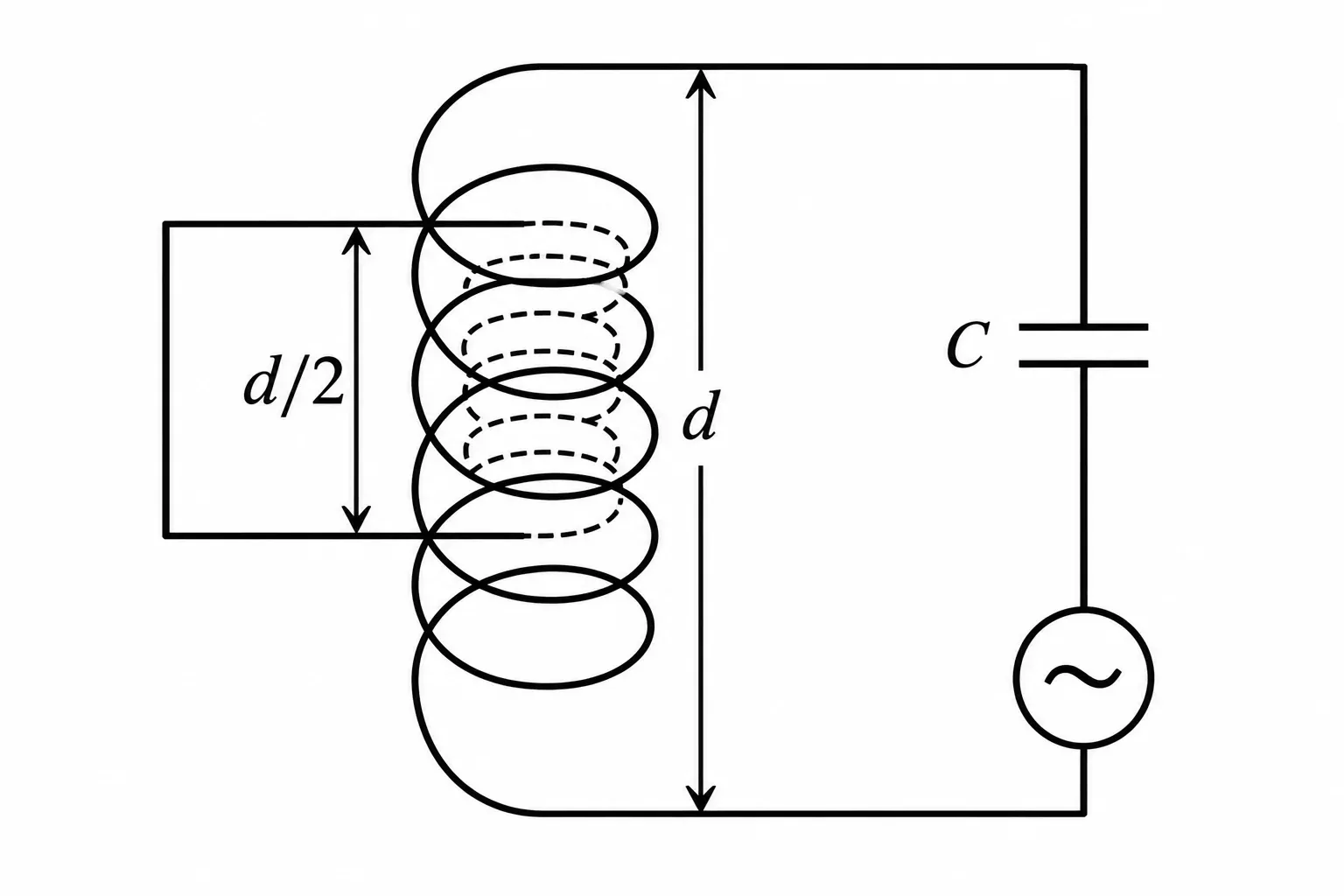
Consider a circuit consisting of a capacitor of capacitance C and a coil with N turns per unit length, cross sectional area S and length d, where d² ≫ S. There is another coil of length d/2, cross sectional area S/2
Physics · Electromagnetic Induction · Mutual Inductance, L-C Oscillations and Transformers
Consider a circuit consisting of a capacitor of capacitance C and a coil with N turns per unit length, cross sectional area S and length d, where d² ≫ S. There is another coil of length d/2, cross sectional area S/2 and 2N turns per unit length completely inside the larger coil, as shown in the figure. The ends of this smaller coil are connected with each other by an insulated conducting wire. The self-inductance of the larger coil is L. Neglecting edge effects and all the Ohmic resistances, the resonant frequency of the circuit is:
Options
Related questions
- A capacitor C initially charged to q₀ is connected to an ideal inductor L at t = 0. At what earliest positive time are the energies in the…
- A coil produces a self-induced emf of magnitude 5 V when its current changes from 3 A to 2 A in 1 ms. What is its self-inductance?
- The graph shows the magnetic flux Φ(t) through a coil. Φ rises linearly from A to B, drops abruptly from B to C, then follows a curved arc…
- A uniform magnetic field is restricted within a region of radius r. The magnetic field changes with time at a rate d B d t \frac{dB}{dt} d…
- A thin semicircular conducting ring PQR of radius r falls with its plane vertical in a horizontal uniform magnetic field B, as shown. When…
- In the above diagram, a strong bar magnet is moving towards solenoid-2 from solenoid-1. The direction of induced current in solenoid-1 and…