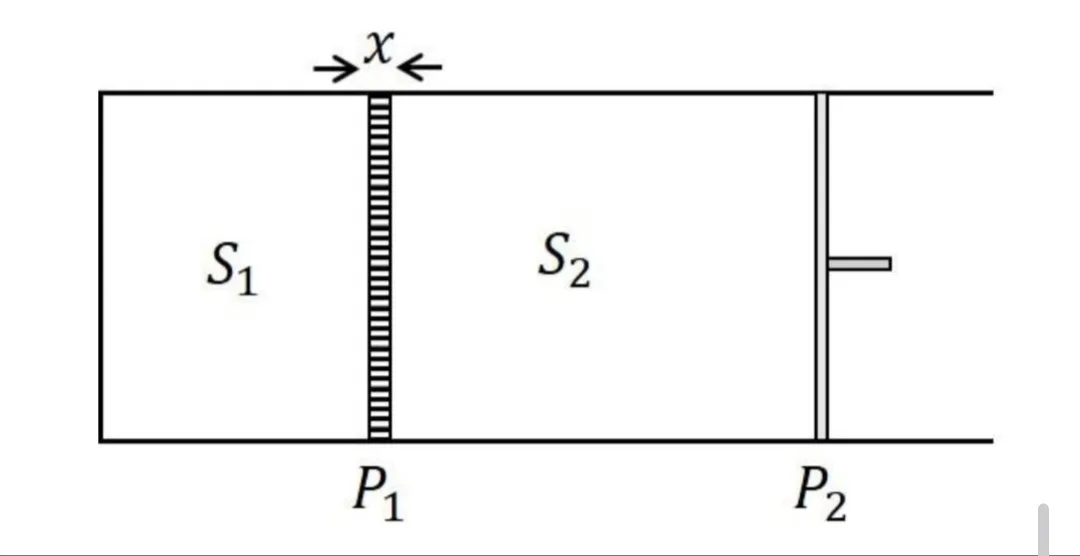
As shown in the figure, an insulated container is fitted with a thermally conducting but immovable partition P₁ and a freely movable but thermally insulated piston P₂. The partition P₁ with thermal conductivity K, cross sectional area A and width x divides the container into two sections, S₁ and S₂, each containing one mole of a monoatomic gas. The piston P₂ moves freely such that the gas in S₂ is always at the atmospheric pressure. Initially, the difference between the temperatures of S₁ and S₂ is ΔT₀. The time it takes for the temperature difference to become ΔT₀/2 is nxR/(KA), where R is the universal gas constant. The value of n is: [Given: ln2 ≈ 0.7]
Physics · Thermodyanmics · first law of thermodynamics
As shown in the figure, an insulated container is fitted with a thermally conducting but immovable partition P₁ and a freely movable but thermally insulated piston P₂. The partition P₁ with thermal conductivity K, cross sectional area A and width x divides the container into two sections, S₁ and S₂, each containing one mole of a monoatomic gas. The piston P₂ moves freely such that the gas in S₂ is always at the atmospheric pressure. Initially, the difference between the temperatures of S₁ and S₂ is ΔT₀. The time it takes for the temperature difference to become ΔT₀/2 is nxR/(KA), where R is the universal gas constant. The value of n is: [Given: ln2 ≈ 0.7]