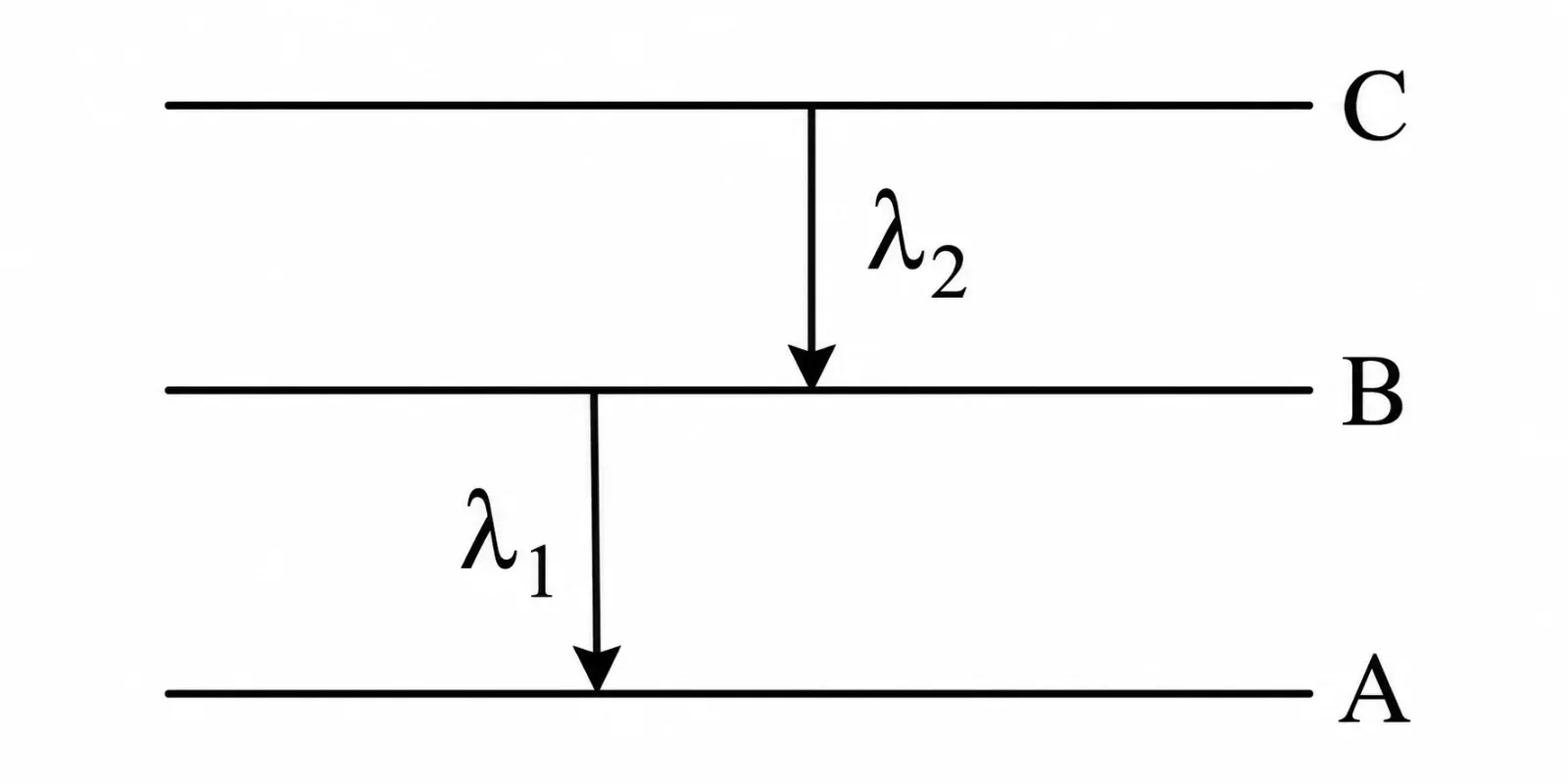
In hydrogen, A, B and C are the first, second and third excited levels respectively. The wavelengths λ₁ and λ₂ correspond to the transitions shown in the figure. If λ₁/λ₂ = 7/(4n), find n.
Physics · Atomic Structure and X-rays · Atomic Structure & Bohr's Atomic Model
In hydrogen, A, B and C are the first, second and third excited levels respectively. The wavelengths λ₁ and λ₂ correspond to the transitions shown in the figure. If λ₁/λ₂ = 7/(4n), find n.
Related questions
- In Thomson’s crossed-field method of measuring the magnitude of e/m for an electron, how are the electric field, magnetic field and electro…
- Some energy levels of a molecule are shown in the figure, with wavelengths λ₁, λ₂ and λ₃ of three transitions. Which given relation is corr…
- Statement I: Atoms are electrically neutral as they contain equal numbers of positive and negative charges. Statement II: Atoms of each ele…
- Match listI (spectral lines of hydrogen for transition from) with listII (wavelengths nm).
- If an electron in a hydrogen atom jumps from the 3rd orbit to the 2nd orbit, it emits a photon of wavelength λ. When it jumps from the 4th…
- Ionization potential of hydrogen atom is 13.6 eV. Hydrogen atoms in the ground state are excited by monochromatic radiation of photon energ…