Free question bank
Atomic Structure & Bohr's Atomic Model questions with solutions
Practice Atomic Structure and X-rays questions for NEET and JEE Main. Attempt each question, then open the solution. Full revision programs are in the Physics courses.
Showing 1–10 of 245 questions
- MCQmediumAtomic Structure and X-raysOpen solution
According to Bohr model, magnetic field at the centre (at the nucleus) of a hydrogen atom due to the motion of the electron in nth orbit is proportional to
Options
- NumericmediumAtomic Structure and X-raysOpen solution
In a Rutherford scattering experiment, a detector first records α-particles scattered through 60°. Without changing the incident beam or target, the detector is then placed to record particles scattered through 120°. If the first count rate divided by the second count rate is N, find N.
- MCQmediumAtomic Structure and X-raysOpen solution
In Thomson’s crossed-field method of measuring the magnitude of e/m for an electron, how are the electric field, magnetic field and electron beam oriented?
Options
- MCQmediumAtomic Structure and X-raysOpen solution
A neutron having kinetic energy 13.6 eV collides with a hydrogen atom in ground state at rest. Assume that the mass of neutron and hydrogen atoms are same and the neutron does not leave its line of motion. Then which of the following is the possible KE of the neutron after the collision?
Options
- MCQmediumAtomic Structure and X-raysOpen solution
Hydrogen (¹₁H) , deuterium (²₁H) , helium (He⁺) and lithium (Li²⁺) each have one electron. For the transition n = 2→1, let the emitted wavelengths be λ₁, λ₂, λ₃ and λ₄, respectively. Which relation is correct?
Options
- MCQmediumAtomic Structure and X-raysOpen solution
In the first excited state of a hydrogen atom, the electron energy is -3.4 eV. Estimate its orbital radius. Take 1 eV = 1.6 × 10⁻¹⁹ J, electron charge magnitude e = 1.6 × 10⁻¹⁹ C and Coulomb constant k = 9 × 10⁹ N·m²/C².
Options
- MCQmediumAtomic Structure and X-raysOpen solution
In the spectrum of single ionised helium, the wavelength of a line observed is almost the same as the first line of Balmer series of hydrogen. It is due to transition of electron from
Options
- MCQmediumAtomic Structure and X-raysOpen solution
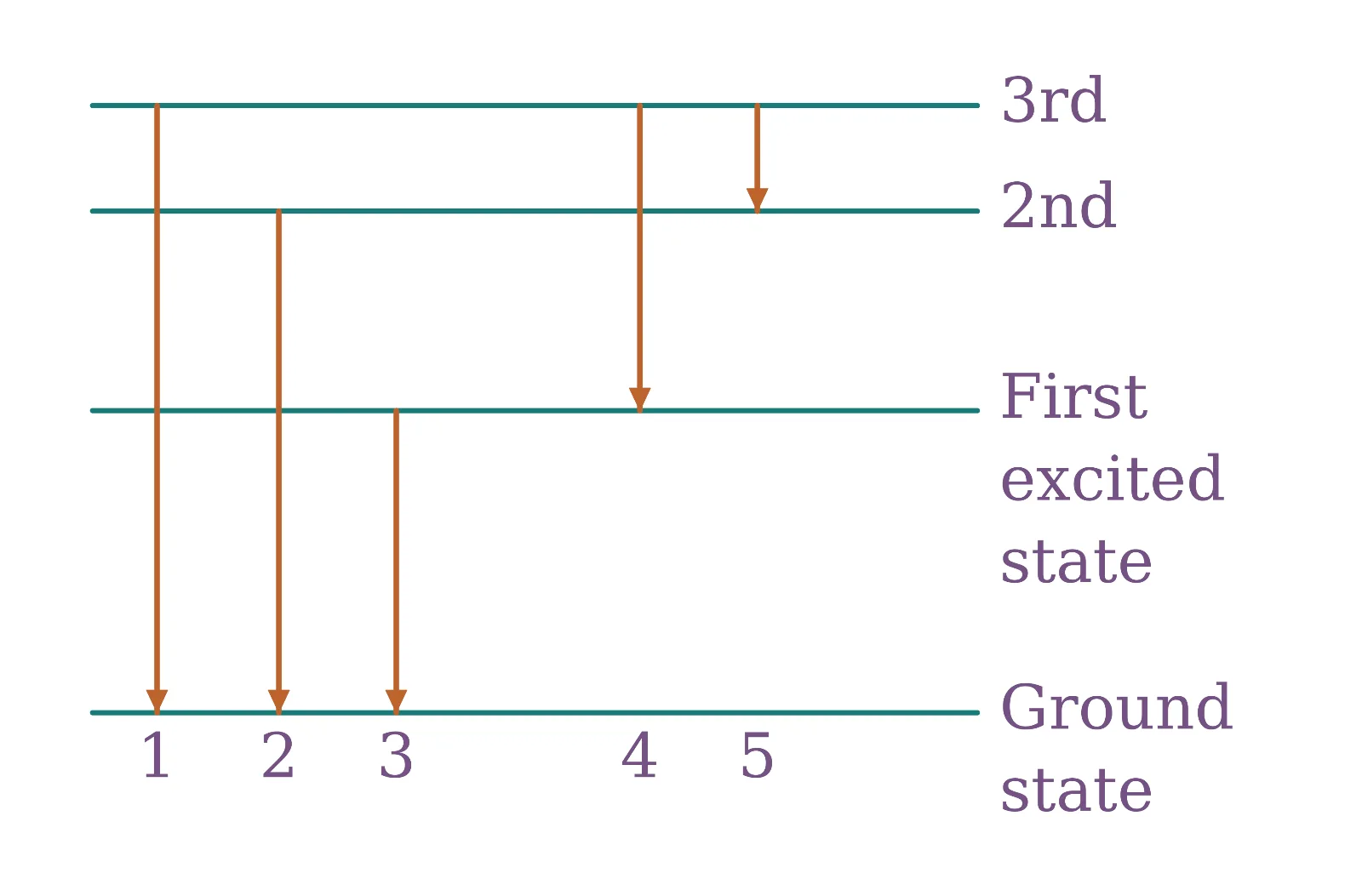
The figure shows an atomic energy-level diagram and five spectral lines in the emission spectrum. Which of these spectral lines will also appear in the absorption spectrum?
Options
- MCQeasyAtomic Structure and X-raysOpen solution
To explain his theory, Bohr used:
Options
- MCQmediumAtomic Structure and X-raysOpen solution
An electron of a hydrogen like atom, having Z = 4, jumps from 4th energy state to 2nd energy state, the energy released in this process, will be: (Given Rch = 13.6 eV) Where R = Rydberg constant, c = Speed of light in vacuum, h = Planck's constant
Options