Free question bank
Simple Harmonic Motion questions with solutions
Practice Simple Harmonic Motion questions for NEET and JEE Main. Attempt each question, then open the solution. Full revision programs are in the Physics courses.
Showing 1–10 of 387 questions
- MCQmediumSimple Harmonic MotionOpen solution
For a simple pendulum, a graph is plotted between its kinetic energy (KE) and potential energy (PE) against its displacement d. Which one of the following represents these correctly? (graphs are schematic and not drawn to scale)
Options
- MCQmediumSimple Harmonic Motion
A body of mass m is attached to the lower end of a spring whose other end is fixed. The spring has negligible mass. When the mass m is slightly pulled down and released, it oscillates with a time period of 3 s. When mass m is increased by 1 kg, the time period becomes 5 s. The value of m in kg is:
Options
NEET Phase-II 2016NEET Previous Year
Open solution - MCQmediumSimple Harmonic MotionOpen solution
Two SHMs y₁ = A sin(ωt) and y₂ = A cos(ωt) are superimposed on a particle of mass m. The total mechanical energy is:
Options
- MCQmediumSimple Harmonic MotionOpen solution
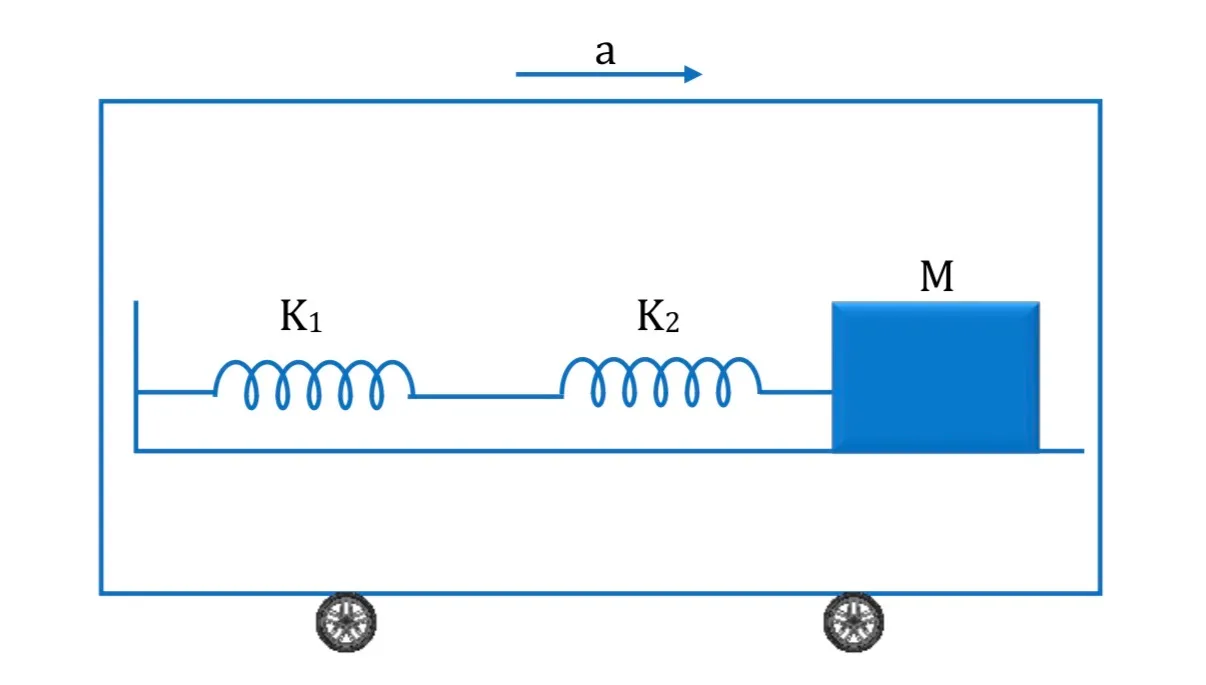
Inside a cart accelerating horizontally with acceleration a, a block of mass M is connected to two light springs of constants k₁ and k₂. The block can move without friction horizontally. Find its vibration frequency.
Options
- MCQmediumSimple Harmonic MotionOpen solution
A particle in SHM is at displacement x = A/4 and is moving towards the positive extreme. Which expression gives the time required to reach the positive extreme?
Options
- MCQmediumSimple Harmonic MotionOpen solution
Two particles P₁ and P₂ execute SHM about the same mean position with x₁ = A sinωt and x₂ = A sin(ωt+π/3). What is the first positive time at which the two particles occupy the same position?
Options
- MCQmediumSimple Harmonic MotionOpen solution
A particle executing simple harmonic motion of amplitude 5 cm has maximum speed 31.4 cm/s. The frequency of its oscillation is:
Options
- MCQmediumSimple Harmonic MotionOpen solution
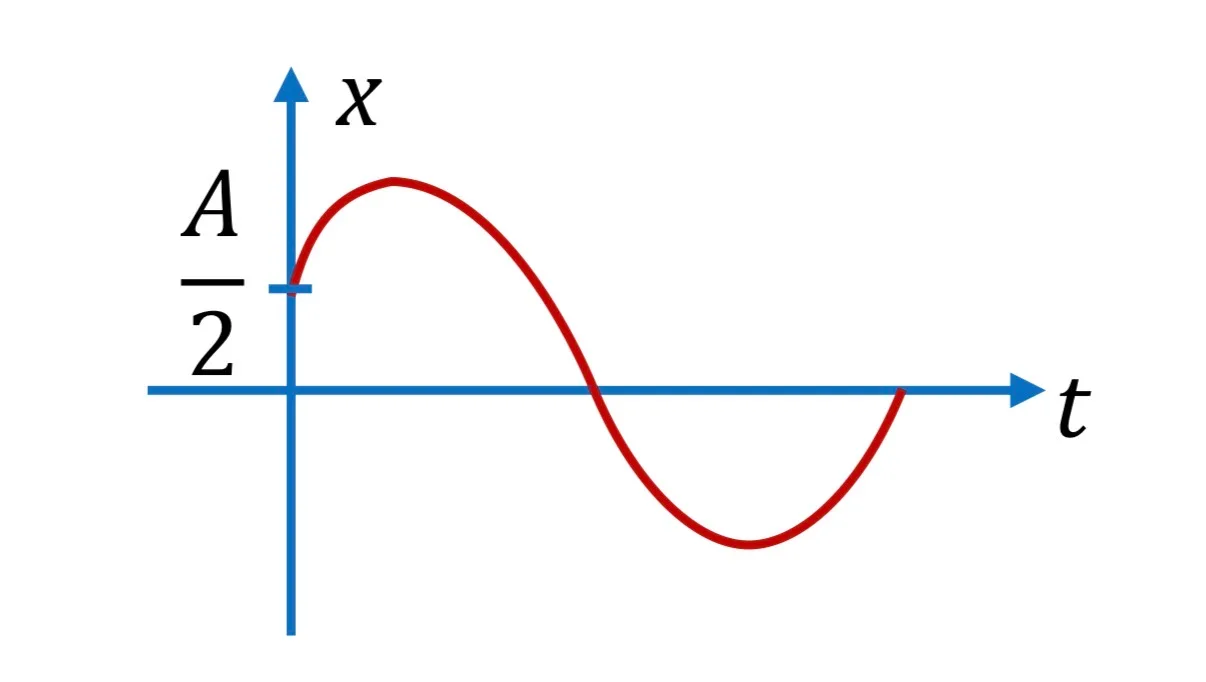
The graph shows a particle performing SHM about mean position x = 0. If t = T/4 is taken as the starting time, the equation of the particle is:
Options
- MCQmediumSimple Harmonic MotionOpen solution
Two simple harmonic motions x = a sin(ωt + δ) and y = a sin(ωt + δ + π/2) act on a particle simultaneously. The motion of the particle will be:
Options
- MCQmediumSimple Harmonic MotionOpen solution
Two particles P₁ and P₂ execute SHM along the same straight line about the same mean position. Their displacements are x₁ = A sinωt and x₂ = A cosωt. At t = 0 they are at different positions. What is the first positive time at which they meet?
Options