Free question bank
Displacement, Velocity, Acceleration and Phasor Representation in SHM questions with solutions
Practice Simple Harmonic Motion questions for NEET and JEE Main. Attempt each question, then open the solution. Full revision programs are in the Physics courses.
Showing 1–10 of 61 questions
- MCQmediumSimple Harmonic Motion
A particle executes simple harmonic motion according to x = a sin(50t+π / 3), where x is in centimetres and t is in seconds. Starting from t = 0, let t₁ be the first time at which the particle comes to rest and t₂ be the first time at which its acceleration becomes zero. What are t₁ and t₂, respectively?
Options
JEE Mains 2026 2 April Evening Shift
Open solution - MCQmediumSimple Harmonic MotionOpen solution
Two collinear SHMs of equal amplitude A and equal angular frequency ω have a phase difference of 120°. If they are superposed, what is the amplitude of the resultant SHM?
Options
- MCQeasySimple Harmonic MotionOpen solution
The circular motion of a particle with constant speed is:
Options
- MCQmediumSimple Harmonic Motion
A simple pendulum performs SHM x = 0 with amplitude a and time period T. The speed of the pendulum at x = a/2 will be:
Options
AIPMT Screening 2009NEET Previous Year
Open solution - MCQmediumSimple Harmonic MotionOpen solution
A particle in SHM is at displacement x = A/4 and is moving towards the positive extreme. Which expression gives the time required to reach the positive extreme?
Options
- MCQmediumSimple Harmonic MotionOpen solution
Which one of the following statements is true for the speed v and acceleration a of a particle executing simple harmonic motion?
Options
- MCQmediumSimple Harmonic MotionOpen solution
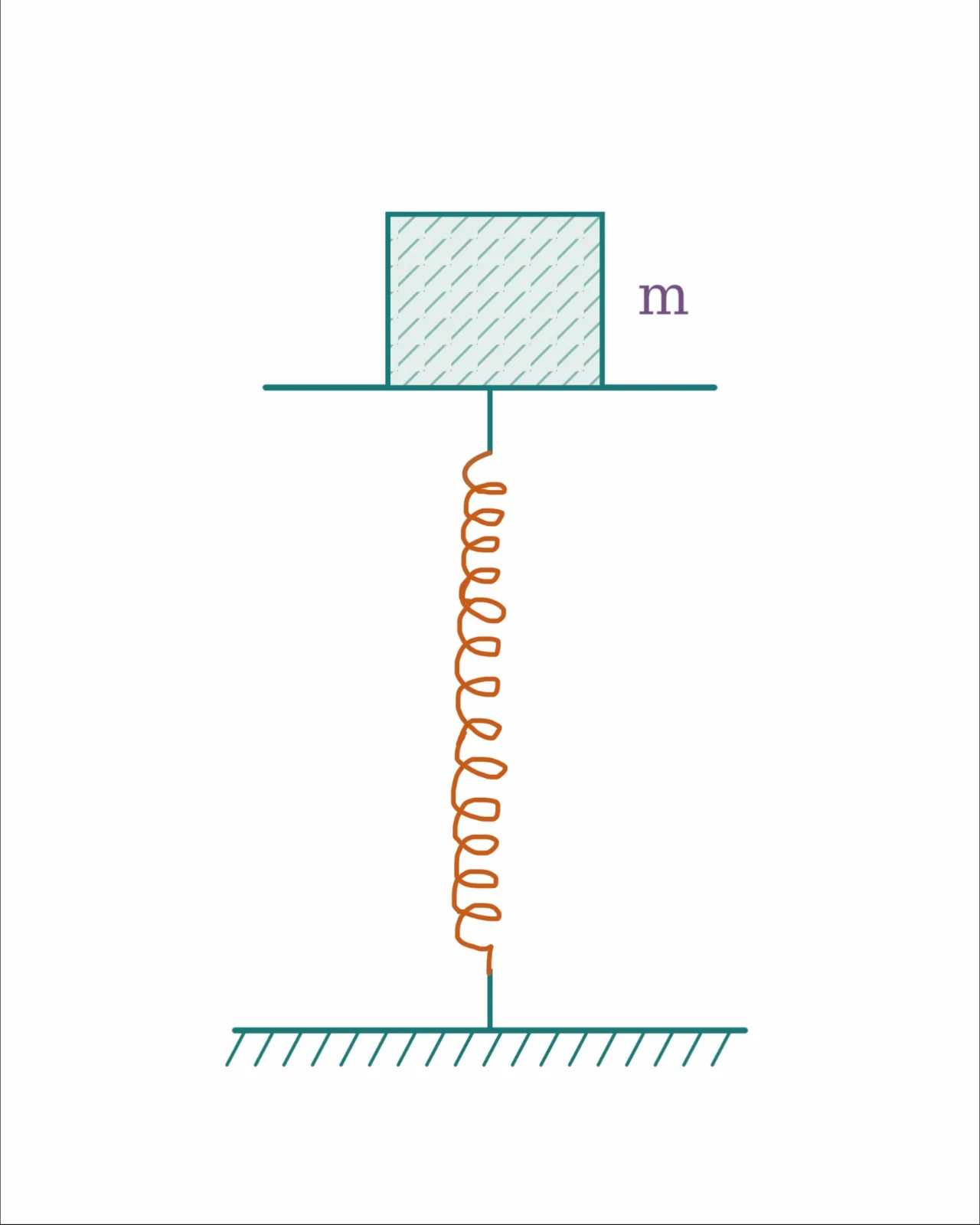
A mass of 2.0 kg is put on a flat pan attached to a vertical spring fixed on the ground as shown in the figure. The masses of spring and pan are negligible. When pressed slightly and released, the mass executes SHM. The spring constant is 200 N/m. What should be the minimum amplitude of the motion so that the mass gets detached from the pan? (Take g = 10 m s⁻².)
Options
- NumericeasySimple Harmonic MotionOpen solution
A particle executes SHM with time period π s. At an instant its displacement from the mean position is 2 cm. If the magnitude of its acceleration at that instant is N cm/s², find N.
- MCQmediumSimple Harmonic MotionOpen solution
A particle moving along the x-axis executes simple harmonic motion. The force acting on it is given by (where A and K are positive constants):
Options
- NumericeasySimple Harmonic MotionOpen solution
Two particles execute SHM on the same line according to x₁ = 4sinωt cm and x₂ = 4cosωt cm. If their maximum possible separation is N√2 cm, find N.