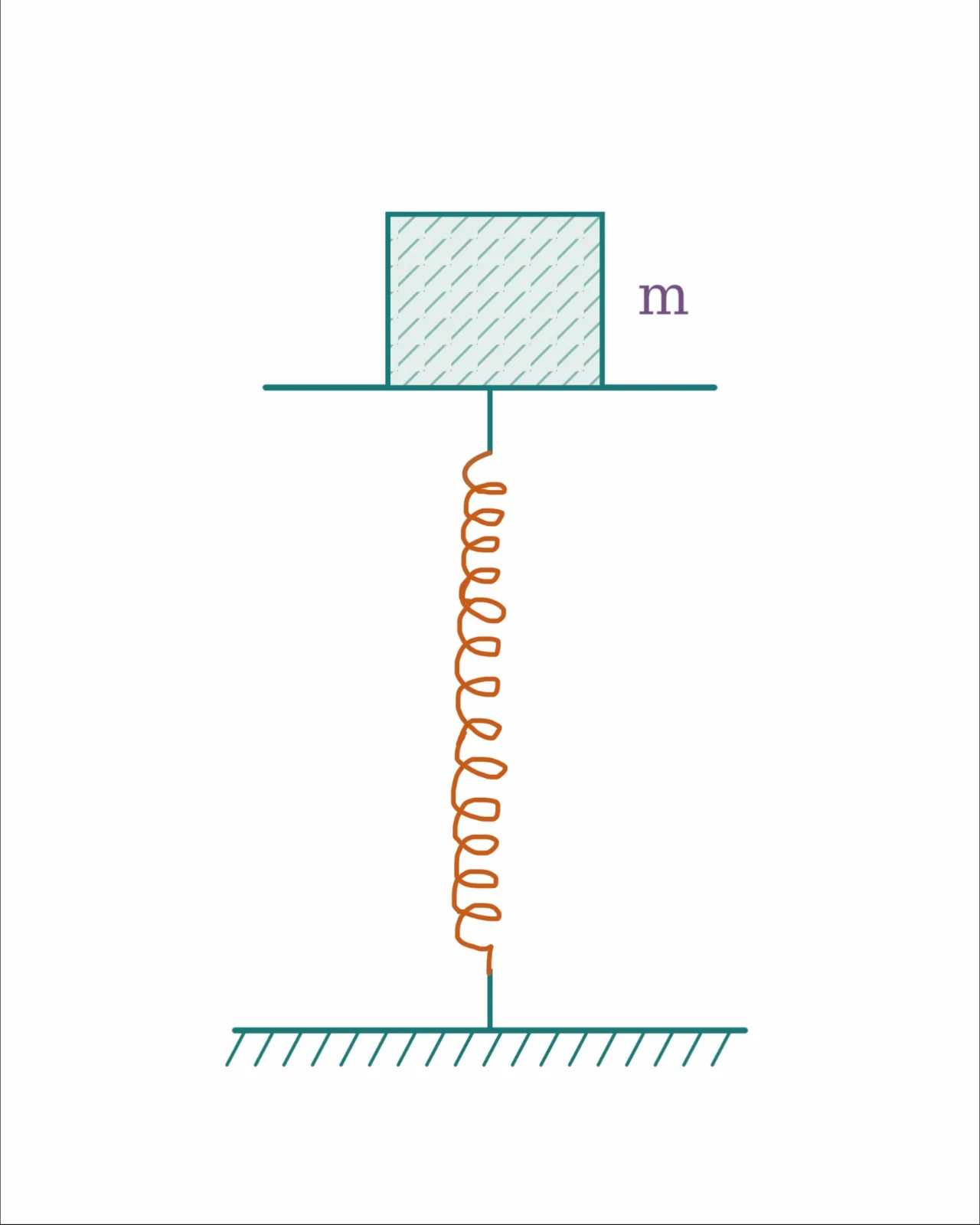
A mass of 2.0 kg is put on a flat pan attached to a vertical spring fixed on the ground as shown in the figure. The masses of spring and pan are negligible. When pressed slightly and released, the mass executes SHM.
Physics · Simple Harmonic Motion · Displacement, Velocity, Acceleration and Phasor Representation in SHM
A mass of 2.0 kg is put on a flat pan attached to a vertical spring fixed on the ground as shown in the figure. The masses of spring and pan are negligible. When pressed slightly and released, the mass executes SHM. The spring constant is 200 N/m. What should be the minimum amplitude of the motion so that the mass gets detached from the pan? (Take g = 10 m s⁻².)
Options
Related questions
- For a particle executing SHM with amplitude a, at what displacement magnitude are its kinetic and potential energies equal?
- What is the potential energy, measured from equilibrium, of a particle of mass m executing SHM with angular frequency ω and amplitude a at…
- A spring–mass oscillator contains sand that leaks gradually from the attached box. Which pair of schematic graphs shows how angular frequen…
- Identical point masses P and Q oscillate vertically on springs of constants k₁ and k₂. If both oscillators have equal maximum speeds, find…
- Savitha, a XI standard student, while conducting an experiment to determine the effective length of a simple pendulum L, notes down the dat…
- A simple pendulum bob of mass 20 g has total mechanical energy (kinetic plus potential) 0.02 J. Find the approximate speed when it passes t…